

Those Yellow Crash Barrels Along The Highway Aren't All The Same
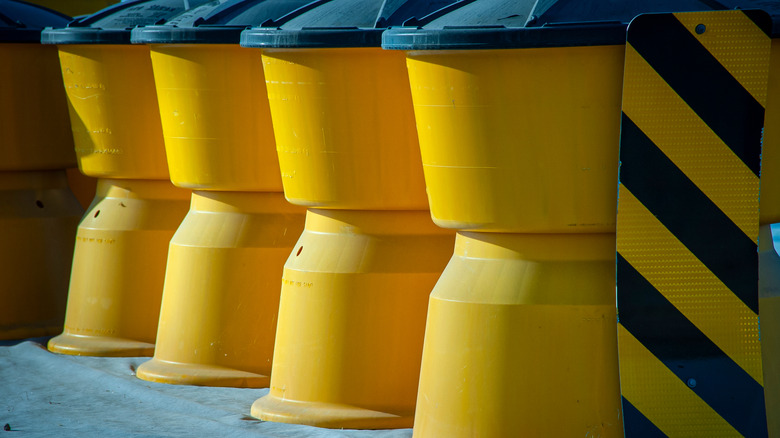
Have you taken a close look at those yellow crash barrels on the freeway? Probably not, and that's a good thing. You should keep your eyes on the road ahead of you instead of brightly colored distractions. While you were passing those barrels, though, you may have assumed that they were the same, but there are several different types of barrels, and what's inside varies, too. For example, several barrels lined up in a couple of rows are usually of varying weights. Some can be much, much heavier than others. An arrangement by order of weight helps to bring crashing vehicles to a gradual stop, instead of a sudden impact. It's a strategy that augments typical guard rails, and good to hear, since it turns out that highway guardrails aren't enough to stop some of the latest heavy EVs.
Weight isn't the only way these barriers, also called impact attenuators or crash cushions, are different from each other. Most are filled with sand (often mixed with salt), while some are filled with water. The barrels are designed to break on impact and need to be replaced after every crash. While these barriers both absorb kinetic energy from a crash, they do it differently. With sand-filled barrels, or "Fitch Barriers", the individual sand particles absorb the energy, which then gets dispersed as the sand scatters. The water-filled barrels use fluid dynamics to absorb the energy and dissipate in the water itself. Either way, it keeps the passengers of the crashing vehicle from absorbing the energy, which could otherwise cause serious harm.
Sand-filled barrels
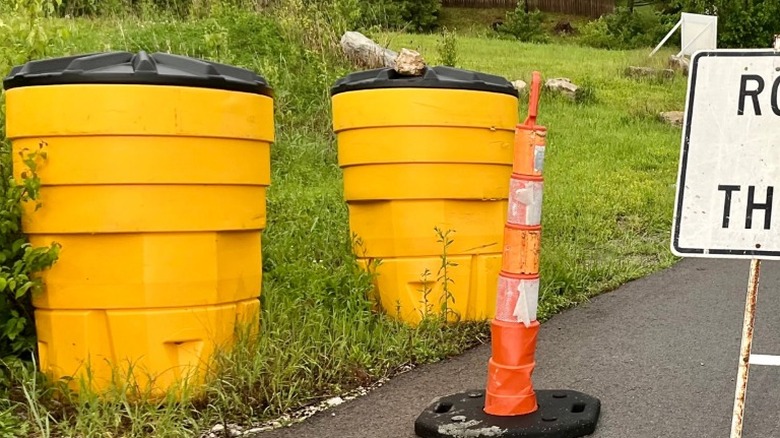
No, in case you were wondering, those barrels are not empty. Most of the barrels you see contain sand. A very specific amount of sand is put into each barrel to assign it a weight. Usually, round barrels with sand in them weigh 200, 400, 700, 1,400, or 2,100 pounds. The sand itself is normally washed concrete sand that contains less than 3% moisture and must be comprised of at least 5% rock salt, which will keep any moisture in the sand from freezing.
The shell of the barrel is made from durable high-density polyethylene plastic (HDPE). These barrels are "frangible", which is a fun word, meaning that the barrier is brittle enough to break upon impact. Once the shell is broken, the kinetic energy from the crash is absorbed into the sand, then dispersed. The barrels are meant to be sacrificial. Once one is hit, it is not repaired but replaced with a new barrel and new sand.
Another name for this type of traffic barrier include Nonredirecting Sacrificial Crash Cushions" or NRS. Catchy, right? This is because they are designed to bring a vehicle to a gradual stop, when laid out correctly, instead of allowing the vehicle to suffer a more catastrophic sudden stop from impact or bouncing back onto the road.
Water-filled barrels
If you type "water-filled barriers" into Google, you will mostly come across, not barrels, but those plastic (likely orange) walls you've probably noticed along the road. These barriers are pretty useful, as they can link together to form one long wall.
However, you can also find crash barrels filled with water. In fact, some of the same barrels that are made to be filled with sand can also be filled with water. Whether the barriers are barrels or wall-shaped, they work on the principle of absorbing the energy of the crash, so that the vehicle and passengers inside don't have to. In water-filled barriers, the water absorbs the energy of the crash, causing it to move, and that energy dissipates as it moves through the water.
What about in very cold weather? Wouldn't the water in these barrels freeze? Thankfully, no. The reason water-filled safety barrels don't freeze is that the water is often mixed with liquid magnesium chloride, which works a lot like the fluid in your coolant system, changing the chemical makeup to lower the freezing point. That's a good thing, because it would defeat the purpose for cars to crash into a barrel filled with hardened ice.
Why are barrels set out the way that they are?
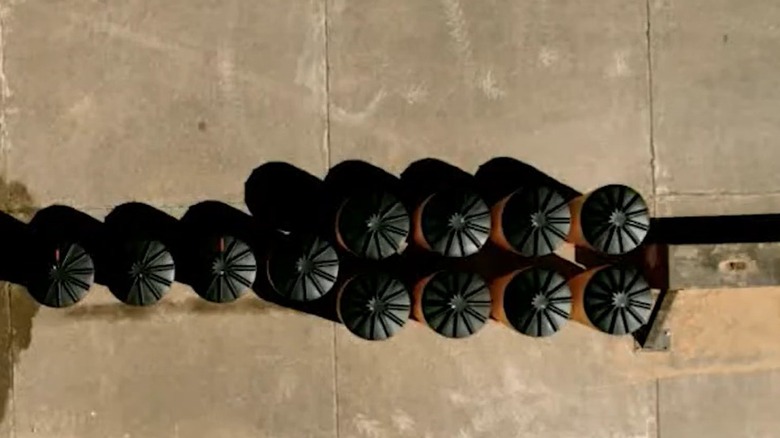
Have you ever noticed that traffic barrels are typically set out in one of several specific patterns? It would be easy to imagine that roadworkers just unloaded the barrels in the order they had been loaded onto the truck, and then went on break. But there is a science behind how the barrels are laid out in front of whatever structure they are protecting. And make no mistake, those barrels are there to protect, not just you, but the concrete wall, toll booth, or whatever it is they are in front of.
Remember, the purpose of these barriers is to stop a crashing car gradually. That's done by setting lighter barrels in front, followed by progressively heavier barrels. So, a typical array of barrels might have 200-pound barrels in front, followed by 400-pound barrels, then 700-pound barrels, then 1,400, and finally 2,100 pounds. It works best this way, because suddenly hitting a 2,100-pound barrel would be like hitting a tree. But this way, your vehicle is gradually slowed down so that you may not even make it to the 2,100-pound barrels, and hopefully the toll booth.
Additionally, how many barrels are used is determined by the speed limit of that part of the road. The faster the speed limit, the more barrels that are used. These specific patterns are recommended by the barrel manufacturers and implemented by government agencies. For example, the New York Department of Transportation requires 6 barrels of varying weights for 25 mph speed limits, 9 for 45 mph, and 21 barrels for 75 mph.
What's done with damaged barrels after a crash?
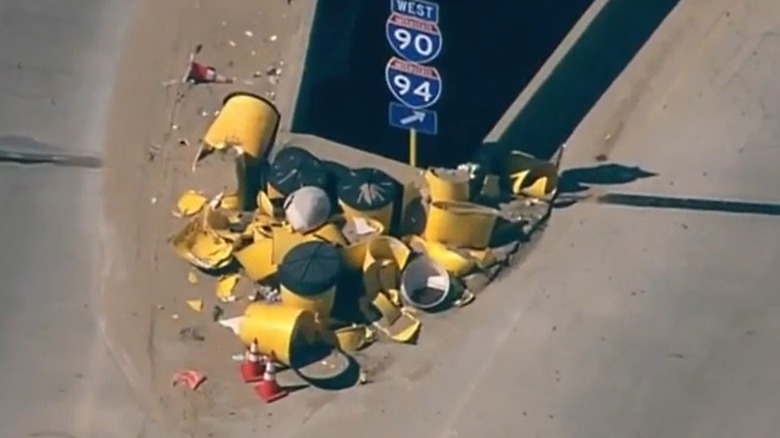
Naturally, with sand or water spread all over the road, and bits of broken barrels everywhere, these big containers need to be replaced any time they are hit. The process to do this seems like a bit of a hassle, especially if the crash happened on a busy road like a freeway, but it's a small price to pay for the increase in safety.
After a crash, there's an inspection to see which barrels in the array were damaged, since it's unlikely that a car makes it through all of the barrels in a lineup. Traffic needs to be blocked off, of course. It would probably be a little sketchy doing this work in a spot where people have already crashed — so no cars driving by please. Next, the old barrels, sand, and debris all need to be picked up and cleared off of the road. Then, the new barrels are put into place. They're set in the same positions as the old barrels, so that the array matches the correct configuration recommended for conditions. Finally, sand is filled to the proper level. Each barrel needs to be at the same weight as the barrel it replaced.
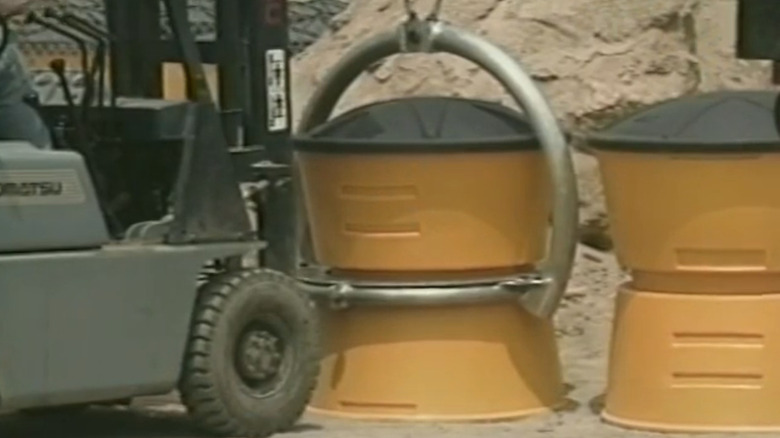
Another way this can be done is to fill the barrels with sand before taking them to the spot of the crash. But in that case, a special crane will need to be brought along to lift them off the trailer.
How sand-filled barrels came to us
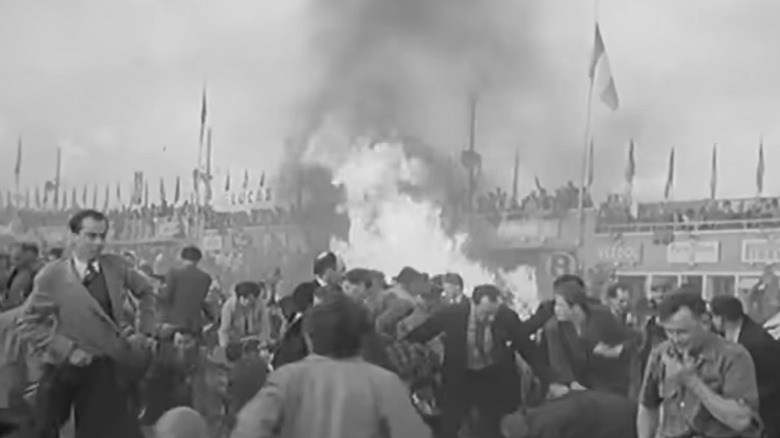
Inventions normally happen when someone is trying to solve a problem. Racecar driver John Fitch decided there was a serious problem with racing safety after witnessing two horribly tragic crashes. The first one happened in 1952 in Watkins Glen, New York. The track for that race included streets right in the middle of town, so of course, there were plenty of spectators. Unfortunately, the driver behind Fitch tried to pass, ran off the road, lost control, and struck several spectators, killing one, a 7-year-old boy named Frankie Fazzary. Just three years later at the 24 Hours of Le Mans, Fitch's teammate wrecked his car so badly that parts of it flew into the crowd, injuring 120 and killing 80. It was one of the worst wrecks in racing history.
So, John Fitch set about the business of creating safety barriers that would be arranged to gradually bring a crashing vehicle to a stop. He began by filling liquor crates with sand and testing the system himself. That's right, he would personally crash into his barriers while driving 70 miles per hour. What resulted was the Fitch Barrier. He also created the Fitch Compression Barrier, the Fitch Displaceable Guardrail, and the Fitch Full Driver Capsule — all key safety innovations for road drivers and racers.
Maybe you don't think very deeply about those sand-filled barrels as you drive past them on the freeway, but their existence was born out of tragedy and brought about by a racecar driver with a desire to save lives.