

The AMC Eagle Turbo-Diesel Was The Performance Version, And One Still Exists
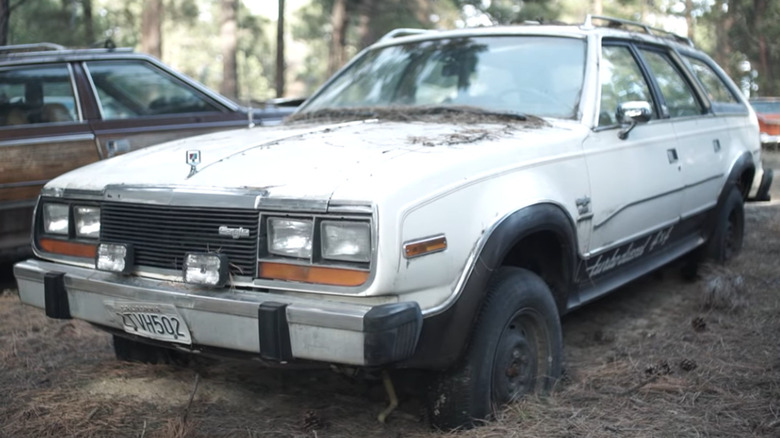
Of course, we're using the term "exists" pretty loosely. The only known 1980 AMC Eagle Turbo-Diesel still remaining was last seen sinking into oblivion at the Rambler Ranch — home to a large collection of Nash, Rambler, and AMC products — in Elizabeth, Colo. It's a sad end for a car once billed, via Curbside Classic, as "The roughest, toughest luxury car in the world!"
But as you could tell by its Turbo-Diesel tag, this machine brought more than just upscale accoutrements to AMC's innovative Eagle. Owners, all seven of them in total, were also rewarded with a 3.6-liter I6 turbo-diesel engine that could deliver 150 horsepower and 219 pound-feet of torque — making this model the only Eagle to ever fly with diesel motivation.
The thought process was that with the U.S. facing another oil crisis in 1979 and efficiency regulations continuing to tighten, installing a diesel in the AMC Eagle would help keep it afloat. It was kind of a Hail Mary play, as AMC had already gamed the system into designating the Eagle as a "non-passenger car" for fuel-economy purposes and as a "light truck" for emissions. It set a precedent for AMC's spiritual successor, Chrysler, to follow when it claimed the same light-truck designation for PT Cruisers (including this pristine Turbo edition with just 1,700 miles and a manual transmission).
The thing is, whatever category best fits the Eagle, the price of the Turbo-Diesel variant didn't fit customers' bank accounts very well. At a time when you could get into the range-topping gas Eagle for $10,500 ($41,446 today ), customers had to cough up an additional $9,000 (an extra $35,525, for a total in today's dollars of $76,971) for the turbo treatment.
How the diesel made a difference
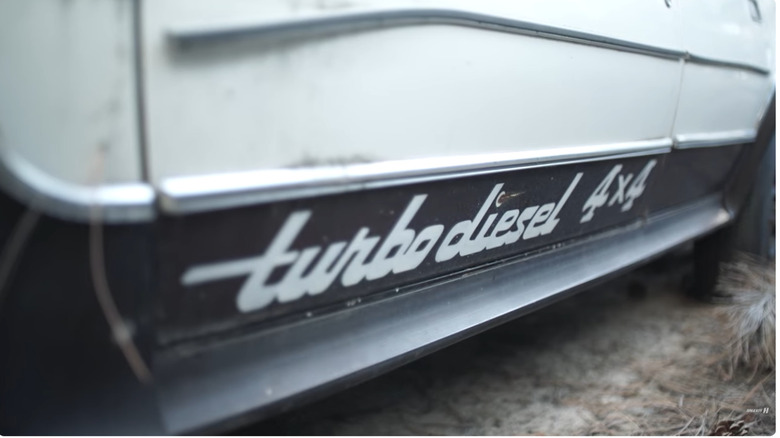
What did those lucky seven owners get for their $9,000? The heart of the matter was the 3.6-liter I6 turbodiesel sourced from VM Motori — an Italian firm founded in 1947 to produce diesel engines for agricultural purposes. (The company would go on to provide diesel motors for European versions of Dodge Caravans, Jeep Cherokees/Grand Cherokees, and even some Alfa Romeos, and remains in business today.)
As we hinted in the headline, the Eagle Turbo-Diesel could outperform gas-powered models, which relied on AMC's 4.2-liter I6 with about 110 hp and 205 lb-ft. Reported 0-60 times varied, but the Turbo-Diesel was advertised as able to complete the sprint in 13 seconds, while Car and Driver clocked a gas version at 13.2 seconds. The VM Motori engines further showed their fuel-sipping ways by more than doubling the fuel-economy results of the standard Eagles. The Turbo-Diesels were capable of up to 35 mpg — again, per the promo materials — while the combined fuel-efficiency ratings of the gas Eagles was an estimated 16 mpg.
For increased customer confidence, a 50,000-mile engine warranty was also included. And for what it's worth, American Turbo-Diesel touted this mill as the first "retrofit diesel" to meet both California and federal emissions regulations without needing additional emissions-control devices. Which wouldn't be a worry today, now that California's emissions standards are a thing of the past and Trump ended greenhouse gas regulations for cars.
The premium parts of the package
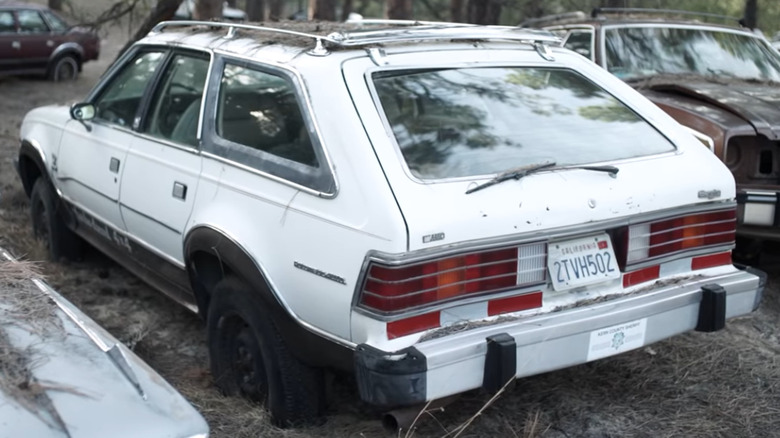
American Turbo-Diesel made a big deal out of performance, claiming its Eagle "out-corners Trans Am in soft sand, out accelerates Mustang Turbo in loose dirt, outbrakes MGB on dry pavement." Yet there was no shortage of contemporary luxury cues. The cabin sported air conditioning, reclining leather seats, cruise control, power windows and door locks, a tilt-adjustable steering wheel, a quartz clock, and an AM/FM/cassette sound system backed by a CB radio.
The exterior increased functionality with a roof rack, supplementary driving lights, power mirrors, and a wiper/washer system for the rear glass. A larger fuel tank was included as well, giving the Eagle Turbo-Diesel and astonishing range of up to 1,500 miles. Meanwhile, the key upgrade underneath it all was AMC's heavy-duty suspension with front and rear sway bars to complement the Eagle's 7 inches of ground clearance
An additional twist came with how the engines were installed. Although these were "factory authorized" vehicles, it wasn't an AMC factory that added the motors. The cars and engines were shipped, separately, to the San Fernando, California home of American Turbo-Diesel for the work. The result was a bit like the process of building the luxurious Cadillac Allanté, the ultimate Italian American car, in reverse — since the Cadillac bodies were made in Italy, then sent to the U.S. for their power trains. At least the plan worked out slightly better for Cadillac, which managed to sell more than 21,000 Allantés, per Hagerty, during its seven years in production.