

You'd Better Be Passing People If You're In These States' Left Lanes
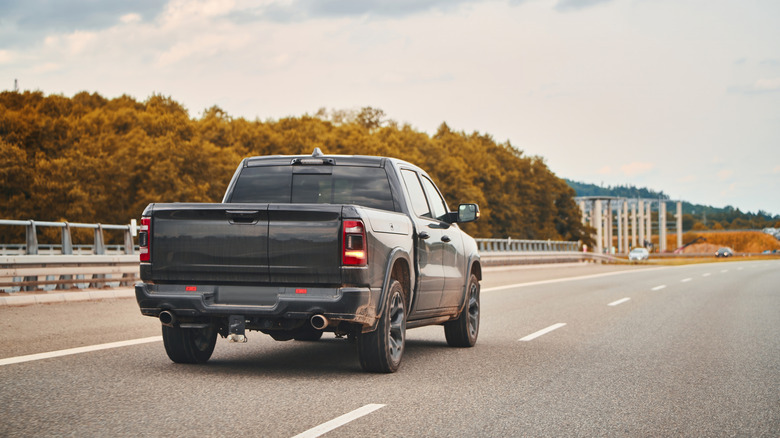
When drivers perform a lane change or merge onto the road, they often have fractions of a second to react to surrounding vehicles. This makes lane-change behavior a meaningful factor in real-world traffic safety. Because lane discipline plays such a pivotal role, many jurisdictions enforce rules designed to discourage people from hugging the left lane for no real reason. That's why cruising in the left lane could get you a ticket in many U.S. states. So, what are those states where you'd better be passing people if you're in the left lane?
According to AAA, "almost every state limits driving in the left lane to passing, merging or exiting." Therefore, all U.S. states have some form of "keep right" or flow-of-traffic requirement that restricts driving in the left lane, but to varying degrees. According to MIT's summary of state traffic statutes, states such as Illinois, Kansas, Kentucky, Louisiana, Maine, Massachusetts, and New Jersey are among those that maintain relatively stricter "keep right except to pass" lane-use requirements.
That means that if you are caught simply driving in the left lane, without actually overtaking, you could face fines ranging from a few dozen to a few hundred dollars, depending on the state. In Louisiana, if you are caught driving below the speed limit in the left lane repeatedly, it can even land you in jail for up to 30 days. As such, although they differ in scope, most left-lane driving laws exist to improve road safety and traffic flow. Here's how left-lane rules are implemented and the penalties drivers may face in various states.
How states regulate left-lane rules

In Illinois, on controlled-access highways, a vehicle may not be driven in the left lane except when overtaking and passing another vehicle. In New Jersey, when road lanes are marked, unless actively overtaking someone else or preparing to turn left, drivers must remain in the lane closest to the right side of the road. However, some state laws are a bit looser and don't strictly reserve the left lane for passing or turning, despite maintaining restrictions regarding the usage of left lanes.
For instance, California uses a slower-than-normal traffic keep-right rule. It does not say that the left lane is exclusively for passing, merging, or turning. In states such as California, the focus is on traffic flow, and the Golden State requires drivers moving slower than normal traffic to stay right if they are within or under the speed limit. This means that left-lane driving is only prohibited when you are actively impeding traffic by driving too slowly. Being a happy camper in the passing lane is a bad driver habit guaranteed to annoy everyone else on the road.
However, on some roads, exceptions exist in the form of managed lanes. Fairly well-known exceptions are high-occupancy vehicle (HOV) lanes that do permit cruising if the vehicle in question abides by strict HOV rules. According to the California Department of Transportation, HOV lanes are typically the left-most lanes. So, in this instance, you can cruise on the left, provided your vehicle qualifies under HOV rules.
Consequences of hugging the left lane

A common consequence of traffic violations is a ticket. However, specific dollar amounts are not typically listed in statutes. These are determined by courts or by other administrative rulemaking bodies. State laws typically dictate the maximum, but it is left for the court to decide the specific amount for an individual on a case-by-case basis. For example, a fee table published by the Illinois Lee County Circuit Clerk notes that the listed dollar amounts are subject to change at any time.
AAA has also reported specific dollar amounts you can encounter in certain U.S. states. For instance, in Alaska, left-lane violation tickets typically range from $75 to $150. In Nevada, first-time offenders could face a $50 fine, while in Utah, such violations come with a ticket of $130. According to a recent report by WBRZ News, persistent violations of left-lane driving rules in Louisiana could land repeat offenders with fines of up to $350 and even a potential 30-day jail sentence.
Arizona's "Slow Poke" bill (HB 2235) was initially considered to strengthen the enforcement of slow-left-lane driving restrictions. The proposed bill included a fine of up to $500, but it also wanted to place signs along the roads reminding drivers that the left lane is only for passing. However, the bill failed to advance.