

What Is A Limited-Slip Differential And How Does It Work?
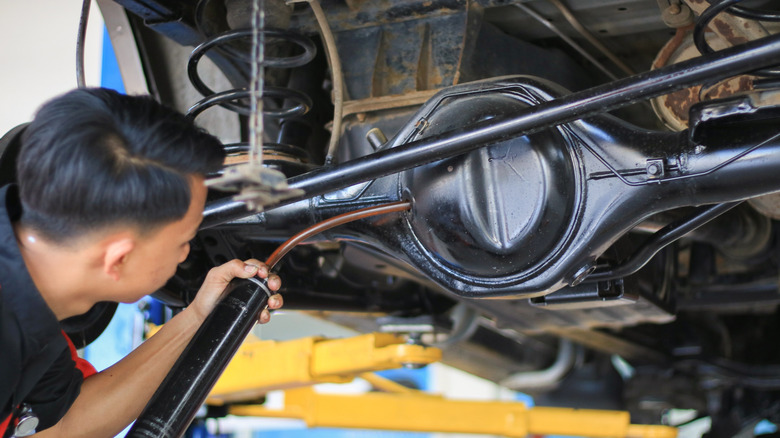
To turn engine power into controllable motion, cars rely on something called the differential. A differential allows wheels on the same axle to rotate at different speeds. If you want more information, this vintage film is still the best explanation of how a differential works.
In low-traction situations, such as if one wheel is stuck in mud or ice while the other is on solid ground, a standard (open) differential can work against you. This is because an open differential will send most of the torque to the wheel with the least grip, causing it to spin, while the wheel that could actually move the car receives very little power.
Meanwhile, if you get stuck in mud or ice with a limited-slip differential, torque is still partially sent to the wheel with traction. This allows the car to keep moving instead of just spinning the wheel that's stuck. Basically, it's a differential that balances torque more effectively between each wheel. Here is everything you need to know about limited-slip differentials (LSDs), how they compare to open differentials, and which is best for you.
Understanding an open differential
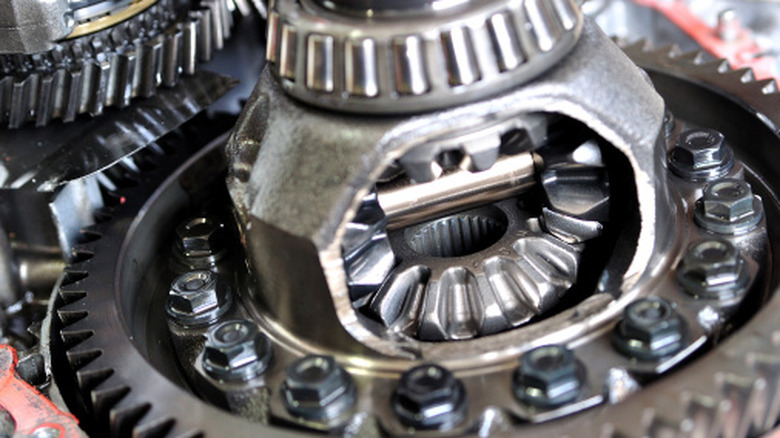
In order to fully understand the benefits associated with LSDs, one needs to first understand the open differential. Torque is created by the engine before being sent through the drive pinion gear, the ring gear, and finally to the two spider gears. As described by The Engineering Mindset, "the spider gears will allow the axles to rotate at different speeds while still transferring torque and rotation to the wheels."
The benefit of an open differential is not particularly relevant when traveling in a perfectly straight line. When a car is turning, however, the outer wheel will have to travel a longer path than the inside wheel. If a car does not have a differential, it will effectively mean that both wheels rotate at the same speeds, causing one of them to rub, slip, or scrub against the road surface.
This is where an open differential helps. It allows the inner tire to rotate slower than the outer tire, negating the issues caused by the different travel distances. Still, although an open differential helps in this regard, it does the exact opposite in different areas. In a demonstration of how off-road traction control works, we outlined how an open differential falls short in off-road driving, and this is why an LSD exists.
Benefits of a limited-slip differential over an open differential
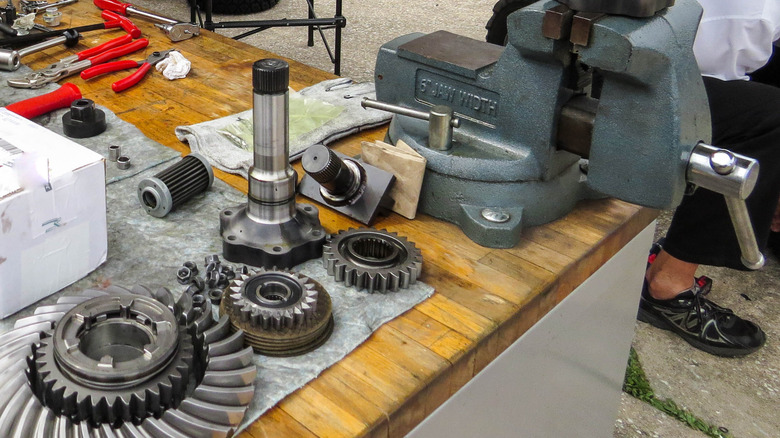
When using launch control, an open differential rear-wheel-drive car (such as a Mustang or a Charger) can cause one wheel to lose traction, and that can slow you down. Burnouts are also a big smoky reminder that you need a limited-slip differential because an open differential may lead to a one-tire fire instead of effectively using both drive wheels. During high-speed cornering, load transfer increases the force on the outside tires. This improves their traction potential while reducing it on the inside tires.
Meanwhile, an open differential can lead to the inner wheel (with less vehicle load) to spin more easily. This effectively causes your car to handle worse because it has less load on it, reducing friction. A limited-slip differential takes these problems and improves upon them by helping maintain traction while still allowing wheels to rotate at different speeds. It basically does what an open differential does, but it can also direct more torque to the wheel with greater traction. The amount of torque is limited, which prevents the wheel from being overloaded and keeps the car controllable. That is where it gets its "limited-slip" name from.
Different types of limited-slip differentials
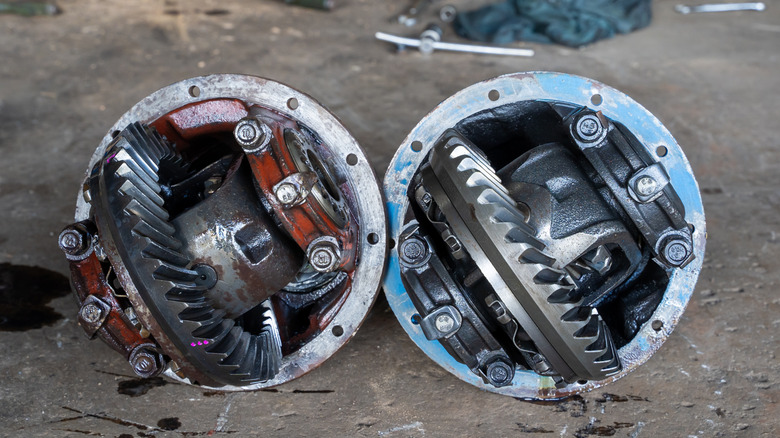
Throughout the past century, LSDs have come a long way, with different types that are more tailored to specific environments. For instance, the earliest clutch-type LSD designs used friction plates (clutch plates) to send torque to a specific wheel. This was enough to provide a bit more traction, but these plates can be very harsh and noisy. Moreover, they require specific break-in procedures and the system also needs proper maintenance to last.
Viscous LSDs (vLSDs) were invented to provide a smoother distribution of torque with less noise via silicone fluids. This made them less aggressive than friction plate designs, and so, LSDs were starting to be used on vehicles other than race cars. However, the downside was that these are difficult to lock fully, which can be a problem for off-roading and racing applications. This prompted engineers in the 1980s to come out with the more responsive "Torsen" (torque-sensing) LSDs, which used gear mechanisms to automatically send torque to the wheel with more traction. This led to a more controlled, maintenance-friendly response that was also beneficial for high-power applications, thus making them suitable for performance cars.
With the turn of the millennium, electronic LSDs joined the mix. An electronic LSD can use sensors and brakes to simulate limited-slip behavior, and it's something you can find in the new rear-wheel drive Bentley Continental Supersports. This allows the system to rapidly adjust torque based on driving conditions, in some cases engaging in as little as 100 milliseconds.
Best differential types for your needs
If you just use your car as a commuter for grocery runs, school runs, and everyday driving, an open differential is typically just fine. However, if you want to experience the benefits of an LSD each day, a Torsen LSD might be a good choice because it is smooth and easy to maintain. For drifting purposes, the LSD is the clear winner.
Out of all the LSDs, clutch-type variants are beneficial for drifting because they can lock-up aggressively, allowing for better control during slides. Selectable lockers, especially electronic ones, are among the most effective solutions for demanding off-road traction. Those can lock-up fully while also being able to operate like open differentials on the pavement. That's part of why mechanical (clutch) plate-style LSDs are commonly associated with motorsports.
If tracking your car is something you like to do, a plate-style LSD is a good option. However, the optimal setup depends on the vehicle and intended driving application. In certain situations, a Torsen setup might be preferred because it is smoother, while a clutch-type is better if you want an aggressive lock-up. Plus, among the other differences between a mechanical and electronic differential, the electronic one can react faster. This tends to provide more precision for traction control, which can be preferred by some performance enthusiasts.