

The First Practical Electric Car Built Looked Like A Giant Baby Carriage
We've been lovestruck and fascinated with our internal combustion jalopies for the better part of the 20th century, so it's easy to forget our ancestors have been dabbling with electric cars since the late 19th century. Electric vehicles are resurgent since American technology company Tesla unveiled the once-ridiculed yet revolutionary first-gen Roadster in 2008 (one of the EVs on track to be a future classic, in our books), and the car that we boldly declared the most important car of the 21st century, the Model S sedan, in 2012.
Although U.S. EV sales comprised only 7.9% (about 9.7% if you include plug-in hybrids, or PHEVs) of the new car market in early 2025, it was a different story in the late 1800s. Back then, electric car sales dominated, and EVs were the preferred steeds of professionals and wealthy urbanites.
Before Charles Kettering gifted the automotive world with the electric starter, gas cars were seen as dirty, unreliable, and a chore to drive. Electric cars were the exact opposite, as they started instantly, were quieter, and didn't emit any smoke or fumes. Admittedly, the earliest EVs were as sparse as a barn and looked like oversized baby carriages, but they had to start somewhere.
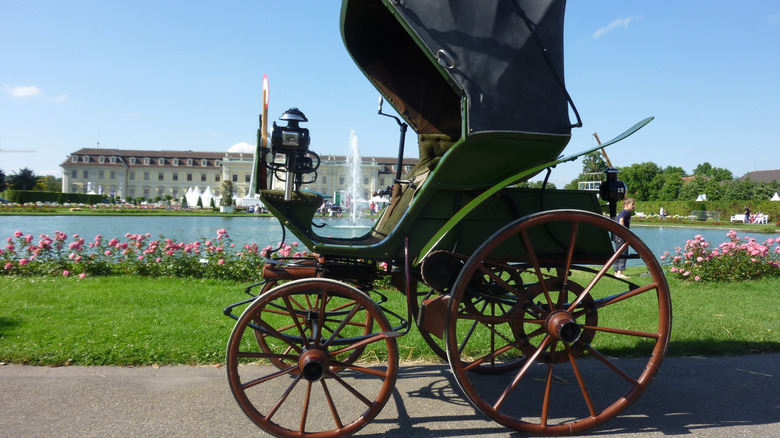
History credits the Flocken Elektrowagen as the first limited-series electric car that was available for customers to buy. It was conceived by German entrepreneur and inventor Andreas Flocken in 1888. But unlike experimental EV prototypes, Flocken built his car to sell to the public, and it was one of the first electric cars that ditched the early tricycle designs for a proper four-wheel layout.
If looks like a carriage because it is
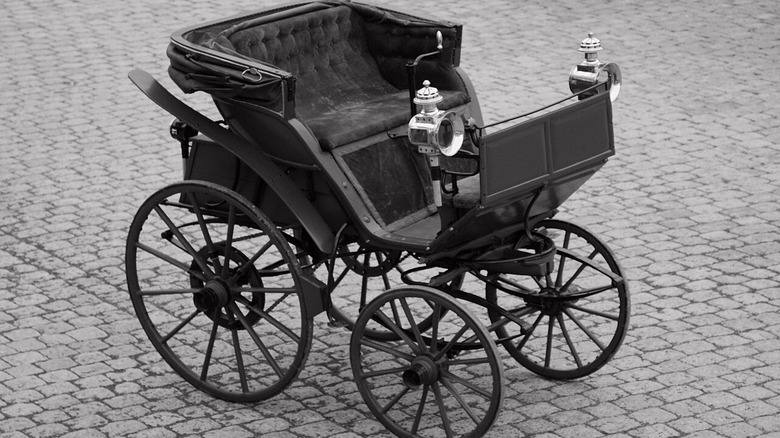
There was nothing modern about the Flocken Elektrowagen's design. It's essentially an open carriage with four wheels, a one-horsepower electric motor, a rechargeable lead-acid battery, and a leather belt driving the rear wheels. Based on what people referred to back then as a chaise (a horse-drawn carriage with two wheels), it had a wooden frame, iron tires, tiller steering, and a rather narrow track. We reckon it could have been highly unstable when cornering at speed, but only if it were able to gather enough momentum.
The Elektrowagen achieved a maximum speed of 9 mph (15 kph) and reportedly drove for about 2.5 hours before the battery ran out of juice. It wasn't quick, but it did the job. Flocken updated the Elektrowagen in 1903 with a few niceties like pneumatic tires, spoked wheels, elliptical springs, ball bearing wheels, and stub-axle steering. Also gone were the charming-yet-hazardous acetate headlights, and in their place was straightforward electrical lighting. There are no known historical records of how many Elektrowagens were built and sold, but it did prove that electric cars are viable for everyday transportation, and Andreas Flocken did it despite facing hurdles with materials and developing battery technology.
The Detroit Electric gave early EVs a proper auto body
Other vintage EVs that came during or after the Elektrowagen were brandishing similar designs and architectures to horse-drawn carriages. The cool-sounding Electrobat by Pedro Salom and Henry G. Morris started life looking very much like the Elektrowagen, but with a somewhat sportier, drag-ready stance.
Meanwhile, Andrew Riker built a three-wheeled electric tricycle in 1884, possibly coping with curiosity and surging hormones as a Brooklyn teen. By 1888, the Riker Electric Motor Company came into being. By 1896, Riker EVs were leaving gas-powered cars in the dust in five-mile sprint races. However, the Riker Electric Roadster still resembled a roofless horse carriage, whereas the Detroit Electric car changed all that.
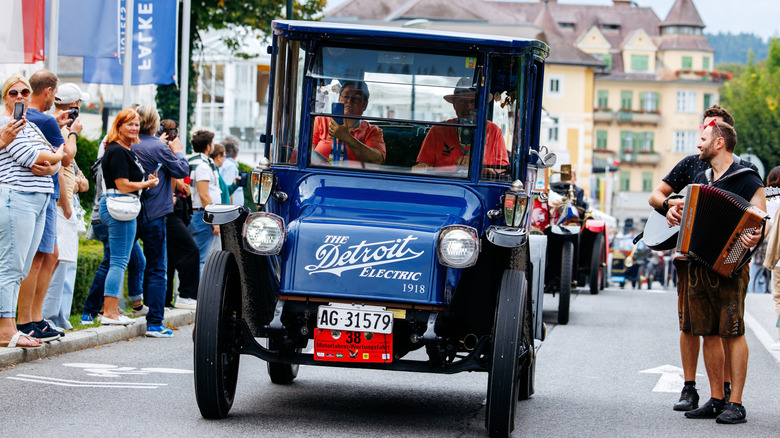
William C. Anderson established the Michigan-based Anderson Carriage Company in the 1880s to build horse-drawn carriages. He later moved to Detroit in 1895 and shifted to building auto bodies for local automakers. By 1907, Anderson unveiled the Detroit Electric car, and by 1908, a closed-cabin version was made available, essentially shedding the infant carriage vibe and going for a more recognizable car shape.