

5 Wheel Bearing Myths It's Time To Set Straight
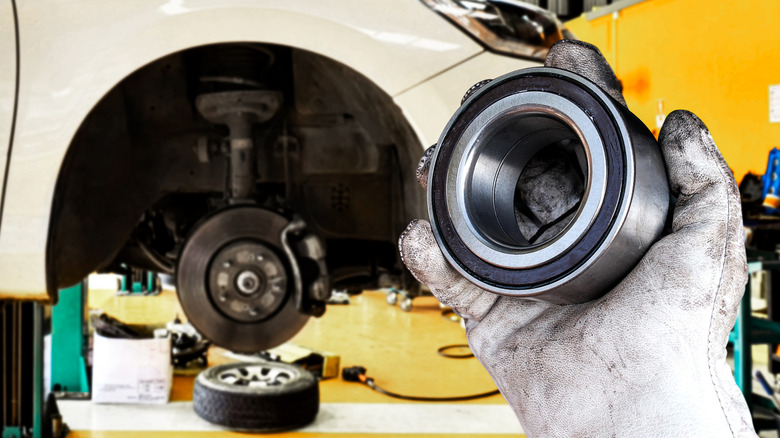
It's honestly pretty crazy how a car works. It's simply a collection of controlled explosions and metal-on-metal violence, all kept in check by clever engineering. And a wheel bearing, like many other car parts, is a critical piece of that engineering. These unassuming rings of metal are tasked with the job of allowing your wheels to spin at speed while simultaneously supporting your car, which weighs several tons. These are the parts silently doing their critical work, and they're also among the most neglected and misunderstood parts of your vehicle. Even their basic maintenance procedures aren't well-known, such as how often you should grease your them.
A wheel bearing is a set of steel balls or rollers held together by a "race" — a metal ring. It rides on an axle shaft and sits inside a wheel hub to allow your wheels to turn freely. Wheel bearings are critical because they handle two kinds of loads: the radial load caused by the weight of the car pushing down and the axial load caused by the force of taking a corner at speed.
Wheel bearings have been around for a long time, and their history is rife with myths surrounding their installation, application, and lubrication. Some of these go beyond half-baked truths to straight-up wrong information. From the violent ways people install them to the weird fascination with the term "bigger is better," here are five such myths surrounding wheel bearings that need to be set straight.
It's okay to hammer a wheel bearing in place
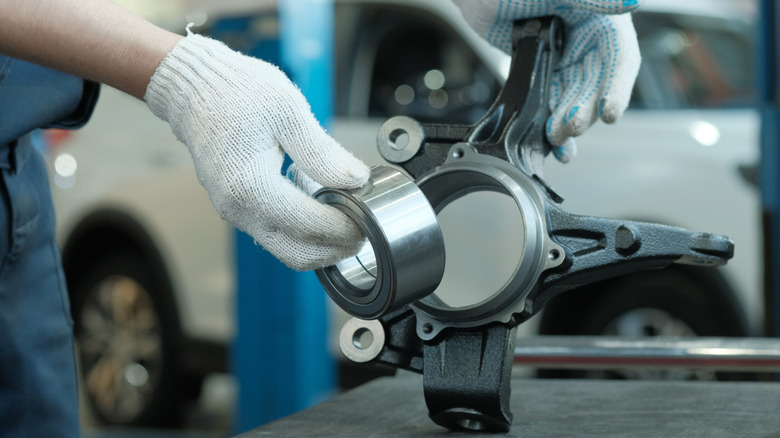
DIYers can easily imagine this scenario: It's been a long day, and you want to wrap up the wheel assembly of your project car. You can't find (or can't be bothered to find) your bearing fitting tool, and the wheel bearing is only halfway inside the hub. That sledgehammer in the corner is looking very promising, and you've heard that it's okay to hammer a wheel bearing in place. But that's far from the truth.
The internal structure of a wheel bearing is a fine example of precision engineering. While manufacturing a wheel bearing, the clearance between the rolling bearing elements and the races is measured in microns; for comparison, human hair is about 100 microns on average. If you hammer the inner or outer race of a bearing, you are sending shockwaves through the hardened steel that causes the balls or rollers to "brinell" the race — in other words, denting its surface. Hammering the wheel bearing causes microscopic dents on the bearing race surface on which the bearings roll. Instead of smoothly gliding, the bearings now bounce over these tiny craters, causing heat and vibrations that could make them fail or seize.
The correct way to fit a wheel bearing is to use a press. A hydraulic press applies evened-out, linear force to the outer race of the bearing, ensuring it fits without the violent impact of a hammer. If you don't have a press, most shops will replace your wheel bearings for a nominal fee. The other tool is a wheel bearing kit, which consists of metal plates with a sliding screw. Never use impact tools to fit bearings.
Bearings should not be hot to the touch
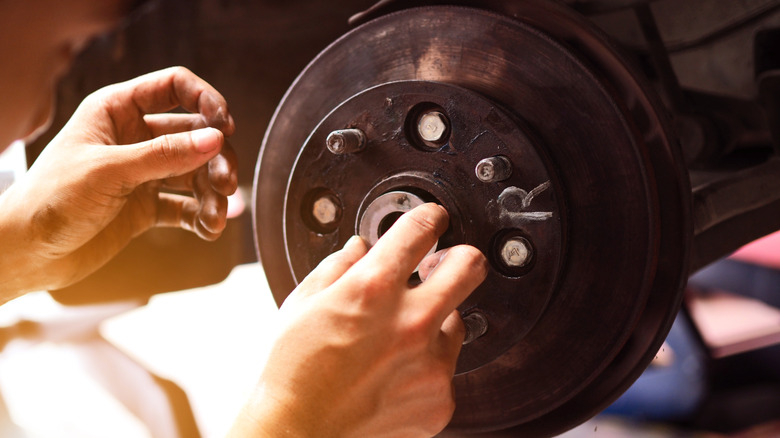
This is another common misconception regarding wheel bearings: if the hub feels hot to the touch after a spirited drive, there is something drastically wrong with the bearing. The flawed logic behind this assumption is that friction causes heat, and since bearings are meant to reduce friction, they should remain relatively cooler. But there are a few reasons bearings can run hot, and it has little to do with friction.
In reality, the bearings themselves generate heat. That heat comes from the internal friction of the grease, the rolling resistance of the parts within the bearing, and even the heat transferred by your brake rotors. This means that your bearing is bound to get warm after an extended drive. You can expect a normal bearing operating temperature to be between 140 and 175 degrees Fahrenheit, and it can be even hotter in some heavy-duty or high-performance applications.
What you are looking for is excessive or abnormal heat, like if the bearing on the left wheel is significantly hotter than the other. You can measure this with an infrared thermometer, and you can also tell if your wheel bearings are going bad by sound. If you see grease liquefy and leak out, which happens at over 200 degrees, then it's time to start worrying about how the bearing's high temperature. However, if your wheel hub is only as hot as a warm cup of coffee, everything is fine.
Bigger bearings are always better
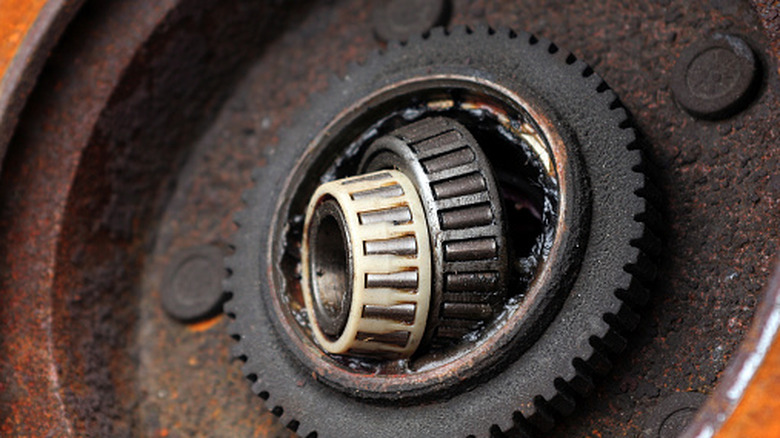
We live in a world where "bigger is better" is the default setting for most things. Many car enthusiasts apply that logic while building heavy-duty rigs by trying to cram the biggest bearing they can find into their wheel hubs. The logic seems sound, as well; bigger means more surface area for the load to spread over, which should aid durability, right? Well, physics doesn't agree with this overbuilt plan.
Bearings are matched to their application based on a parameter called "minimum load". Every bearing needs a certain amount of weight or pressure to ensure it will actually roll instead of sliding over the race surface. If you put massive bearings on a lighter vehicle, there might not be enough load to keep the bearings rolling. This causes them to be dragged across the surface, creating flat spots and damaging the bearing.
There are other downsides to larger bearings as well. Larger bearings need a higher starting torque and have more internal friction. They're also heavier, which means more unsprung weight will affect your ride and handling. When building a vehicle, engineers spend countless hours calculating weight and speed requirements for a specific vehicle. When you go for beefy parts, you create a problem that most cars aren't designed to handle, which is why adding wheel spacers can also cause premature bearing failure. A bearing's longevity comes from its quality and its compatibility, not its physical size. If you want reliability, don't buy oversized bearings; buy high-quality ones.
Sealed bearings last forever and need no maintenance
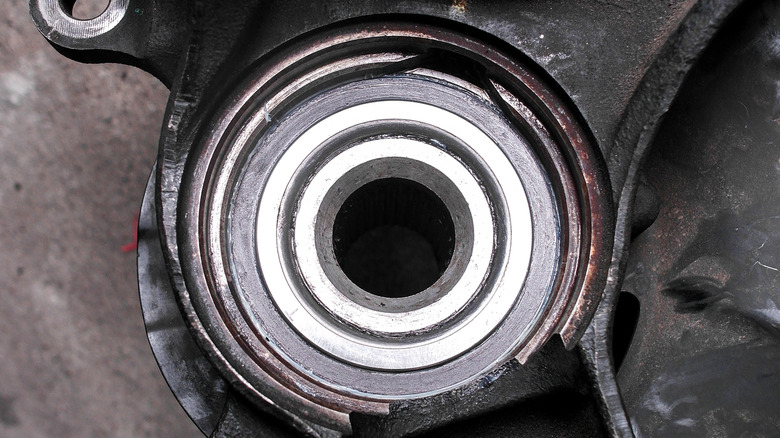
The "Sealed for life" label is both one of the greatest marketing moves and the biggest lies of the modern automotive era. In theory, since the bearing unit is packed with grease and sealed with high-tech rubber or synthetic shields, you never have to touch it again. While you can't maintain sealed bearings in the traditional sense, the idea that they last forever is a myth.
In many cases, the term "lifetime" in automotive speak refers to service life. While the idea of a sealed bearing sounds cool, in the real world filled with salt-covered winter roads, deep puddles, and large potholes, the seal is the only thing standing between your precision bearing and destruction. All it takes is a tiny seal breach by moisture or road debris. Once water gets in, it emulsifies the grease into a milky sludge that reduces its lubrication properties. And since you can't re-grease a sealed hub, the bearing is effectively done for once the seal fails.
A typical wheel bearing is designed to last up to 100,000 miles, which does not factor in hitting curbs or towing boats. The marketing spiel that sealed bearings are maintenance-free leads to owners ignoring them until it is too late. In reality, sealed means disposable — something you don't service but replace when it goes bad. While you can't grease sealed bearings, you should still check for play and keep an ear out for abnormal noises.
Any kind of grease works for bearings

When it comes to wheel bearings, the topic of grease is arguably the one most surrounded by myths. Some think that any type of grease works with a wheel bearing, while others think the more grease you can cram into a bearing, the better it is. Both these conclusions are myths, and following them will leave you by the side of the road with a smoking hub.
You may have heard the term, "grease is grease," but nothing is further from the truth. There are different types of greases, like chassis grease and chain grease, and wheel bearings require grease with specific additives. Mixing different kinds of grease is even worse, as different greases contain different thickeners, such as lithium or polyurea, which can be chemically incompatible. Mixing them could cause a reaction, leaving behind a hard crust or a runny liquid with no lubricating properties.
Then there's the "more is merrier" train of thought. If you over-lubricate a bearing housing, you create a phenomenon called churning, where — instead of the grease providing a thin protective film — the rolling elements have to force their way through a thick mass of grease. This can cause massive internal friction, and the resulting heat heat will make the grease break down into liquid. You should typically apply grease to a bearing to no more than 40% of its capacity.