

What Causes An Engine To Seize And Can It Be Fixed?
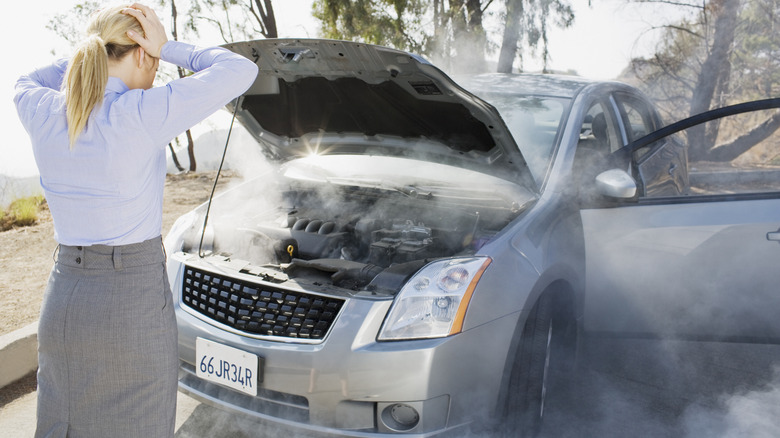
Short of falling victim to one of those massive hydraulic car crushers, one of the absolute worst fates for your vehicle is a seized engine. It renders your ride unable to start, effectively stranding you without the help of a tow truck. Even worse, it potentially indicates that many catastrophic events have already occurred that'll require expensive repairs, if the engine is even in a salvageable state. So, what happened?
Often, an engine seizes due to an oil issue. If levels become too low, temperatures and friction between metal components increase, until moving parts essentially get stuck. Oil is critical to engine health, as it manages thermals and provides a protective layer between the pistons and cylinder walls, among other components. That's why periodic inspections are so important, as there are circumstances that can cause sudden oil consumption, leading to problems if not addressed. Other causes for seizing include cooling system failures, rust (an engine sitting dormant for too long), broken internal parts, or debris becoming lodged somewhere that inhibits internal movement.
Whether a seized engine can be repaired depends on the severity of the damage and how it occurred. For example, a vehicle left in storage for a considerable period may seize due to rust, which can be resolved with certain penetrating oils. In this case, the engine wasn't firing when it seized, so getting it running again may simply involve adding lubrication. However, if an engine in motion seizes, excessive heat could cause engine internals to expand and scrape against each other, potentially fusing them together. Ultimately, a trained technician will need to take a hands-on look before determining if a rebuild is possible.
An engine rebuild versus replacement

While a seized engine may be repairable, it'll require a lot of work. For a rebuild, the engine must be removed from the vehicle and then carefully taken apart. Each component is examined for damage and verified to be within specifications outlined by the manufacturer, with faulty parts getting swapped out. Then, the mechanic puts the whole thing back together, reinstalls it under the hood, and evaluates it to confirm that it runs properly. Considering that this process can involve up to 40 hours of labor and potentially involve machining, a rebuild can run you anywhere from $2,500 to more than $8,000, depending on the vehicle, as well as the engine type and size, per Panda Car Talk.
A replacement engine may not technically be new, but instead remanufactured. A remanufactured replacement engine has been crafted and measured to the same specs as a brand-new unit. It may include used parts but will have undergone the same level of scrutiny as a new one, meeting or exceeding OEM standards. Conversely, a rebuilt engine isn't held to the same standard, as parts in working order will remain in place if showing wear that's within manufacturer guidelines. You'll also typically get a better warranty with a remanufactured engine versus a rebuilt one.
In some scenarios, even if a seized engine can be rebuilt, it doesn't always make financial sense to move forward. According to JD Power, the average cost to replace an engine is between $2,000 and $10,000, depending on several factors. If the cost to rebuild an engine exceeds the amount of money required for a replacement, you're better off going with the latter.
Signs your engine is getting ready to seize

In order to avoid the mess of a seized engine, it's important to pay attention to signs something is wrong under the hood. One of the most obvious indications that you're headed for engine trouble is unusual sounds when driving. It doesn't take a dedicated automotive enthusiast to recognize that a metallic clank or scraping noise from the front of the vehicle is a bad sign. This could be caused by a lack of oil leading to insufficient internal lubrication, and it should be an immediate cause to head to the nearest mechanic before things get worse.
Prior to an engine seizing, you may notice other unpleasant symptoms, like overheating, smoke, or even lethargic performance. One of the first things to check when your engine is hemorrhaging horsepower is the consistency of your oil. It's not just a lack of lubricant that can lead to seizure, but also the presence of old oil, which can become a gummy sludge carrying contaminants that may clog the system. If you have low oil pressure at idle, it could be caused by an oil pump being starved for supply while dirty oil hampers the flow. Although these aren't automatically signs that your engine will soon lock up, they are definitely harbingers of costly repairs, potentially leading to seizure.