

What Are The Practical Limits Of Turbo Boost Pressure?
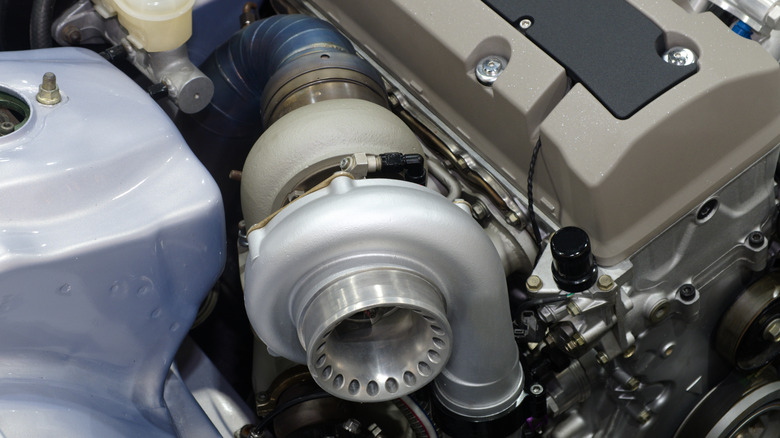
Is there such a thing as too much boost? As much as it'd be fun to say no and slap massive turbochargers and superchargers on everything, there are limits of turbo boost pressure. In theory, as long as the engine's internals are strong enough, you can go as far as you like with whatever amount of boost you prefer. However, in the real world, there are obviously practical limits to how much you can shove into an engine before something breaks.
In a purpose-built racing engine designed to take obnoxious amounts of boost pressure, you can crank that dial as high as you'd like. On most engines, though, there's a limit to how far you can crank that same dial before you break things. Naturally, there are places in the middle for tuned engines that can take a ton of boost without being so overbuilt as to be unrealistic in a road car. But pressure numbers in the double-digits might be a big ask for cheaper blocks, and triple-digits should only be reserved for the best of the best.
How turbocharging (and supercharging) works
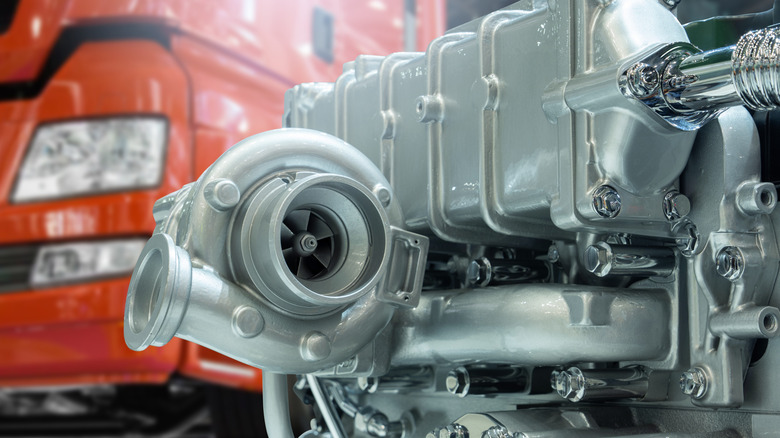
Supercharging was invented in the late 1800s by Rudolf Diesel (yes, the same guy who invented the diesel engine), so it isn't a new technology. Supercharging and turbocharging effectively do the same thing, they just go about it slightly differently. Both increase the volume of air inside of a cylinder's combustion chamber by compressing air before it enters the combustion changer. As you compress air, you essentially pack the air molecules tighter, thus allowing more air in the cylinder. This means that there's more fuel to get the mixture right, providing a bigger bang.
Turbochargers differ from superchargers because the compressor wheel is connected to a turbine wheel that's driven by exhaust gasses as they exit the combustion chamber. A supercharger's compressor is belt-driven by the engine. The advantage of a turbo is that it essentially runs on engine waste, while a supercharger requires engine power to run, making turbos more efficient. The tradeoff is lag, as the turbo takes some revs to actually get going. So, depending on the size of the snail, there can be a sizable gap in the engine's power band.
That increased pressure, or turbo "boost," is usually measured in pounds per square in (psi) or bar. All of that boost, and the bigger combustion that comes with it, can damage the engine if it can't handle the pressure. Turbos increase mechanical strain on the cylinder head, pistons, connecting rods, crankshafts, and pretty much anything else that's part of the engine's internal rotating assembly. It takes a lot of effort to manage it all, which is party of why wastegates can sometimes be used to make sure boost pressures don't get too high.
Engines can take a more pressure than usual, but there's always a limit
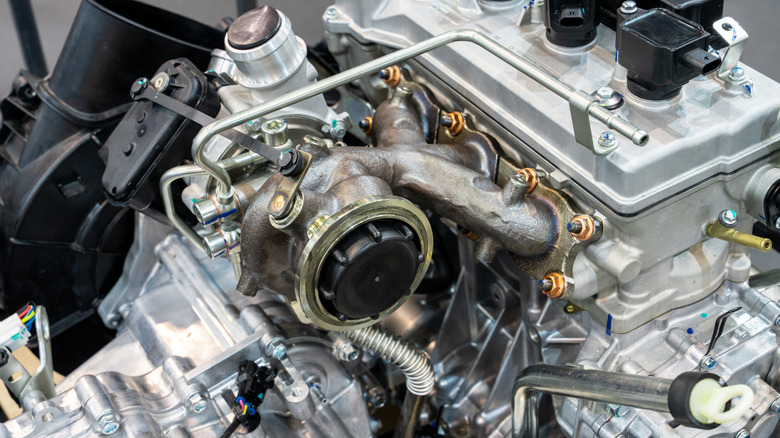
Enthusiasts put bigger turbochargers in their cars all the time without damaging the rest of the engine, but there's always a limit to what your vehicle can take. A typical amount of turbo boost pressure in a stock car is between 6-8 psi, but how much further you can go than that depends on the engine itself. There's no general rule of thumb for how much additional boost is safe.
Some engines are designed to handle much, much more. The Ferrari F80, for example, makes a whopping 55.5 psi of boost. And that's not because it's twin-turbocharged, as the number of turbos doesn't always represent how much boost is possible. The Bugatti Chiron, with its four turbochargers, makes a maximum of about 40 psi — quite a bit less than the F80's two turbos make. Meanwhile, the famous Offenhauser racing engines of the 1960s were said to run about 30 psi of boost and had their cylinder heads welded to the block in order to handle it. Some diesel tuners even got their custom truck engine to make over 185 psi of boost.
Realistically, the only practical limits of putting more boost in your car comes from the material and design of the engine's internals. Even if you upgrade the pistons, valves, and connecting rods, there's a chance the cylinder head still might not be able to handle such massive boost pressure. So if you're looking to upgrade your turbo or supercharger, it's important to first research your engine to see how much additional boost it can handle. And then maybe dial it back a bit from there, unless you also plan on doing extensive internal upgrades.