

Which Requires More Maintenance And Repair, Turbocharging Or Supercharging?
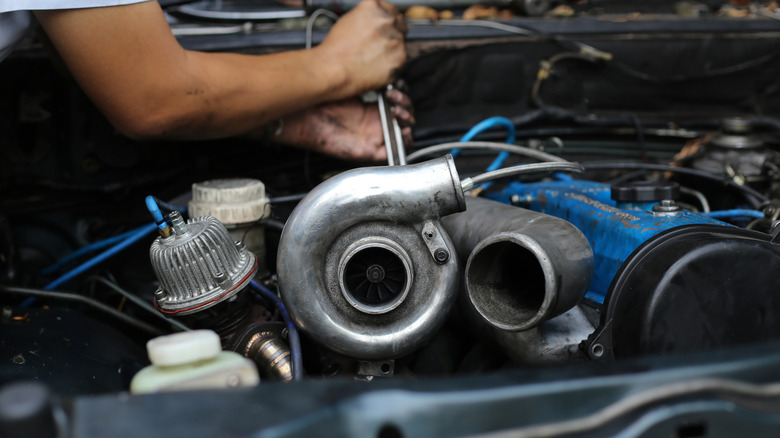
Since the invention of the automobile, engineers and enthusiasts alike have been working on squeezing more power from their engines through advanced designs and robust aftermarket add-ons. Options like turbochargers and superchargers are among the car mods that actually make your car faster. Both turbochargers and superchargers take in air and compress it, making it denser. This supplies the engine with greater levels of oxygen, enabling more performance output. However, they work much differently, and they each provide advantages and disadvantages. But which one usually requires less upkeep?
There are many different types of superchargers and turbochargers, making a definitive judgement across the board a challenging proposition. However, in general, superchargers are considered easier to maintain for a few key reasons. Superchargers typically utilize fewer parts than turbochargers and can be simpler in terms of their construction, which can reduce the number of problems and repair complexity down the line. While a supercharger must be integrated into the intake, a turbocharger must also tap into the exhaust system and may need cooling components.
Turbochargers also utilize the engine's oil for cooling and lubrication, requiring a strict oil change regimen (and high-quality oil) to prevent issues such as failure — in comparison, superchargers can have their own separate oil reservoir. While both systems create heat, turbochargers tend to run hotter, which may require the use of an intercooler. Although, this doesn't mean a supercharger is better or doesn't come with its own set of challenges, and many superchargers do use intercoolers, too.
What you need to look out for after installing a supercharger
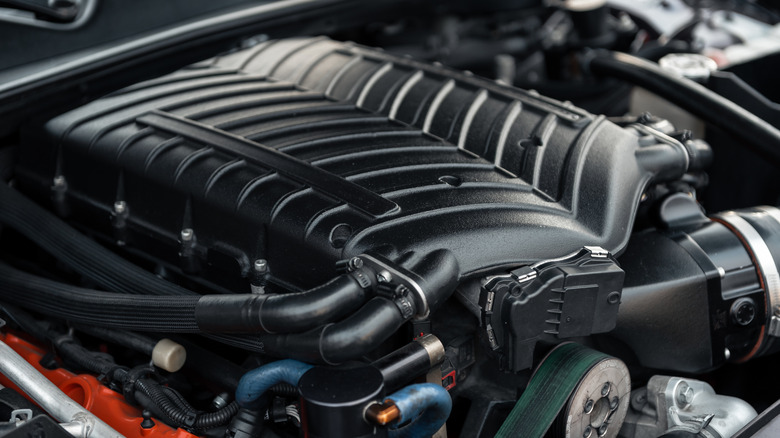
The biggest difference between a supercharger and turbocharger is how each one creates boost. A turbocharger utilizes exhaust gases to spin up a turbine. But a supercharger is belt-driven directly by the engine's crankshaft. This belt will degrade over time and need to be replaced. According to Automotive Training Centres, this is roughly between every 50,000 miles (80,000 km) and 68,000 miles (110,000 km). If the belt snaps, not only will your engine suddenly feel exceedingly lethargic under throttle, but (depending on your setup) your engine may also be trying to run on an extra rich mixture, leading to a noticeable drop in fuel economy.
Another issue with superchargers is that, because they're attached to the crankshaft, they are always running. On the one hand, this provides boost across the entire RPM range , versus a turbocharger, which must spool up once enough exhaust gas and pressure are present. However, the downside is that because the supercharger belt is always being driven by the engine, it's constantly forcing things under the hood to work harder.
While either form of forced induction will have engine internals grappling with increased pressure, a turbocharger is only boosting at certain times instead of running continuously. This added stress could take a toll on supercharged engines, especially if maintenance is neglected. Despite this fact, it's hard not to marvel at what's possible by adding one under the hood. Just look at the several family cars that are ridiculously overpowered, like the Dodge Durango SRT Hellcat with a supercharged output of 710 horsepower.
Both superchargers and turbochargers are expensive to replace

While both turbochargers and superchargers have their benefits, neither one is exactly cheap to fix or replace if something goes wrong. Speaking of things going wrong, watch for these warning signs that mean your turbo is about to fail. According to RepairPal, replacing a turbocharger assembly could run up to $3,004, while a supercharger can average as much as $3,966.
In both cases, labor is a sizeable chunk of the cost, as diagnosing problems can require extensive disassembly and testing. In fact, in some cases, even though superchargers are less complex than most turbochargers, mechanics may need to remove the entire engine to disconnect them, though this isn't required in all situations.
Because turbochargers tap into the engine's oil, a replacement can require the system to be completely drained prior to removal. In particularly tough scenarios, in order to be able to physically remove the turbocharger, mechanics may loosen the engine mounts to create a space large enough for the part to slip out.