

The Rarest Chevy Bel Air Was This Limited-Run 2-Door Sport Wagon
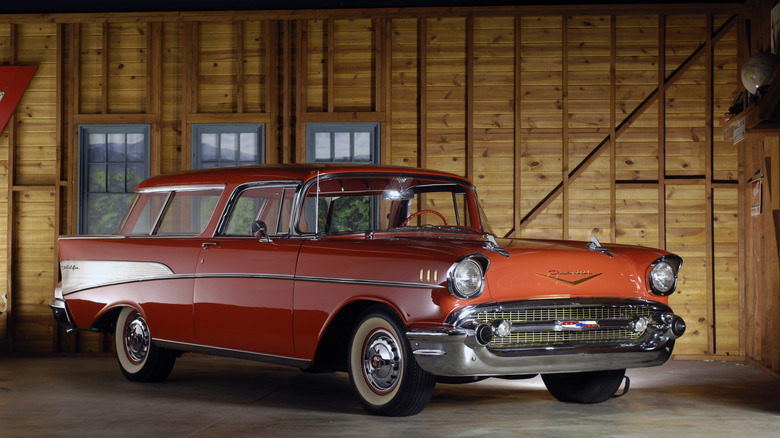
Tri-Five Chevy models are some of the most culturally iconic American classics, and for the uninitiated, that term refers to a trio of trim lines produced between 1955 and 1957. For the budget shoppers, Chevrolet produced the 150, while for those wanting a middling product, the 210 was offered. And for well-heeled folk after a top-dog product, there were the chrome-clad, leather-trimmed Bel Air models.
Despite enjoying just three years in production, millions of Tri-Five cars were churned out, with the luxurious Bel Air models counting for a significant proportion of those cars, especially in popular body styles like the two-door hardtop and four-door sedan. According to compiled factory totals, the 1957 Chevrolet Bel Air four-door sedan alone reached 264,449 units, while the Sport Coupe hardtop hit 168,293 cars. These were some of the most popular cars of their decade.
But hidden within those huge totals was the seldom-spotted Chevrolet Bel Air Nomad; a two-door wagon with distinctive roof ribs and slanted tailgate pillars derived from a Corvette-based show car concept. As was typical for a Bel Air-badged product, it was stylish and expensive, but also relatively impractical compared with conventional four-door wagons. As a result, buyers largely ignored it, and it was that lack of demand which created the rarest production Bel Air variant ever built.
To throw some numbers at the situation, in 1957 Chevrolet produced just 6,264 Nomad wagons, making it the lowest-production Bel Air body style of the entire Tri-Five era. By comparison, Bel Air convertibles reached over 48,000 units that same year.
The result is a strange historical quirk. Among the millions of Tri-Five Chevrolets built between 1955 and 1957, the rarest Bel Air wasn't a flashy convertible or a high-performance coupe, rather, it was an easily overlooked two-door station wagon.
A closer look at the Bel Air Nomad
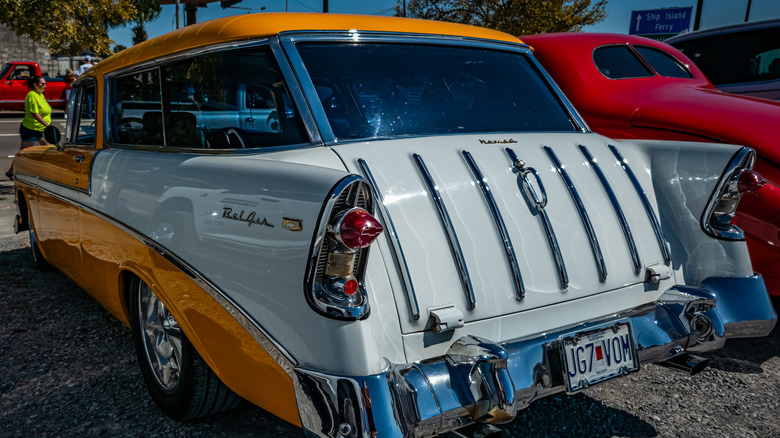
Regardless of what the numbers tell us today, Chevy never intended for the Bel Air Nomad to be some sort of niche collectible. Instead, it was introduced in 1955 as the flagship wagon of its line-up, borrowing styling cues from the Corvette-based Nomad concept car shown at the 1954 GM Motorama. The production version carried over the distinctive ribbed roof, wraparound rear glass, and sharply angled tailgate pillars that set it apart from ordinary wagons.
It was produced for all three of the Tri-Five years, with 8,530 units finding homes in '55, 8,103 in '56, and the (rather unfortunate) record-setting 6,264 for the final model year in '57. Ensuring the Nomad delivered on its Bel Air credentials, it was lavishly equipped for a wagon of its time. As part of the Bel Air trim level, it included premium interior materials, extensive chrome trim, and two-tone paint combinations which worked well to highlight its distinctive roof design. Buyers could also specify a wide range of options, including power steering, power brakes, power windows, and of course they had a smattering of V8 engines to choose from, dictating just how motivated their new Nomad would be.
While cool today, the concept of luxury features and an impractical twist on a traditionally practical body style didn't lead to sales success, but today, the scarcity of this bizarre model has led to increased collector interest. Restored examples in top-notch condition can easily soar past $100,000, according to industry experts Hagerty.
Rarer Bel Air models do exist, once you break things down further
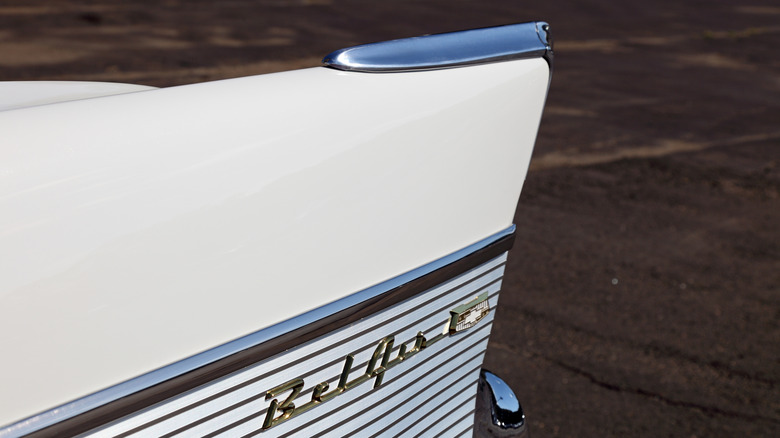
So yes, the '57 Nomad is the rarest Bel Air body style, but if we break things down a little further, we do stumble across even scarcer Bel Air configurations. Anxious that we don't start sounding like Corvette-owning boomers stating their Tuesday-painted yellow C5 is a one-of-one, we're just going to invite engine variations into the mix, and most notably, the fuel-injected 283 small-block V8.
The injection system was known as the Rochester Ramjet fuel injection, and in its highest-performance configuration, the engine produced 283 horsepower — exactly one horsepower per cubic inch — an important milestone in American engine development.
Fuel injection was an expensive and unfamiliar technology at the time, so as a consequence, very few buyers forked out for the (somewhat expensive) option. Among the rarest combinations was the 1957 Chevrolet Bel Air Convertible equipped with the Ramjet-injected 283. It is suggested that only 68 fuel-injected Bel Air convertibles were produced in 1957, making them some of the rarest performance variants of the Bel Air lineup — all of a sudden, our 6,000-strong Nomad looks like a Camry in comparison. To add a mint one to your collection, Hagerty suggests putting almost $200,000 aside, but you'll have to actually find one, first.