

This WW1 Helmet Designed By Ford Looks Like Something Out Of A Medieval Horror Story
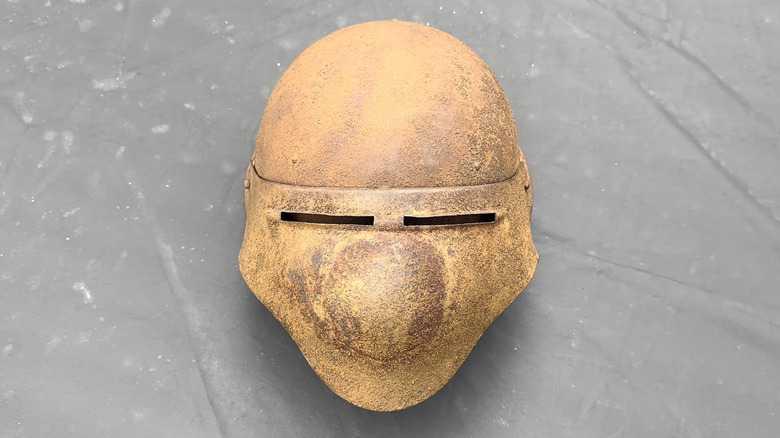
Upon entering World War 1 in 1917, the U.S. lacked its own standardized steel helmet for infantry in Europe, so troops were initially equipped with British- or French-pattern helmets to begin with. Immediately, work began to equip the troops with an American design that not only offered increased protection, but was also distinctly their own.
Naturally, many people were involved in the manufacture and design of these helmets, but few were as influential as Dr. Bashford Dean, an armor expert who led the development program. Under his oversight, a series of experimental designs were toyed with, and to help with production, the assistance of the Ford Motor Company was called upon. A major industrial player, with machinery and employees at the ready, it made sense for Ford to jump-in and join the war effort, lending both its Detroit and Philadelphia plants to military production throughout the war. It would be a tricky task to accomplish nowadays, what with much of Ford's workforce now working remotely.
Back then, Ford didn't just produce helmets, but also artillery pieces and trucks, yet this rather medieval-looking 'Model No. 8' helmet design stands out. Only around 1,300 of these full-faced steel helmets with two narrow slits in the visor were produced by November 1918. They were built of steel, boasted a three-pad liner, and a khaki drab finish. Production began so late in the war that few, if any, saw frontline service before the Armistice, making them a seldom-spotted oddity that few recognize today. Prior to this, Ford also manufactured around 2,000 Model No. 2 designs, although these were deemed too similar to the German design, and so were discarded. As a result, they are scarce collectibles today.
Ford's involvement stretched far behind a few horror story helmets
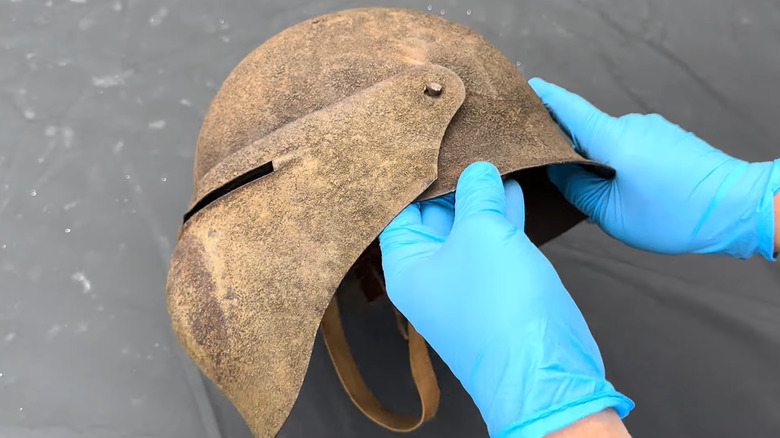
Ford's involvement in helmet manufacture might seem unusual, but as a big industry name at the time, with multiple factories and an experienced workforce at hand, it made perfect sense for a firm like this to get involved with the war effort. It wasn't just Ford either. Automakers all over Europe stopped their day-to-day operations and instead became military-focused throughout the war.
In Philadelphia, Ford's workforce learned specialized steps for finishing helmets, which had been formed elsewhere. After forming, helmets were painted in olive drab to reduce glare and textured using blown sawdust, then dried and re-painted for final finish. Liners were riveted, leather straps were fitted, and then the finished articles would be shipped off on crates of 50 at a time.
The output from Ford's Philadelphia plant during this time cannot be underestimated. Henry Ford insisted that no profit would be made from the task, (would you do the same if you were Ford's CEO?) saving the U.S. government hundreds of thousands of dollars at the time, and earning the plant the right to produce almost 2.5 million helmets in total — of which only a small portion were the aforementioned and experimental Model No. 8. In addition, the plant also managed to churn out over 35,000 eye guards and 5,000 suits of body armor, while also repairing no fewer than 384 machine gun trucks. Ford was equally keen to assist during the Second World War, and the Blue Oval even built a massive mile-long factory to produce aircraft.