

Marine Vs. Automotive Spark Plugs: What's The Difference?

Maintaining the health of any internal combustion engine is critical for not only peak performance, but peak longevity as well. The methods used to take in air, fuel, and spark are a big part of the puzzle — particularly the latter, as a clean, effective zap from the spark plug ensures a complete burn. This translates to the best, most reliable performance. So what about when a spark plug is lighting off in a marine environment?
An engine operating on the water requires a few notable design changes over those being used on the road, so the sum of its parts must be adapted accordingly. That includes, of course, its ignition components.
The difference between spark plugs designed specifically for marine engines and those meant for standard applications is a matter of design, durability, heat range, and resistance to moisture — especially where saltwater is involved. Beyond that, manufacturer specifications become even more crucial.
Sturdier all around
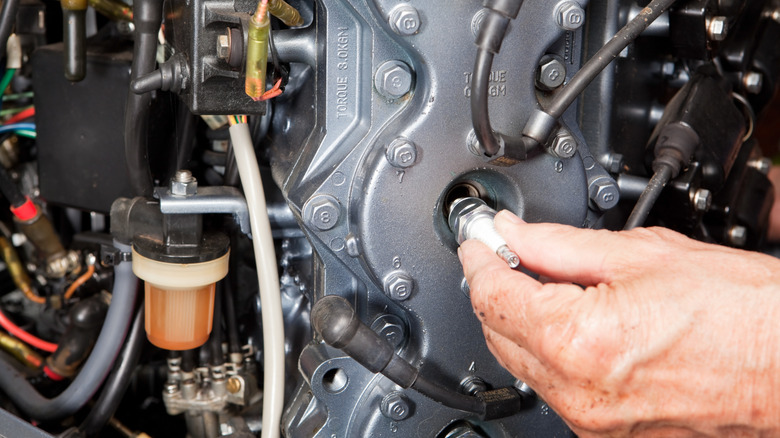
Upon first glance, a standard marine spark plug generally doesn't look much different than one you'd pick up in any auto parts store. Sure, some of them are designed for comparably shorter wells, depending on the engine they're being bolted into, but otherwise, they look quite similar.
However, because the environment in which they operate typically has more vibration than is encountered under the hood of a car, they're generally made of sturdy materials. The insulators — the typically white ribbed part just below where the coil pack or wire attaches to — are made of materials such as high-grade alumina silicate ceramic, although this material has become common on many plugs intended for cars and motorcycles as well.
Since marine spark plugs live in environments where water is constantly being sprayed around, they are made of corrosion-resistant metals and coatings. Additionally, while you can generally get away with not coating the terminal of a car's plug with dielectric grease, it's very much advised here. This is an added defense in keeping moisture out, which helps prevent corrosion and ensures proper terminal contact for good flow of electricity. It also makes removal much easier when it's time for replacement.
Heat range, materials, and preparation

Another important trait of marine spark plugs is their heat range. Marine engines often run a sustained high load at steady RPMs, so they require plugs with a colder heat range. Essentially, a colder spark plug has a shorter insulator — therefore, a shorter distance for heat to transfer through — which means that heat transfers to the cylinder head quicker. However, this is heavily dependent on manufacturer specifications, so check the engine owner's manual for the exact type of plug that's required.
Otherwise, the basic properties of marine spark plugs are a lot like the ones found in your car. Typically, going with a platinum- or iridium-tip plug will last longer since these materials have a higher resistance to wear. Another similarity that marine plugs share with automotive spark plugs is the plug gap. Spark plugs don't always arrive with the proper gap — meaning, space between the center electrode and ground electrode — so grabbing a cheap gap gauge and slightly closing or opening the gap might be necessary.
Ultimately, it all comes down to the intended environment and specifications. So while some automotive spark plugs and marine spark plugs may have a lot of similarities, following manufacturer recommendations and keeping everything clear of corrosion makes all the difference.