

How The 80s Handled Overdrive (And Why We're Kinda Glad It's Not A Thing Any More)

In automobiles, "overdrive" refers to a transmission system with a wide ratio, that is, a number lower than 1:1. That setting allows the engine to sustain a given speed at lower rpm than usual, which lowers fuel consumption at the expense of making the engine less responsive to throttle input and making its acceleration weaker, less immediate. The goal is to use that mode in situations like highway driving, where speed is generally constant and there's no demand for sudden acceleration.
In modern cars, especially automatic ones, activating overdrive is simply a matter of the electronic control unit (ECU) setting different operational parameters when the car reaches adequate speed. In manual cars, most models have the highest gear with less than 1:1 ratio and, with that, make the engine run at lower rpm than usual. However, there was a time when electronics simply didn't exist, and even building transmissions of five gears or more wasn't a feasible solution.
Up until the 1980s, the overdrive effect was reached through a separate mechanical device. In short, it used to be an auxiliary mechanism attached to a conventional transmission that could lower the rpm with which the engine effectively worked. Because of that design, overdrive could be engaged on multiple gears — drivers would often alternate modes when upshifting. However, once transmissions with five or more gears became commonplace, automakers quickly switched to simpler solutions.
Early overdrive systems used a separate mechanism
Overdrive systems were popular in the 1950s and 1960s; one of the most popular was the Laycock de Normanville, invented by Edgar de Normanville in 1948 and built at Laycock Engineering in the British city of Sheffield. It was placed after the transmission and used a set of epicyclic gears around the driveshaft. When activated, a cone clutch would disengage, and the spin would be redirected through the epicyclic gears to reach the overdrive's higher ratio and use an external part, named annulus, to effectively power the output driveshaft.
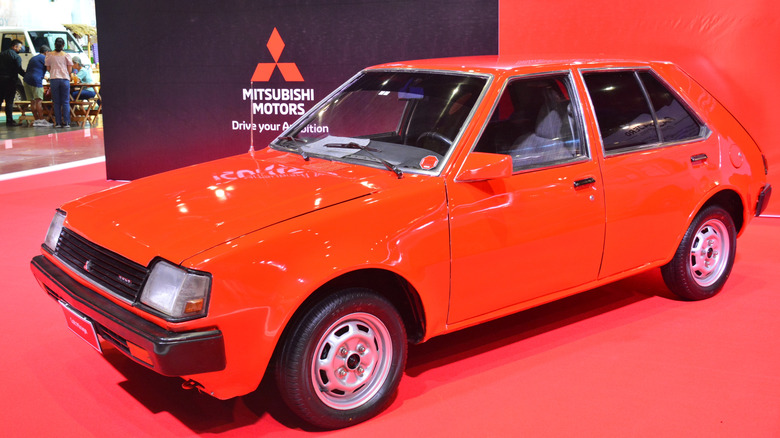
While that system was in decline by the 1970s, some automakers still tried their chances with other approaches. In 1979, Mitsubishi came up with a four-speed manual transmission with high and low ranges — not typical overdrive. Unlike what off-road vehicles usually offer, that dual range was available on all gears and could be switched at road speeds. The most interesting part, though, is how it was marketed: Mitsubishi added a second stick, named those ranges Economy and Power modes, and called the system Twin-Stick.
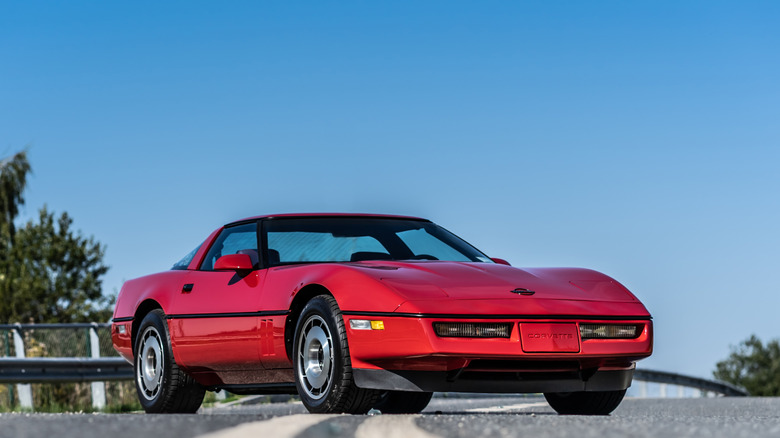
Five years later, Chevrolet would release the Corvette C4 with the "Doug Nash 4+3" gearbox: a manual four-speed with automatic overdrive on the top three gears. Here, overdrive is activated by flipping a rocker switch, but there's a computer to manage all shifts. It analyzes rpm, engine temperature, current speed, and throttle pedal position to decide which gears to use. At highway speeds, the 4th gear in overdrive mode would act as a fifth with a higher ratio than usual.
Overdrive systems ended up replaced by simpler, more reliable alternatives
One of the reasons why those overdrive systems were abandoned is low reliability. In the Laycock unit, for example, internal plates could crack due to excessive pressure, the clutch could fail at typically high temperatures; and the system would operate roughly if some adjustments weren't extremely precise.
In other cases, like the Doug Nash's, the reliability issue was joined by the fact that the overdrive action wasn't that effective. Even when the rpm reduction was noticeable, the mileage gain it brought was far from impressive. That issue was even more frustrating in Mitsubishi's Twin-Stick cars, since they required the driver to manually switch between a total of 8 gears considering both modes. In the end, operating those transmissions was too much work for minimal benefit.
The last nail in the coffin was technological advancement. Over time, transmissions with five gears or more became more common, so automakers switched to simply designing the highest gears longer, with a lower ratio than usual. Later, electronics played another major role in that change: in modern cars, driving at low rpm requires as little as having the ECU alter some engine and transmission parameters whenever it's necessary.