

This Honda CR-V Shower Attachment Might Be The Weirdest Vehicle Option Ever
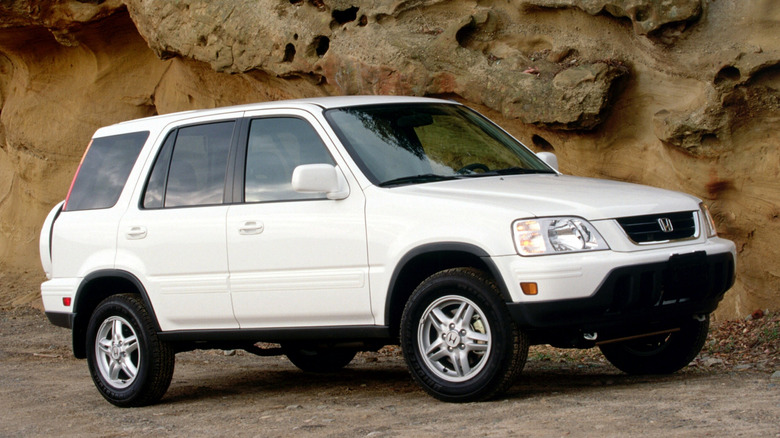
Like many other SUVs, the Honda CR-V became popular in the 1990s for being an alternative to fully urban cars, like sedans and minivans, as well as an alternative to inefficient utility vehicles like pickup trucks. After successful SUVs like the Jeep Cherokee XJ (1984) and the Nissan Pathfinder (1986) hit the scene, different automakers saw the light and started making dedicated SUVs of their own. Released in the United States in 1997, Honda's Comfortable Runabout Vehicle (CR-V) was an attempt from Honda to stand out among compact SUVs, and their unique feature set helped with that mission quite a bit, including an electric shower.
The CR-V debuted in a pivotal moment for Honda. A few years earlier, the Japanese automaker ended its partnership with Rover right when they were planning to build a casual, not-so-rugged SUV together. While the British company eventually released the Land Rover Freelander with the strong off-road brand (and a stylish two-door convertible version), Honda went with the CR-V instead.
Even though it was an all-new model, the CR-V had a reputation for reliability built in thanks to its shared chassis and engine with the Civic, and overall brand reputation, too. It also had attractive traits like a typically boxy SUV design, high seating position, optional all-wheel drive, and a fifth door with side hinges, and an exposed spare tire to up the usability quotient, but there was more. It also offered a series of lifestyle items, one of them being the optional electric shower; it used a power outlet in the trunk and could hang from the open rear window for people to use before entering the car.
The CR-V's electric shower was useful after outdoor activities

While it's easy to label the shower as weird because it's unusual in cars, the truth is that Honda was just attempting to anticipate the needs of their target audience, the same way they did with other options. The CR-V offered roof racks and several storage areas to carry large and small gear, a foldable table that doubled as the trunk's floor when not in use, a 12-volt power outlet on the trunk wall, and a waterproof compartment beneath the trunk for dirty clothes and shoes.
In other words, the CR-V's extensive equipment list offered convenience, and the shower was just an evolution of that concept. The SUV was aimed at people with an active lifestyle, and the shower was actually part of a whole kit that made it ready to use for outdoorsy types. The shower head came with a plastic hose and a dedicated water jug that was specifically made to use that 12-volt outlet in the trunk — similar to what some non-automotive companies offer as a kit today.
The Honda CR-V kept offering the electric shower until 2007, when it got a complete redesign. That generation was marked by a more car-like design, more refinement, and a general effort to push the SUV upmarket. Those changes reflected the CR-V's new role as a family vehicle designed for the city; it wasn't as focused on wacky adventure features as the first-generation model. Nowadays, Honda still offers some pretty useful features, though, like the in-bed trunk on the Ridgeline pickup truck, or even their modern take on the foldable table – but this one on the Passport SUV — so it isn't a strategy they've abandoned altogether.