

How Does The BMW N54 Compare To The N55?
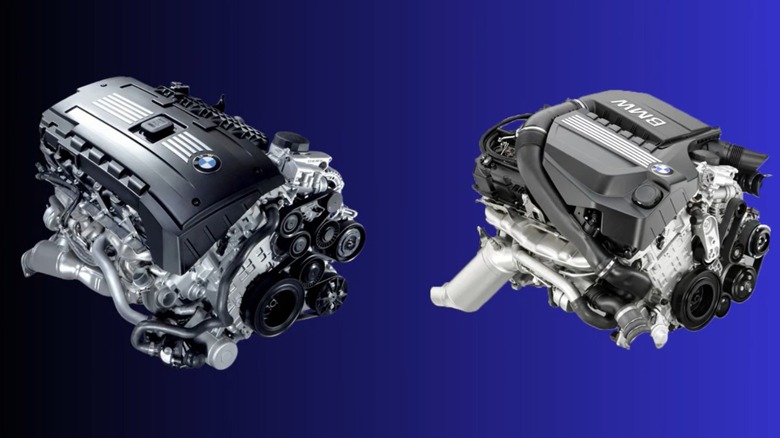
In the mid-2000s, BMW launched a new straight-six engine that would be one of the most important in the brand's recent production history. The N54 was the German company's first gasoline-powered engine with a turbocharger, and not just one. It had two. Just a few years after the N54 hit the streets, the N55 appeared on the scene, replacing the N54 in several models.
Was there much of a difference between the N54 and N55, besides the name? Actually, yes, albeit mostly in how the N55 handled turbocharging. Instead of the twin turbochargers in the N54, the N55 was built with a single dual-scroll turbocharger. This simplified design cranked out as much power as its predecessor, but did it more efficiently, thereby reducing emissions. It was also more reliable, correcting some of the issues that had come with the N54 while providing the same powerful performance, but more efficiently and at a lower cost.
That efficiency came at a small price, however. The N54 is a favorite among engine tuners due to its adaptability. By halving the number of turbochargers, the N55 has a slightly lower limit in terms of the horsepower can be squeezed out by adding aftermarket parts. Nevertheless, you can still tune the N55 and increase its horsepower significantly over its factory specs.
How the N54 worked
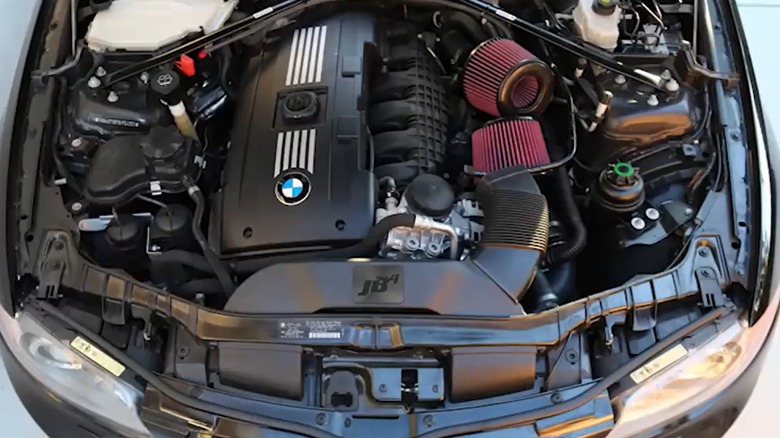
The 3.0-liter N54 roared onto the scene in 2006, first seeing service in the 2007 BMW 335i. It had two turbochargers and could crank out 306 horsepower and 295 lb-ft of torque, which, at that time, was nothing to sneeze at. The engine itself was constructed of aluminum and was built with a forged crankshaft and rods. It also had two overhead camshafts and 24 valves.
It was also pretty cutting-edge for the day. It featured high-pressure direct fuel injection, which contributed to its power and efficiency. The N54 also included BMW's VANOS variable valve timing system and electronic wastegate control. These features would provide impressive control and optimization of the engine's performance, but it would also add complexity to the engine, which typically results in more that can go wrong.
The N54 would end up being pretty popular with the tuning community. Aftermarket parts for this engine are plentiful, making it comparatively easy to squeeze more power out of it. According to some sources, tuners can regularly get upwards of 400 horsepower out of the engine, and many report achieving more than 500. It is probably the tunability of the N54 that sets it apart the most.
Where the N54 fell short
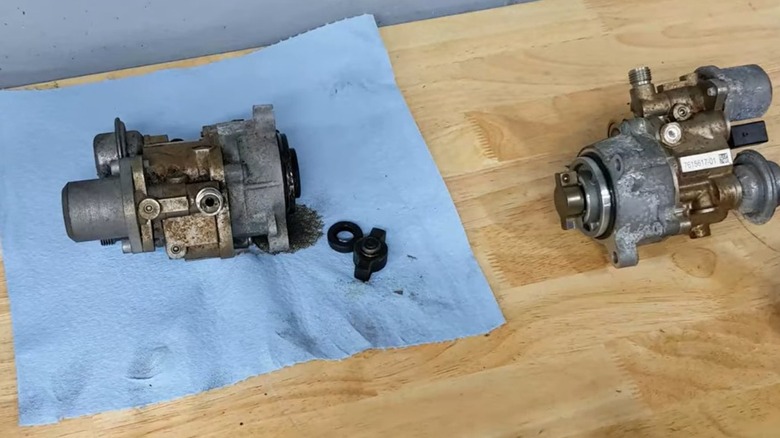
For all its innovations, the N54 had its share of problems. That's to be expected, since BMW was new to building mass-produced inline-six gas turbo engines. There were kinks that had to be worked out and issues that had to worked through.
One of the most notorious issues was widespread high-pressure fuel pump (HPFP) failure. This led to a massive recall in 2010 of 130,000 2007-2010 model year vehicles with N54 engines. The recall targeted HPFPs with specific manufacturing codes. BMW would also extend the warranty for the HPFP to ten years or 120,000 miles, which was a good thing, since having the dealership replace the pump with an OEM model could cost upwards of $1,500. Of course, that warranty has long run out, so anyone who owns any of these cars that did not have the HPFP replaced would be on the hook for the cost today.
Other common issues experienced by owners of cars with N54 engines would include, leaky fuel injectors, a leaky valve cover gasket, carbon build-up, a failing water pump, and a rattling wastegate (here's an explanation of wastegates and how they work). To put it mildly, the N54 was a little rough around the edges.
How the N55 worked
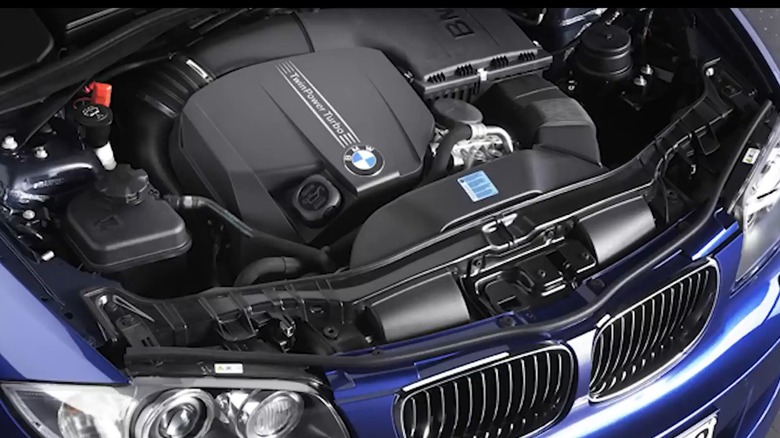
BMW had been learning from its mistakes from the N54, and rectified a lot of them with its successor, the N55. Just like the N54, the N55 offered 306 horsepower and 295 lb-ft of torque. But it was more reliable, got better gas mileage, and let out fewer emissions. One of the ways it achieved this was through the addition of the Valvetronic variable valve lift system, which better optimized and regulated airflow through the engine.
The N55 was built with a single turbocharger, but it was a twin-scroll, branded confusingly as "TwinPower Turbo". This was a lighter turbocharger with a simplified design. Still, the stock set up was able to crank out the same amount of power as the N54 with its two turbochargers, even reaching peak RPMs a little faster, though some would say not notably faster. Of course, this simplified design contributed to the N55's reliability.
While there were upgrades to fix some of the problems that came up with the N54, much of the construction was similar. The block and head of the N55 were made out of aluminum, just like the N54. It also had dual overhead camshafts and 24 valves. And both the N54 and N55 were 3.0-liter I-6 engines. BMW wasn't trying to re-invent the wheel with the N55, just improve on it a bit.
Where the N55 fell short
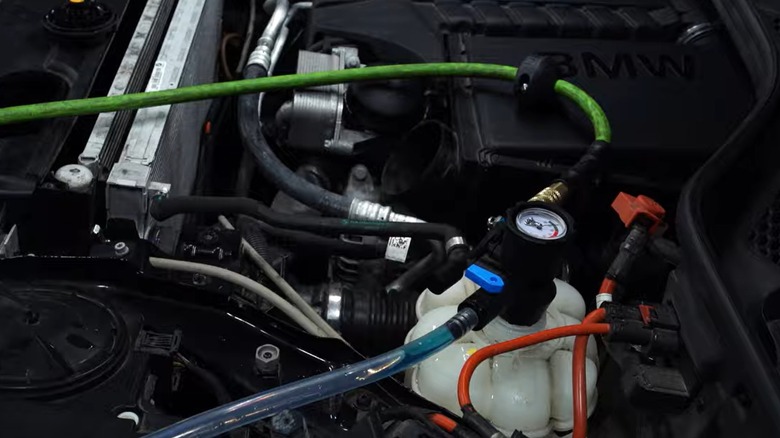
While the N55 improved the design in lots of ways, it did not perfect it, and the newer engine came with its own set of problems. One thing it didn't fix was the leaky valve cover gasket. In fact, it was one of the newer engine's most common issues. Even the valve cover itself was prone to get cracks once the odometer approached six digits. Another problem that wasn't fixed was the failure-prone water pump. But this was an issue across BMW engines.
One weakness was the VANOS valve lifting system, which is an electronic VVL system, and works in conjunction with the N55's Valvetronic, a VVT system. (Here are the differences between VVT and VVL.) Not only was the N55 prone to issues with the solenoids, but the bolts in the VANOS system in the early years were faulty, as well, so much so that there was a recall. Another common problem was the oil filter housing gasket (OFHG), which can deteriorate over time, causing oil leaks.
Of course, tuners would say that the N55 fell short in tunability. With the right aftermarket parts, you could get over 400 horsepower out of the engine, but that wasn't near the performance you could eke out of the N54. For the most part, the tuning community prefers the older N54.
Differences between the BMW N54 and N55
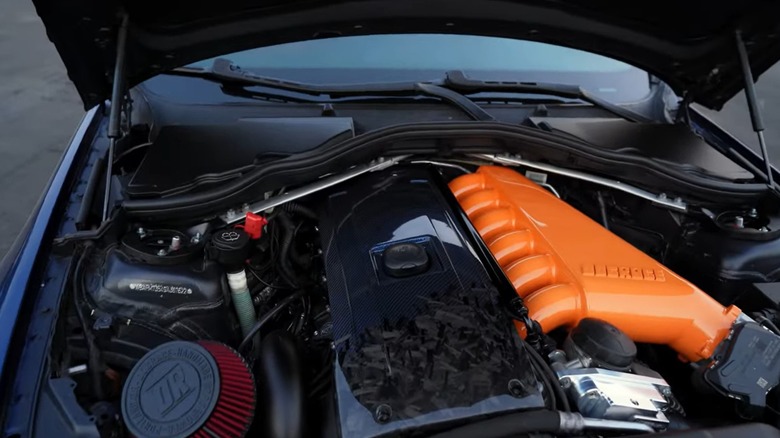
We've already pointed out a couple of differences between the N54 and N55. The N54 used a set of twin turbochargers to get optimal power, whereas N55 streamlined the design by using a single dual-scroll turbocharger. Both twin turbochargers and single dual-scroll turbochargers are designed to address the same issue — back-pressure interference, which is when exhaust from multiple cylinders crash against each other, reducing the ease of airflow. Twin turbochargers and single dual-scroll turbochargers attack this by dividing the exhaust from I-6 cylinders into two exhaust channels, three cylinders into one, the other three into another, reducing back-pressure interference.
The problem with twin turbochargers is that there are two of every part, meaning twice as many parts that can break, fail, or wear out. The simplified design of the single dual-scroll turbocharger means that the only parts that are duplicated are the exhaust channels or scrolls. There is just one turbocharger for both channels, making for a more efficient design. Besides efficiency and greater reliability due fewer parts that can fail, the single dual-scroll design can produce more torque at lower speeds and can experience less turbo lag.
The downside to having just one turbocharger instead of two has to do with tuning. You can only get so much extra horsepower out of one turbocharger. Logically, then, you can get more horsepower out of two chargers instead of one. Still, both the N54 and N55 have a lot going for them.