

Plymouth's Hy-Drive Transmission Was Half-Manual, Half-Automatic, And Totally Confusing
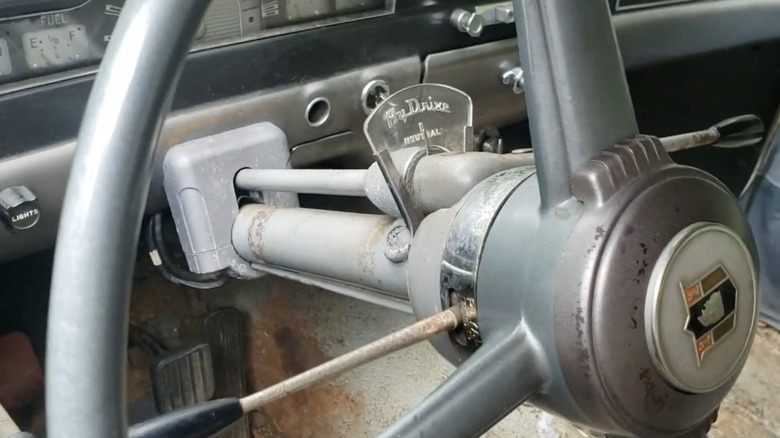
From awkward transmission designs to a long history of automakers at re-inventing gear shifters, post-war cars had this lovely but quirky charm that seems to have successfully wooed several classic-car enthusiasts. However, not everything was fun and dandy at the time, and there were bits of engineering that'd genuinely leave you asking: why did someone go to the trouble of making this? And that brings us to Plymouth's Hy-Drive transmission.
To Chrysler's credit, the conglomerate tried to democratize an automatic transmission (or semi-automatic, rather), but failed. Although the PowerFlite existed, it was allocated – initially, at least — for the corporation's higher strata. The budget-brand Plymouth desperately needed a version of its own as competition started offering automatics. So, engineers decided to shoehorn Plymouth's massive clutch in between a torque converter and the company's Synchro-Silent three-speed transmission to arrive at an exceptionally-smooth shifting system among cheaper vehicles. Although it may have sounded revolutionary, the transmission only managed to stay in production for two years and was discontinued for the 1955 model year.
Operating the Hy-Drive transmission is pretty easy. You start the car in Neutral, slot the shifter into Drive while depressing the clutch (similar to a manual), and simply drive off. Since it can idle without disengaging the clutch, no further foot gymnastics are required when you come to a stop. It isn't a sprightly thing to drive, though, as Hy-Drive-equipped Plymouths take roughly half a minute to hit 60 mph from standstill. You can, however, row your own gears and improve the 0-60 times, which proved to be one of its highlights — but doesn't that defeat the purpose of an automatic?
Task failed successfully?
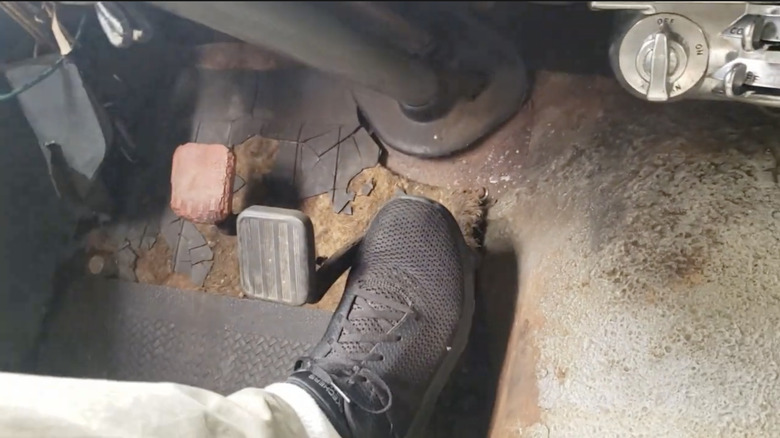
The Hy-Drive's demise was unsurprising given how expensive an option it was relative to its innovation. At $146 (which is roughly $1,800 in today's money), the semi-automatic transmission with a foot-operated clutch only saved $32 (about $400 today) over Chevy's Powerglide, which was a true automatic. For a budget-conscious new car buyer, optioning that on a '53 Plymouth Cranbrook, which had a base MSRP of just under $1,900 (around $23,000 today), would not have made much sense unless they really wanted the latest and greatest.
Although it was a simple concept, the execution wasn't. Engines for the Hy-Drive cars needed separate oil passages since the transmission, unlike a traditional torque converter automatic, did not come with an oil pump of its own. The torque converter was basically running off the engine's oil reserve, which is why Plymouth doubled the model's oil capacity and recommended oil changes at least twice a year. The gears within the three-speed transmission were also made stronger to handle the extra torque from the converter. All this left Chrysler no choice but to price it on the higher side. The corporation managed to undercut its rivals, but were its consumers actually checking it out for themselves?
Estimates, as pointed out by Curbside Classic, show the company managed to shift hundreds of thousands of these transmission units over its relatively short two-year production run. However, an overwhelming majority of Plymouth customers went with the standard three-speed manual — or the two-speed PowerFlite when that became available. You could call the Hy-Drive a failure, but it perhaps wasn't a resounding one.