

Why Early Harley-Davidsons Had Bicycle Pedals
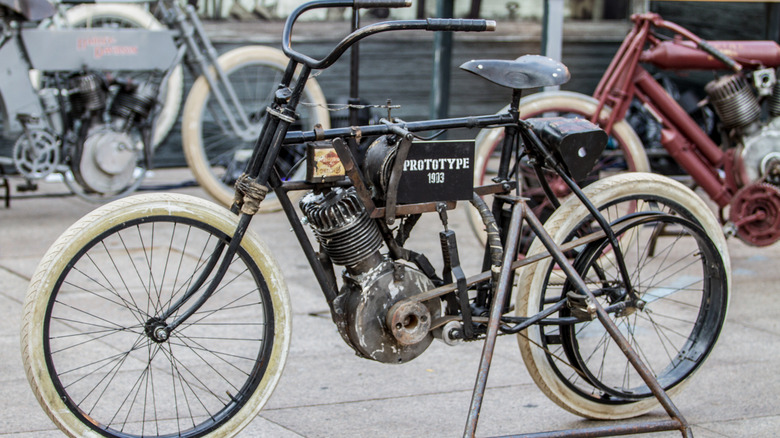
The bicycle arrived long before the motorcycle. In fact, the first motor bikes were essentially modified bicycles, which still required pedals in order to help facilitate propulsion. While modern technology has given enthusiasts a wide selection of the quickest sport bikes on the market, fledgling Harley-Davidson models from the early 1900s needed human-powered support to navigate hills. Featuring a 10.2-cubic inch motor with a single cylinder, the underpowered bike could only manage speeds in the single digits. They were a far cry from modern models like the Fat Boy, which offers 103 horsepower. (Although, riders say that particular Harley-Davidson model is the most difficult to handle.)
Even by the time the second iteration of the brand launched a couple years after the first model, it required pedals to charge the battery for starting. Essentially, you were required to manually pedal the bike themselves for some time, providing enough power to the battery for the engine to turn over. This wasn't like pedaling a regular bike, either, as the motion was also building compression in the engine.
When Harley-Davidson started moving away from traditional pedals
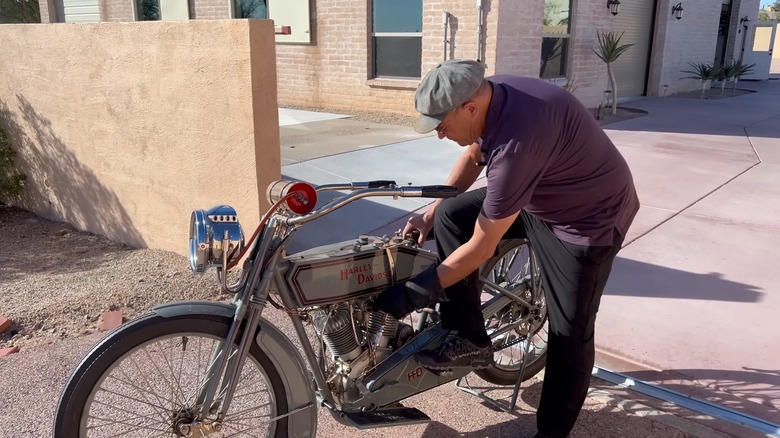
While the first crop of models from the iconic brand required pedals to help augment power and even start the engine, the 1915 Harley-Davidson 11F would be the last (of the three-speed models) to feature them. Throughout the next decade, Harley-Davidson would continue to add power and more robust features to its models, making bicycle pedals less necessary. For example, with the 11F, Harley-Davidson certified in writing that every model would output 11 horsepower (which was unheard of at the time). It produced around 37% more power than the previous year's model, per BikeBound. With a 61-cubic inch F-head V-twin and a transmission with three speeds, what were the pedals for, then?
For the 1915 11F, the pedals — in one of their last appearances on a Harley-Davidson motorcycle — were used for starting the engine. You could either pedal it to get the bike going, or you could kick-start it. The model had both a hand clutch and foot clutch, which would need to be engaged in order to fire up the engine. As you can see, while motorcycles began by simply adding an engine to a bicycle, they quickly diverged as technology improved. Interestingly, though, the latest crop of electric bikes are blurring the line between bicycles and motorcycles once again, hearkening back to those early days when the two shared many similarities.
Pedals weren't the only things the first Harley-Davidsons shared with bicycles
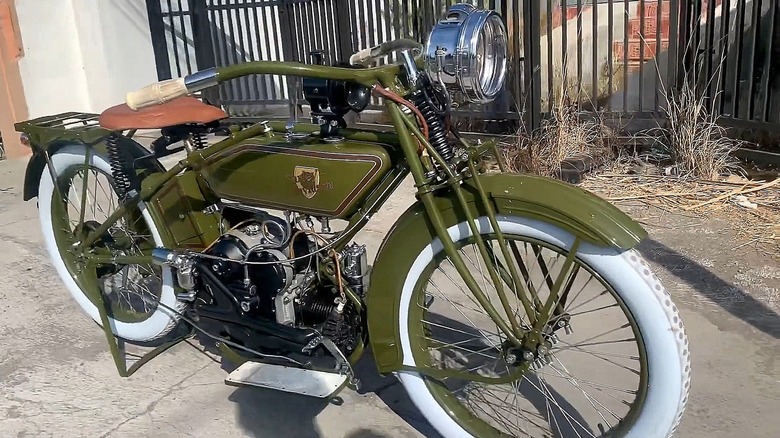
While the first motorcycle from Harley-Davidson would lead to the quintessential American fixtures we know toady, it also shared quite a bit more than just pedals with the bicycle. The 1903 Harley-Davidson was built on a rigid frame, essentially devoid of any suspension system, similar to a very basic bicycle. Both wheel hubs were attached to the rest of the motorcycle via a solid fork in the front and a metal seat stay in the rear. This meant that the only cushioning effect provided to the rider was achieved through the rubber tires, making every bump in the road noticeable.
It wouldn't be until the 1919 Harley-Davidson 19W Sport Twin that a trailing-link suspension was added to the front fork. The system is designed with a point in front of the axle acting as a pivot, with the 19W Sport Twin utilizing a single center-mounted spring above the front wheel connected to the arms of the suspension configuration. 1949 is when Harley-Davidson would offer a telescopic front fork suspension system, which is still found on the brand's current model lineup. As influential as these models were, not every one is featured on our list of the 10 most iconic Harley-Davidson motorcycles that made history, but their contribution still made significant ripples across the industry.