

Approval For The AMC Gremlin Rested On The Impressive Artwork On An Air Sickness Bag
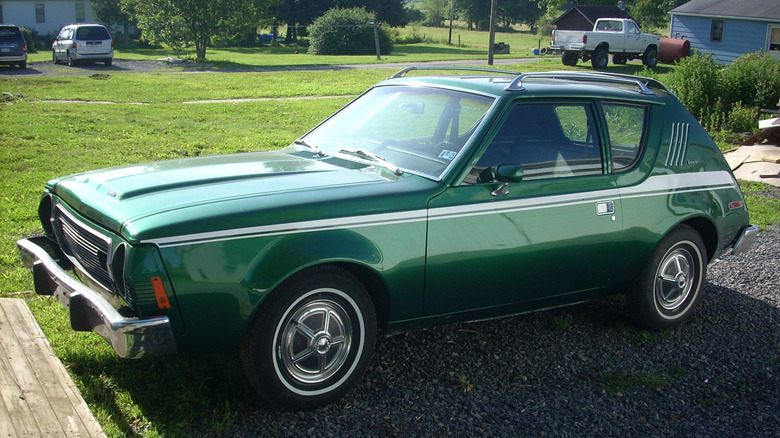
Gremlins have been causing trouble on airplanes at least since the 1940s, which is when Royal Air Force pilots began blaming them for in-flight malfunctions during World War II. Another, less whimsical gremlin showed up on the wing of William Shatner's plane during his 1963 trip through the "Twilight Zone." But perhaps the most horrifying example — at least for certain members of the auto-verse — may be the one Dick Teague drew during a fall flight in 1966.
Teague was vice president for styling at American Motors Corporation, and he had been working with designer Bob Nixon to come up with a new import-fighting small car that, specifically, would slow the momentum of the Volkswagen Beetle. Teague one day found himself flying with Gerry Meyers, AMC's head of product development, and decided he'd pitch the new car concept to his captive audience — but because he didn't have any of Nixon's sketches with him, Teague put pen to barf bag to give Meyers an idea of what the vehicle would look like. (It's a good thing this wasn't on the Frankfurt flight with 70 vomiting passengers or there might not have been an extra.)
Anyway, Teague must have done a pretty good job, since Meyers approved the car on the spot. Well, it seems that what Meyers liked most wasn't so much the car's distinctive look, but the fact that it would be impressively cheap to build. Teague's drawing, though, was enough to get the project off the ground.
Getting to know the Gremlin
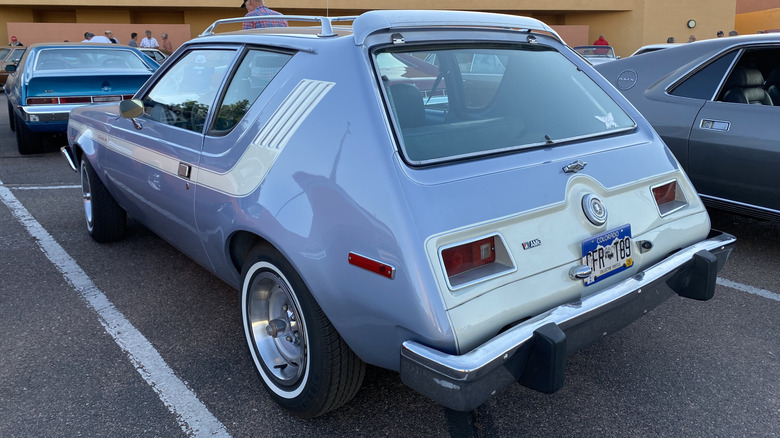
The American Motors Corporation was formed in 1954 to save two other automakers — Nash-Kelvinator and Hudson — from financial ruin. However, AMC was never able to entirely shake off its own money problems, often going to great lengths to save cash. For the brand's sports car, for example, AMC basically transformed an old, pre-existing chassis into two of the underrated AMC cars that time forgot — simply by lopping a foot of length out of one (the Javelin) to create the other (the AMX).
The same tactic helped reduce the cost of developing AMC's new subcompact. This time, the compact AMC Hornet was big brother to the Gremlin. The Hornet was a bit more than 179 inches long and rode on a 108-inch wheelbase, while the Gremlin's length shrank to roughly 161 inches and its wheelbase to a mere 96. At that stage, the Gremlin was only approximately 2.3 inches longer than the 1970 Beetle, with an extra 1.5 inches in the wheelbase.
What didn't shrink was what came under the hood. Emphasizing the Gremlin's long-in-front, short-in-back proportions was an engine bay that could accommodate the standard I6 engine — a 199-cubic-inch motor making 128 gross horsepower. The Bug, by comparison, had two fewer cylinders, almost 100 fewer cubic inches of displacement, and topped out with 57 SAE brake horsepower. Nor was there a huge delta in fuel economy, as both were capable of about 25 mpg, at least in theory.
The Gremlin's short history
Despite being named one of Time Magazine's 50 Worst Cars of All Time, and never establishing itself as a real-world rival for the Beetle, the Gremlin has to be considered at least a modest success on its own terms. For starters, AMC sold 674,492 Gremlins between 1970 and the car's end of production in 1978. The high-water mark came in 1974, a year in which 171,128 new Gremlins reached the road.
Probably helping those numbers was a constant trickle of upgrades. Born as a low-budget ride with a sticker price of $1,879 — $15,580 when adjusted for inflation — the car continued to add content. In 1972, for instance, AMC began offering front disc brakes and a much-improved Torque Command automatic transmission — not that the company spent time developing the gearbox. Instead, it purchased TorqueFlite transmissions from Chrysler and rebranded them. AMC began selling Gremlins with an optional 304-cubic-inch V8 the same year. The motor turned out 245 pound-feet of torque to get the car off to a quick start and complemented that output with 150 net horsepower.
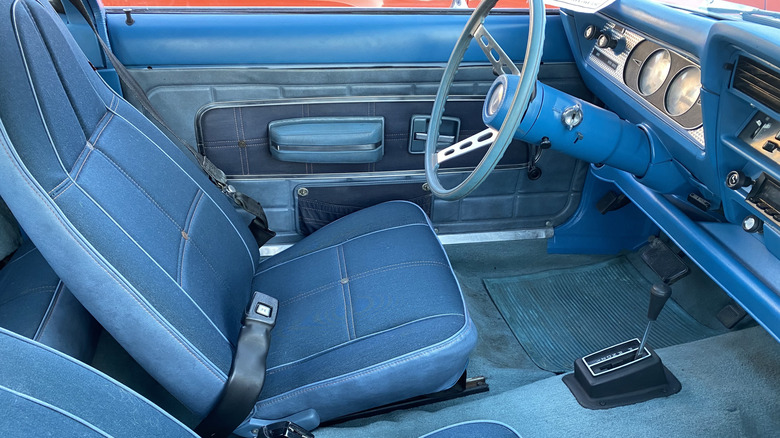
The 1973 oil crisis put a swift end to the Gremlin's sporting pretensions, but AMC kept a spotlight on the car with appearance packages, highlighted by the Levi's Edition that also premiered in 1973 and, more recently, was named one of the world's truly special automotive special editions. Here you got denim-like seating surfaces accented by traditional Levi's details such as metal buttons, copper-colored stitching, an iconic red tag, and, on the color-coordinated door panels, pockets made from actual denim.
The Levi's Gremlin was sold through 1978, when the car itself was rebodied and renamed. So even though the Gremlin died, its Spirit lived on — until 1983.