

Why The Harley-Davidson Milwaukee-Eight Engine Has Four Spark Plugs
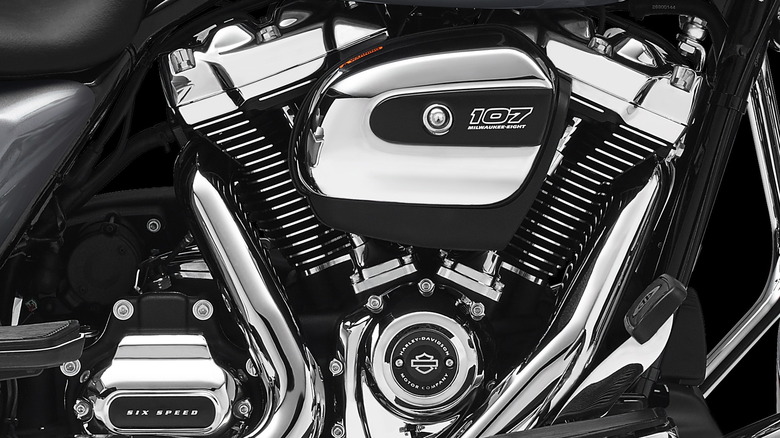
Harley-Davidson unveiled its newest V-twin engine almost a decade ago and named it the Milwaukee-Eight for having four valves per cylinder (for a total of eight). It was an all-new engine on both the inside and outside, but it retained the iconic 45-degree V-twin look of its Twin Cam predecessor. But unlike the Twin Cam that had powered various Harleys since 1999, the Milwaukee-Eight is an entirely different beast.
The goals of the Milwaukee-Eight's design and engineering are to produce more power and torque while sipping less gas, be as reliable as clockwork, and to spew fewer emissions while at it. To achieve those, Harley engineers had to rethink the engine's heat management, since producing more power and raising the compression ratio produces more heat. For reference, the Milwaukee-Eight produces 11% more torque while weighing the same as the Twin Cam, and the compression ratio is as much as 10.5:1.
Another defining characteristic of the Milwaukee-Eight is having two spark plugs per cylinder. Dual ignition four-stroke engines with eight plugs have been around for a while, and it's about improving performance, efficiency, and emissions. It's the same deal with the Milwaukee-Eight, but it also has to do with reducing heat by speeding up combustion. With two plugs per head, the Milwaukee-Eight burns the air and fuel mix quicker, and having two exhaust valves means the hot combustion gases can escape faster out of the chamber and keep things cooler.
Mitigating heat buildup and producing a more efficient burn
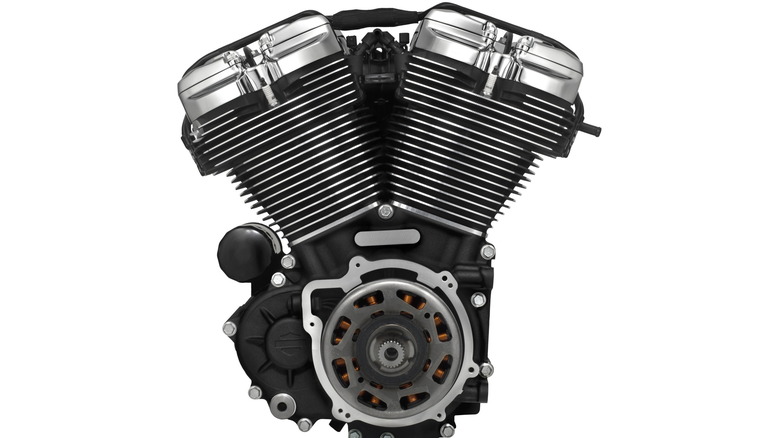
Since Harley-Davidson engineers were looking to expedite combustion to reduce heat buildup, having dual plugs per head that fire simultaneously ensures a more complete burn. Along with having four spark plugs, Harley-Davidson abandoned the previous hemispherical two-valve head design of the Twin Cam and gave the Milwaukee-Eight a redesigned, flatter chamber with four-valve heads to reduce the surface area to which heat can accumulate. They also improved the airflow into the engine by 50%, primarily motivated by a larger 55-millimeter throttle body. The result wasn't one of the most expensive Harley-Davidsons or the most iconic H-D motorcycles. It just worked.
Depending on the configuration, the Milwaukee-Eight can have oil or liquid-cooled cylinder heads and a cooling strategy that targets the hottest parts of the cylinder heads. To reduce heat absorption and to deliver a comfier ride, Harley-Davidson relocated the exhaust pipe and catalyst while lowering the idling speed to 850 rpm from 1,000 rpm. The dual spark plug design not only helps in reducing heat buildup, it also lets the engine burn less fuel.
Although having four spark plugs is not primarily about adding more power, the Milwaukee-Eight's systematic heat management gave it an extra jolt of power and torque. According to Harley-Davidson, the Milwaukee-Eight 107 is 11% quicker than the Twin Cam High Output 103 from 0 to 60 and 60 to 80 mph in top gear, while the Milwaukee-Eight 114 is 8% quicker from 0 to 60 and 12% quicker from 60 to 80 than the old Twin Cam 110.