

The World's Weirdest Rotary Engine Is A 118-Year-Old French Spinner That Leaks Castor Oil Everywhere
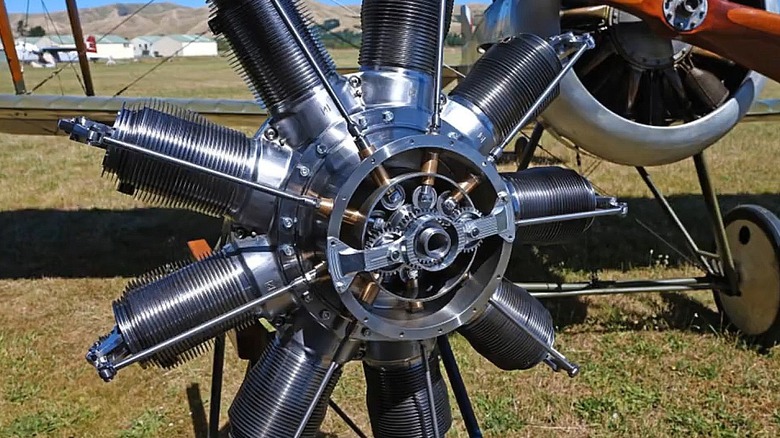
While modern engines feature many tweaks and improvements on the original ideas, they usually aren't as interesting as the strange contraptions engineers experimented with in the early days. Take, for instance, the curious Gnome engine, used as the power plant in some World War I aircraft. It was introduced in 1908 by manufacturer Societe des Moteurs Gnome et Rhône, an organization created by French brothers Laurent and Louis Seguin.
The Gnome is considered a rotary engine but is far different than the one later perfected by German engineer Felix Wankel. Wankel's creation utilized a triangular rotor that spins inside an oval housing, allowing for open pockets to facilitate the steps of the combustion process. This would eventually become the foundation of Mazda's most famous rotary-powered car. While the Wankel engine does not include cylinders, the Gnome engine does, but not like you may be thinking.
The air-cooled 8.01-liter seven-cylinder Gnome Omega engine could generate around 50 horsepower at 1,200 rpm, though later iterations would produce more power. But wait, if there are cylinders it can't be considered a rotary engine, right? Well, the Gnome worked by spinning the cylinders and crankcase around a stationary crankshaft. At first glance, it looks a bit like a wheel's interior frame, except that instead of spokes, what's rotating are thick, stubby cylinders. And there's all that castor oil.
How did the Gnome rotary engine work exactly?
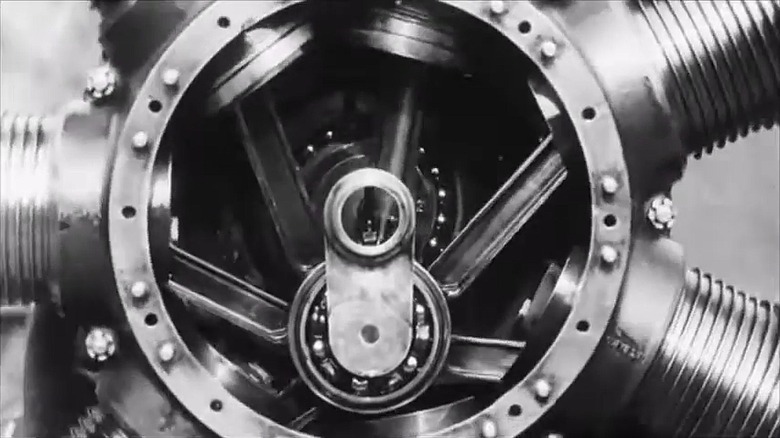
The Gnome's design was straightforward. There was no carburetor, and each cylinder featured a single valve. The process begins with the piston moving down and valve opening, until around two-thirds of the upper cylinder is full of air, and then the valve slams shut. Vacuum pressure pulls in fuel-heavy combustion material as the piston moves up creating a compressing force, until the spark plug creates ignition, just beneath top dead center. Energy is then generated, with the valve opening before the piston reaches its lowest position, exhausting the cylinder.
The Gnome had some quirks, though, that made its control of speed a bit unorthodox. The brothers first tried regulating fuel disbursement to permit various engines speeds, but were unsuccessful. They tinkered with using the camshaft timing, but its complexity ended up nullifying one of the Gnome's major advantages, its simplicity. The most straightforward approach ended up being a simple on-off ignition: The Gnome essentially had two states, on or off.
Various iterations of the engine ended up being installed in many aircraft, including Sopwiths, Nieuports, and Moranes. In fact, according to the National Air and Space Museum, by the time World War I was over, over 20,000 Gnomes of different variations were built. Of course, with powered flight still relatively new, aircraft looked vastly different than they do today. Just look at Boeing's first airplane, a tiny seaplane called the B&W.
What happened to the Gnome rotary engine?

While the Gnome power plant saw a lot of action in World War I, it didn't have much staying power beyond that. For one thing, while its spinning motion provided adequate air-cooling, it also made certain flying maneuvers more challenging. For example, pilots reported difficultly with right turns, whereas left turns were easy. As you can imagine, in a combat scenario this quirk would be unfavorable for evasive action.
Even worse, the Gnome used castor oil for lubrication because it burns cleanly, and centrifugal force made its total-loss oil system spit unburned oil out as it was running. Combine that with the speed achieved during flight and pilots in those early airplanes' open cockpits would get covered in an oily residue of engine fluid — potentially embarrassing in other ways, too, since castor oil is a laxative.
The Gnome's design limited its potential, particularly in how much power was possible, considering it couldn't realistically be made much larger. It certainly could never be adapted for an automotive application, and other aviation engine configurations were improving beyond the Gnome's capabilities. While a marvel considering the technology at the time, the Gnome now lives in the pages of history, outside of a few hobbyists who have built replicas. However, the Gnome is far from the only bizarre power plant design to come out of the 20th century; the weirdest engine you'll read about today is the Sarich Orbital.