

Here's Where Automakers Freeze Their Lugnuts Off For Cold Weather Testing
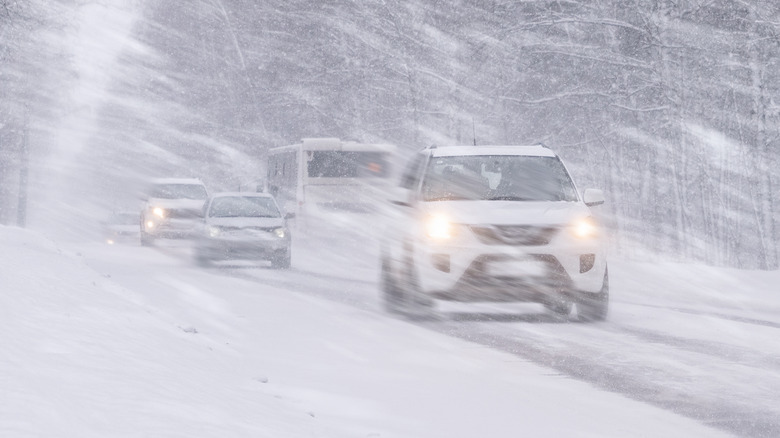
For those of you living in a place like San Diego, you probably experience nearly the same climate year-round. Designing and engineering an automobile to work in average weather conditions isn't a challenge. But many, many more people have to deal with rain, snow, sleet, and extreme heat or cold temperatures. For customers living in those areas, automakers have to test their cars in all environments. And in the world of winter testing, that means they'll have to go somewhere cold.
Automakers can simulate nearly any climate or condition in a controlled way through environmental chambers at their test facilities. The one Nissan uses at its technical center in Farmington Hills, Michigan, can go as cold as -40 degrees (both Celsius and Fahrenheit) or as hot as 80 degrees Celsius (176 degrees Fahrenheit). On top of that, the operators can independently control humidity; Mercedes-Benz operates a wind tunnel that can simulate a blizzard. But nothing beats real-world testing, and that's why automakers still drag their cars to some of the most extreme places on Earth to test.
So where do they go when they want to freeze their proverbial lug nuts off to test in the cold? Mostly places you already expect, like Alaska, Sweden, or Canada. But a few of those tests are performed in much stranger places, with one brand even doing it in Florida.
Tesla goes to Alaska
Some have criticized Tesla for designing cars for use only in California. But the company does travel to cold places to test its cars, and it has taken journalists there in the past. Located near Delta Junction, Alaska, Tesla's massive facility sports a giant asphalt oval. There are groomed snow and ice surfaces designed for testing traction and stability. There are iced gradients to help owners get up a frozen driveway on a hill, and there's even a giant skid pad.
In addition to testing performance and handling on ice and snow, Tesla tunes other systems to ensure everything works when ambient temperatures head deep into the negative. That includes tuning the HVAC system to ensure it can actually warm the cabin in cold weather. Of course, EV automakers also perform tests to ensure their cars can charge in extreme cold. But even with those tests, sometimes there are still issues, like when EVs died while waiting to charge in Chicago's longest cold snap in years.
Volvo goes to the Swedish Laplands

At approximately 150 kilometers north of the Arctic Circle, Kiruna is home to Volvo's winter testing facility in its home country of Sweden. Located near the airport, the facility is where the company completes final testing on many of the vehicles it has already revealed. Being so public and so close to a small town, keeping prototype cars under wraps there is difficult, so Volvo also uses other facilities throughout the area.
Kiruna is a mining town, like many communities in far northern Sweden, and is actually undergoing a transformation. Over the past few years, officials have been building a new city near the current city, where everyone will relocate. The expansion of the ore mine makes the current city unsafe. Wild. One of those more secret facilities Volvo uses is at Jokkmokk, which is a military base. Security is tight, and the last thing the automaker wants is spy photographers catching something too early.
There's more happening in Sweden

South of Volvo's exclusive facilities lies Arjeplog, where nearly every automaker tests cars. The population of the town quadruples during the winter months as engineers flock to the region's frozen lakes and accommodating facilities. Because the people visiting outnumber the number of available hotel rooms, locals have set up places for these people to rent out, providing some extra income to people in the community.
While there might not be exclusivity here, automakers are said to work together to ensure that testing runs smoothly for everyone. Engineers quickly become friends, even between rival brands. The town is so famous that it was even featured in an episode of Top Gear:
Nearly every European automaker tests there, including Jaguar and Audi, as well as some Asian manufacturers and even some tire suppliers, including Bosch and Continental. Like Alaska for Tesla, it's an easy location for them to reach, and it has some of the coldest temperatures on the planet. That should be more than enough to account for whatever temperatures customers might encounter.
There are more places to test
For American automakers, testing in Alaska or Canada makes more sense than loading cars onto a boat for a trip to Europe. The Brimley Development Center in Northern Michigan is a place where many automakers test in the winter, and it's also where suppliers like Continental put tires to the test. (The best snow tires aren't going to develop themselves.) For many American brands, a trip to the Upper Peninsula for testing purposes is easy, as long as it's cold enough and there's enough snow.
But as mentioned at the beginning, environmental chambers can provide much of the data these companies need. At Volvo's Kiruna facility, these chambers dot the landscape and are used if it doesn't get cold enough. Ford even conducts some of its winter testing in these types of chambers at Eglin Air Force Base in Florida, which certainly provides one way to cool off from the Florida summer heat.
Where an automaker ultimately tests depends on the location's convenience and the weather conditions there. While some parts of the globe get colder than -40 degrees, most automakers don't sell in Russia, and Antarctica doesn't exactly have a wide consumer base. Most of the customers buying these vehicles will never drive in that sort of cold, but it's important to account for those fringe cases. Those engineers freeze their lug nuts off so you hopefully won't have to freeze yours thanks to a car that doesn't work.