

2026 Jeep Grand Cherokee's 324-HP Hurricane Turbo-Four Is Powerful But A Bit Unrefined
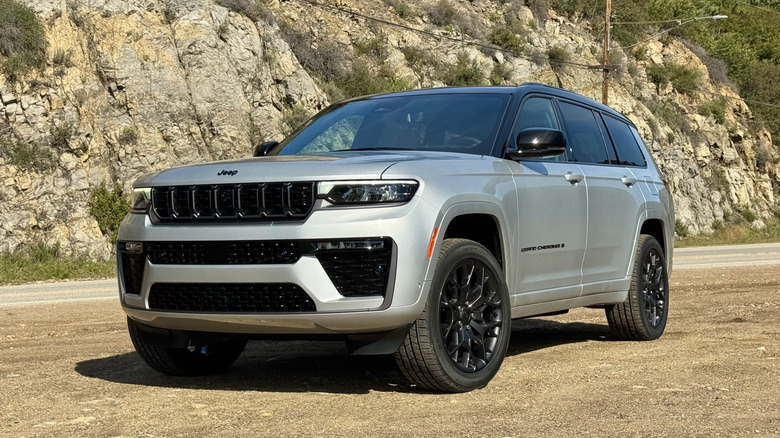
Let's be real, a turbocharged 2.0-liter four-cylinder engine is not exciting anymore. They're the go-to powerplant in most new cars across virtually every segment from sports cars to pickup trucks, but Stellantis is hoping its new Hurricane turbocharged 2.0-liter four-cylinder engine will make a splash.
This zesty and innovative little engine makes its debut in the 2026 Jeep Grand Cherokee and Grand Cherokee L. It runs on regular gas, produces a respectable 324 horsepower and 332 pound-feet of torque, and is capable of towing up to 6,200 pounds in rear- or four-wheel-drive configurations. While the Pentastar V6 remains the standard powertrain for the two base trims (and the plug-in-hybrid 4xe is sadly dead), the new turbo four is used in all other Grand Cherokee and Grand Cherokee L trims for 2026. The Grand Cherokee is Jeep's biggest seller by a huge margin, so this new engine had better be good.
Full disclosure: Jeep invited me out to the currently emerald-green hills of Malibu to drive its new 2026 Cherokee, and tossed in a chance to sample the Grand Cherokee's new Hurricane powertrain. I only had about an hour with the Grand Cherokee, so this first drive review is mostly focused on the viability and character of the new engine.
Let's cut to the chase
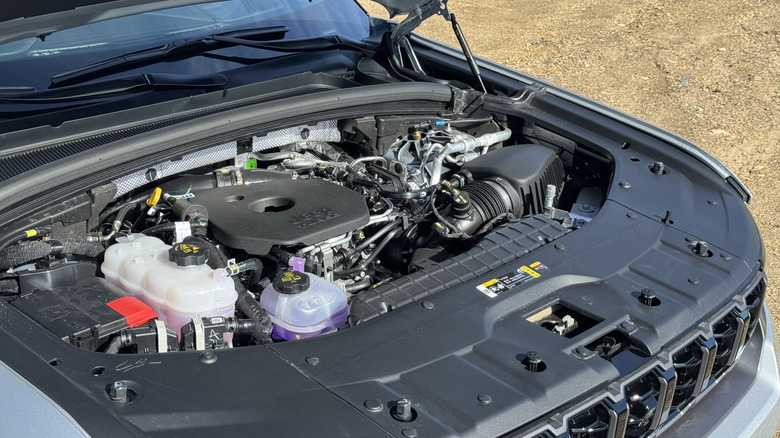
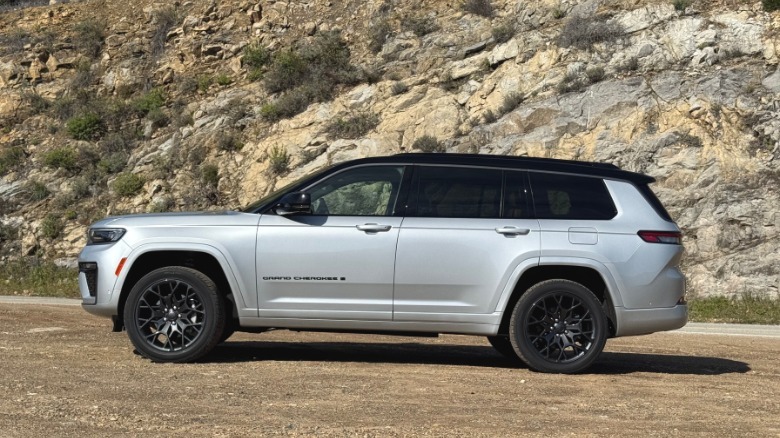
Prior to my extremely brief time with the 2026 Grand Cherokee, I doubted the little turbocharged four-cylinder's ability to adequately power a vehicle as beefy as the Grand Cherokee, let alone the larger three-row Grand Cherokee L that can weigh as much as 5,068 pounds. I climbed behind the wheel of a top trim 2026 Grand Cherokee L Summit to see what the little four-popper had to say about lugging around all that weight.
The first thing I noticed was that it sounds and feels like a diesel at idle and low rpm, with lots of clatter and a slightly rough demeanor. I also noticed that despite Jeep's claim that it produces 90% of peak torque from 2,600-5,600 rpm, it feels pretty gutless below 3,000 rpm. Once the digital tachometer needle climbs above 3,000 rpm, the variable geometry turbocharger clocks in and launches the Grand Cherokee's nose into the air. When the Hurricane is in its power band, it does a great impression of a turbocharged six-cylinder, with more than enough oomph for duty under the long, tall hood of this 2.5-ton three-row hauler.
 Logan K. Carter/ Jalopnik
The standard engine for the 2026 Grand Cherokee remains Stellantis's venerable naturally aspirated 3.6-liter Pentastar V6 that produces 293 horsepower and 260 lb-ft of torque, but now it's only under the hood of base Laredo and Laredo X models. All other trim levels — Laredo Altitude, Limited, Limited Reserve, and the top Summit — are powered by the Hurricane as the only choice. Though all 2026 Grand Cherokees have an eight-speed automatic transmission, Pentastar-equipped SUVs feature a Torqueflite 8HP70 eight-speed, and Hurricane-powered models receive a Torqueflite 880RE/8HP80 with revised gear ratios.
In the Hurricane-powered Grand Cherokee L Summit that I drove, the transmission felt too eager to upshift into higher gears in the Auto drive mode. This meant I had to push my right foot deep into the throttle to get it to downshift and access the swell of torque from the little turbocharged four. When it's in the right gear, though, the new powertrain is a winner. Fuel economy gains aren't all that impressive; it returns between 1 and 2 mpg better than the Pentastar does, for 21 mpg city, 27 mpg highway, and 23 mpg combined in rear-wheel-drive Grand Cherokees. (The highway number drops by 1 mpg when you go for four-wheel drive.) Regardless of drivetrain, the Pentastar gets 19 mpg city, 26 mpg highway, and 22 mpg combined.
 Jeep
Jeep
Smaller engine aside, the Grand Cherokee still feels heavy and purposeful to drive, which seemed befitting of a big SUV. The brake pedal was similarly firm, and required a bit more pressure than I expected, though they brought the thicc Grand Cherokee L to a halt just fine. The Hurricane makes its presence known at high engine speeds, but the interior is a serene leather-lined cabin when you're just cruising.
Jeep changed more than just the engine
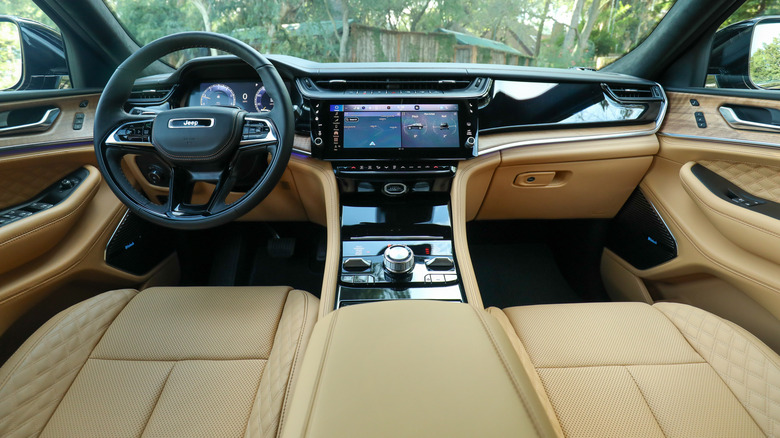
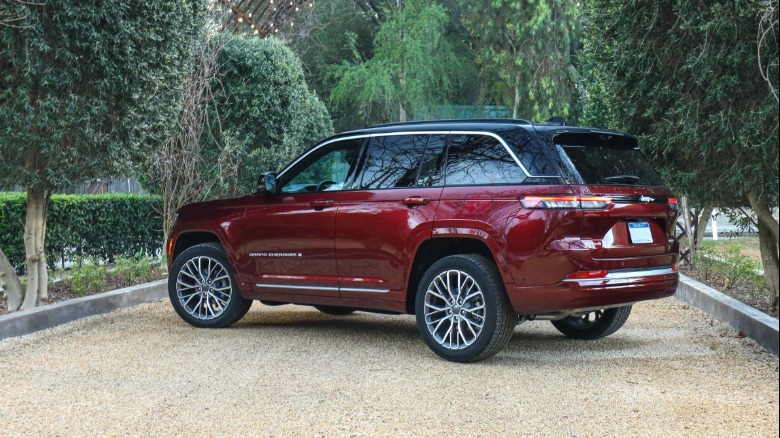
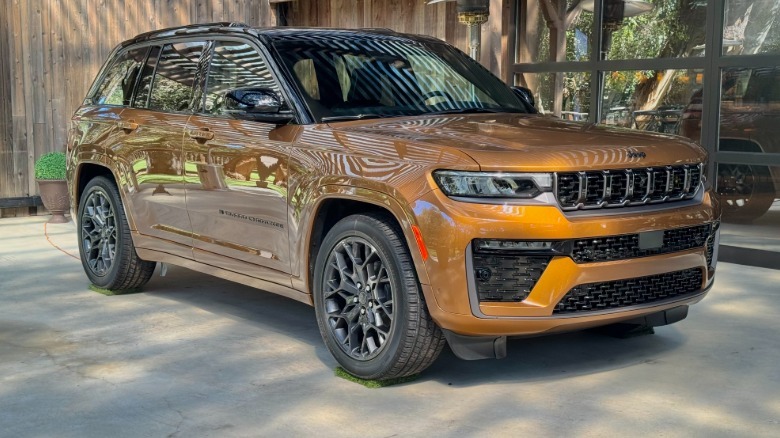
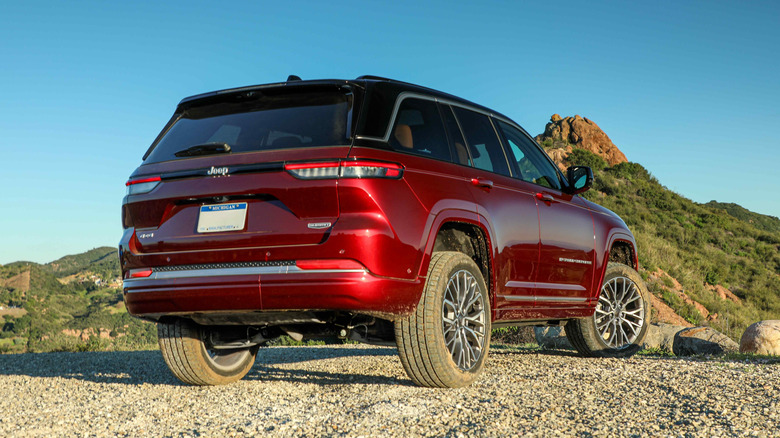
Other updates for the 2026 Grand Cherokee include a lightly refreshed exterior and a reworked interior with more technology, as well as a simpler trim structure and three great new paint colors. Pentastar-powered Laredo and Laredo X Grand Cherokees don't get any updates for 2026 aside from more standard features, so they still feature the old interior and exterior styling, not that it's an especially big difference. Those Laredos retain the 8.4-inch infotainment screen, but all other trim levels get a new 12.3-inch infotainment screen.
All Grand Cherokees now come standard with more safety features including Active Lane Management, blind-spot monitoring, rear cross-traffic detection, and automated emergency braking. The Laredo X trim is a half-step above the base Laredo, and brings with it standard heated seats, a heated steering wheel, a sunroof, a power liftgate, and a wireless charging pad.
 Logan K. Carter/ Jalopnik
Most 2026 Grand Cherokee trim levels are available with either rear-wheel drive or with Jeep's Quadra-Trac I four-wheel-drive system, but the Limited Reserve trim is only available with Quadra-Trac I, and the range-topping Summit trim exclusively features Jeep's Quadra-Trac II four-wheel-drive system and air suspension.
Dropping two cylinders doesn't drop the Grand Cherokee's appeal
Pricing for the 2026 Grand Cherokee doesn't change drastically, but some trims have gone up in price while others have gone down. The base 2026 Grand Cherokee Laredo starts at $40,410 including destination, and the Laredo X starts at $42,905. The Laredo Altitude with the Hurricane turbo four starts at $45,850, the Limited costs $45,810, the Limited Reserve is $53,405, and the most-expensive Summit trim comes in at $62,190. That means Laredo pricing has increased by $780, Laredo X increased by $2,525, Limited increased by $410, and top Summit trim has actually decreased by $2,845. Opting for the three-row Grand Cherokee L adds $2,000 on all trims.
Overall, the 2026 Jeep Grand Cherokee and Grand Cherokee L are still compelling choices for car buyers seeking a rugged and capable midsize crossover, regardless of how many cylinders are under its hood. Other than the powertrain its updates for 2026 are minimal, but the Grand Cherokee still feels fresh, and yes, it still feels like it can take you anywhere you want to go, paved or otherwise.