

How Traffic Light Sensors Detect Your Car
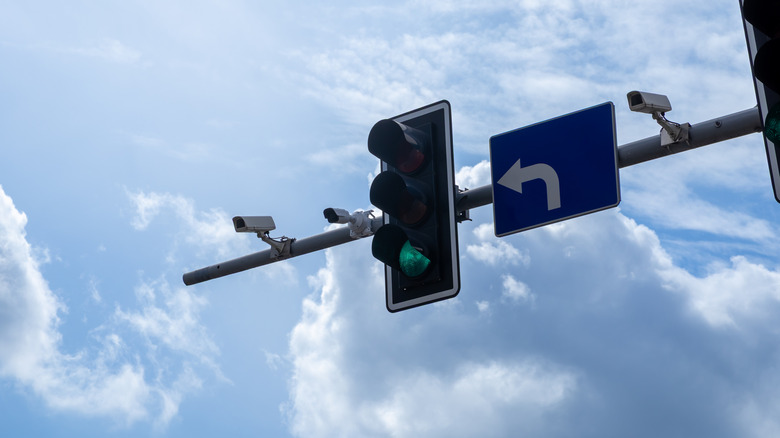
You might think traffic light systems are fairly basic. After all, electric traffic signals first appeared all the way back in 1914. However, they have advanced significantly since their inception, with the ability to sense and monitor traffic in several ways. Granted, not every new step has been beneficial, as some pedestrian traffic signals confuse drivers, but you might be surprised at just how much tech is present along the streets of your community.
For congested urban thoroughfares, signals can often be on a timer, which is the simplest system. These roads typically have a continual flow of high-volume traffic, so more sophisticated measures aren't needed. However, intersections outside of downtown — such as the surrounding suburbs and less-populated county roads — may employ a myriad of sensors. These sensors come in the form of cameras, radar, infrared, and in-road detection methods like an inductive loop. The one place where these measures aren't used is Bhutan, which is the only country without traffic lights.
All the data then goes into a metal box called a Traffic Signal Control Cabinet, which is located somewhere near the signal pole. Inside, amidst a plethora of carefully organized wires, you'll find a computer system and a conflict monitoring system. Officials can not only monitor how the system is adjusting conditions to facilitate more efficient traffic flow, but can also tap in with a laptop, getting the video feed from the various cameras. The conflict monitoring system is designed to find any problems in the system, whether they're coming from external sensors or within the cabinet itself.
Inductive loop sensors are buried in the street surface
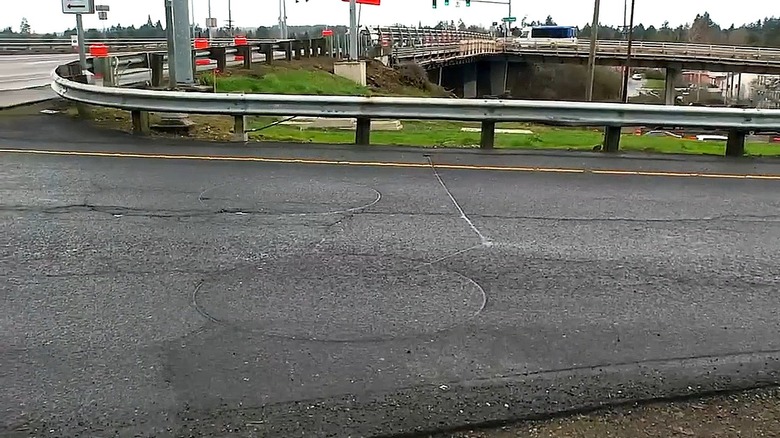
When slowing to stop at a red light, you might have noticed that the pavement near the white line often features rectangular shapes or loops carved into the surface. These lines are actually a result of road crews sawing into the pavement and installing a wire, which creates a weak electromagnetic field. The presence of a significant amount of metal (such as a car) changes the properties of that field. This change is sent to the Traffic Signal Control Cabinet, which processes the data and prompts the corresponding traffic light to react.
While these inductive sensors work reliably, they aren't foolproof, as motorists can fail to trigger the system. An inductive sensor isn't "smart," as it requires two things to function properly: the vehicle must stop directly over the sensors, and it must be comprised of enough metal to facilitate a change in the electromagnetic field. Basically, if you don't stop in the right place on the road, or if you're utilizing a smaller vehicle like a motorcycle, the system might not realize that you're there.
Radar, infrared, and video camera sensors
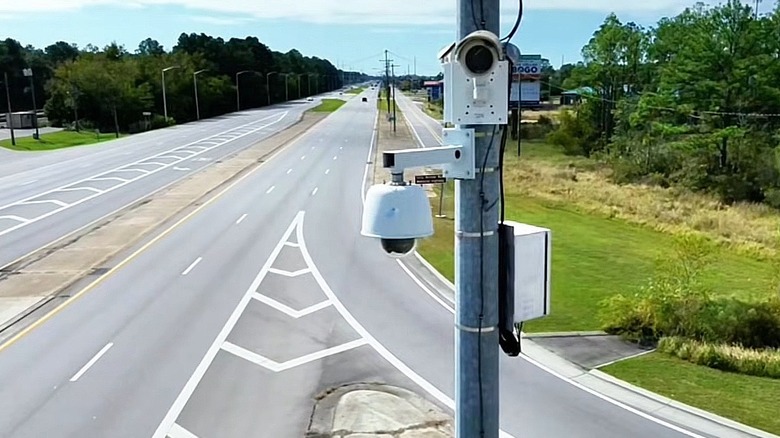
The inductive loop method is simplistic compared to other high-tech detection tools you can often spot installed on the pole near the signals. A microwave radar system looks like a small box mounted on the same pole as the traffic signal. It sends out an invisible beam, which is pointed out towards the oncoming traffic heading for the intersection. On top of these microwave radar systems being easier to install than inductive loops, they can also provide the controller cabinet with all sorts of data, including the amount of traffic and the speed of passing vehicles.
Infrared sensors are either active or passive. The former sends out an invisible beam that, when interrupted (such as when a car travels through it), recognizes the presence of motorists. The latter doesn't send out a beam; instead, it detects the increase in heat radiating from vehicles in operation.
Cameras can also be used to help control traffic flow through intersections. These are clearly visible near the signals or mounted on the vertical section of the traffic pole. Of the cutting-edge approaches to intersection management, cameras are considered among the most sophisticated, partially because they include software for identifying objects. In addition, some traffic systems include 360-degree cameras, which can be remotely controlled by officials for additional traffic monitoring capability. Despite the technology, though, you'll probably still need to wait a bit for the light to change. In a bid to save time, some motorists might try to avoid a traffic light by rat running, but you should know that such maneuvers are illegal in many U.S. states.