

GM Introduced Airbags So You Wouldn't Have To Use A Shoulder Belt
European automakers are typically renowned for kick-starting the automotive industry's obsession with safety. For instance, Volvo was the first automaker to introduce a laminated windscreen in 1944 with its PV444. It was also the first production Volvo with unibody construction (which is when the architecture has no separate chassis, unlike a body-on-frame). Meanwhile, Mercedes-Benz has a few safety milestones; it received patents for the crumple zone in 1951, anti-lock brakes in 1978, electronic traction control in 1985, and the surround view system in 2012 — features that now come standard in modern cars. Mercedes also garnered patents for front airbags with belt pretensioners in 1971, but the three-pointed star was not the first brand to have airbags in a production car.
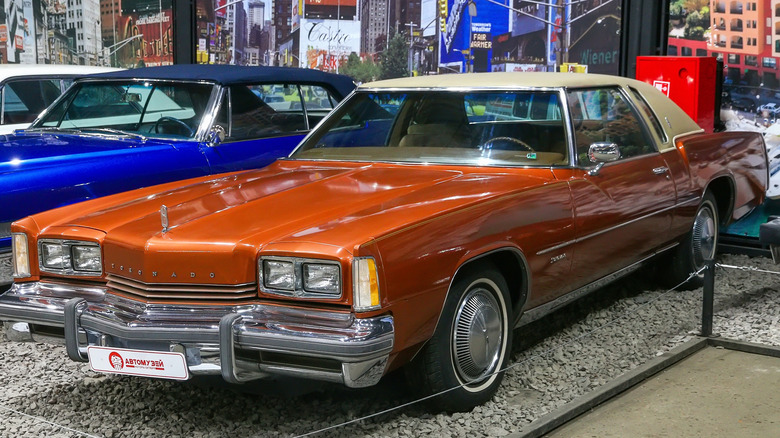
Despite earning patents for airbags in the early '70s, it wasn't until 1981 that Mercedes introduced the 126 S-Class sedan, its first production car to come with a driver's airbag and belt pretensioner. Meanwhile, American carmaker General Motors has been dabbling with airbags since 1972, and it even built 1,000 Chevy Caprice and Impala variants with experimental airbags and distributed them to fleet customers for testing. By 1974, GM introduced the world's first production car with airbags: the Oldsmobile Toronado, one of the most powerful Oldsmobiles ever made.
The airbags, or what GM referred to as the air cushion restraint system (ACRS), consisted of separate units for the driver and front passenger, but that's not the quirky part. Although the Toronado was more renowned for its styling, unibody construction, V8 power, and front-wheel drive platform, what caught our eye was how GM originally marketed the ACRS to be a viable alternative to seat belts, effectively seeking to make them optional. But if you drove those older models, you wouldn't want to rely on those airbags for safety.
Early airbag designs were pretty dangerous
Airbags may initially sound soft and cuddly, but they deploy with violent force. Early airbag designs were pretty quick, bursting out of the dashboard at 100-200 mph, and they were engineered with no regard to whether the driver or passenger was fastened by seat belts. By 1984, the federal government ordered carmakers to install airbags and other automatic passenger protection devices in new cars by 1989, though it was willing to lift or ease the new safety regulations if states enacted mandatory seat belt laws.
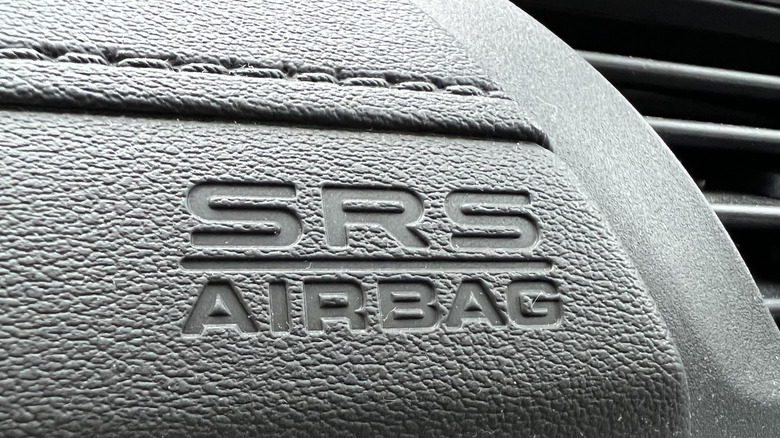
Sometime around 1995, though, data showed that airbags were hurting or killing passengers in some low-speed crashes — and it all had to do with the victims not wearing their seatbelts during the crash. As it turns out, passengers were being thrown forward violently during impact or hard braking before a crash, and the airbag (or airbag door) was fatally striking their face and/or body. By 1985, driving with seat belts became mandatory in New York (despite cars having standard seat belts since 1968), and regulators approved lower-powered airbags in 1997 to address the injuries and death cases related to airbag deployment during a crash. That's why airbags have the SRS label; it stands for supplemental restraint system, since it's only supplemental to proper seat belt use.
As for the Oldsmobile Toronado's air cushion restraint system, GM dropped the optional airbags in 1976, just three years after fitting it to Cadillac and Buick models. GM expected to sell 100,000 cars with ACRS, but only 10,000 units with airbags left the factories. GM tried a new safety innovation in 2013 with the front-center airbag, and it's now a common feature in many new cars.