

Automakers Have A Long, Annoying History Of Trying To Replace The Gear Shifter
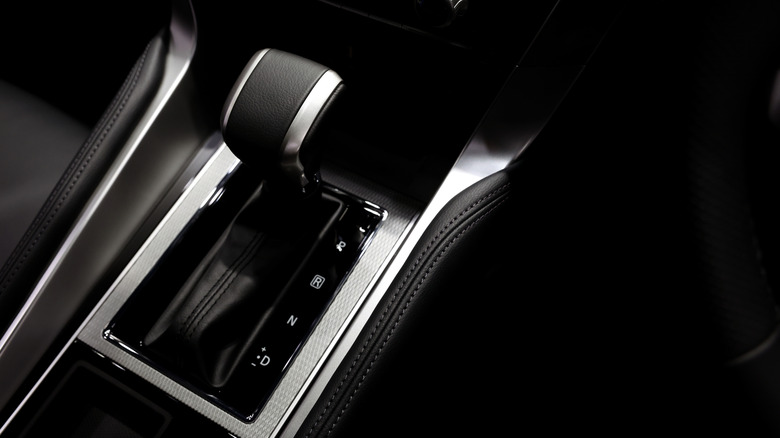
It seems like carmakers have some sort of beef with the traditional shift lever. Whether it be through rotary dials, fancy knobs, or crystal shift orbs (looking at you Genesis), manufacturers have — rather annoyingly — taken a keen interest in re-inventing the once familiar "PRNDL" automatic shift sequence. As you might expect, the vast majority of consumers are becoming increasingly frustrated by this exercise. What was once muscle memory is now a two- or three-step process.
This, mind you, is not specific to 21st-century motoring. Before the NHTSA (National Highway Traffic Safety Administration) was even a thing, Chrysler, Mercury, Packard, and AMC all had a go at push-button gear selectors. The sequence was all over the place and non-uniform until the "Standard Gear Quadrant (PRNDL) For Automotive Vehicles" rule (which you can read here) was brought into effect in 1966, first for federal vehicles and later for passenger vehicles. Manufacturers went back to levers years prior (for business reasons), even though the law did not invalidate push-button selectors nor mandate a traditional lever. But it did standardize the PRNDL shift sequence.
It's not like the NHTSA's modernized take on the law (FMVSS 102) is radically different from what it was in the past. Per the standard, manufacturers can still make cars without a traditional shift lever as long as Neutral is placed between Park and Drive, among other requirements. But there's nothing that specifically prohibits the use of these new-age shift designs. That's why "PRND" is still the shifter standard in cars, albeit packaged in the weirdest and most wackiest of ways.
Innovation at the expense of safety?
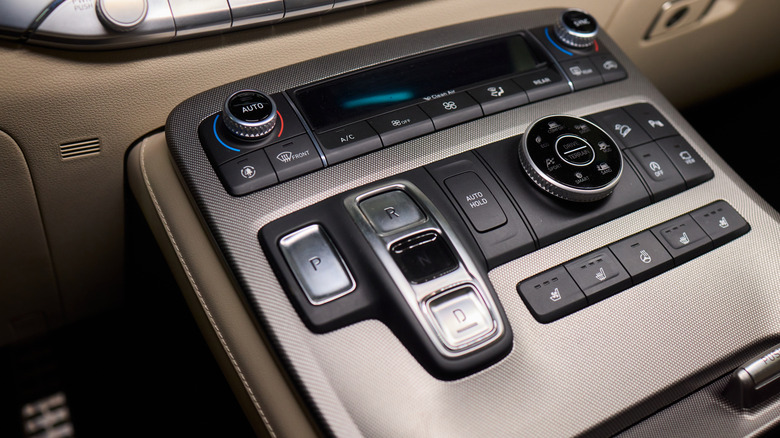
Certain shifter designs are so nonintuitive that they require re-wiring your brain. Re-inventing the gear selector was certainly not something that anyone asked for, with Consumer Reports even going so far as to penalize certain carmakers for gear shifters that are confusing or difficult to use. Unconventional shifter designs can sometimes be a safety hazard, as noted by one of Consumer Reports' test drivers in a Rivian R1S. In this example, the vehicle shifted into Reverse while the driver attempted to disengage the adaptive cruise function.
Sure, having an electronic shift-by-wire mechanism (seen in rotary shifters, for example) comes with perks like reduced complexity, weight, and space requirements. However, implementing it through twist-style knobs, rotary dials, or even via touchscreens (like in modern Teslas) is where drivers express frustration. Surprisingly, the NHTSA did not find Tesla's touch-based gear shift controls to beviolating any of its safety standards, as noted in a statement made to The Verge. However, the agency did get numerous complaints about certain Stellantis vehicles and their rotary gear shifters. But it closed the probe, citing a lack of evidence.
These so-called innovations make it feel as though history is repeating itself. If the '50s and '60s are anything to go by, it's easy to assume that at some point, manufacturers might just go back to traditional levers. After all, some car brands acknowledged that shoehorning everything into a touchscreen is not necessarily making life any easier.