

5 Manual Transmission Cars That Can Out-Accelerate Their Automatic Siblings
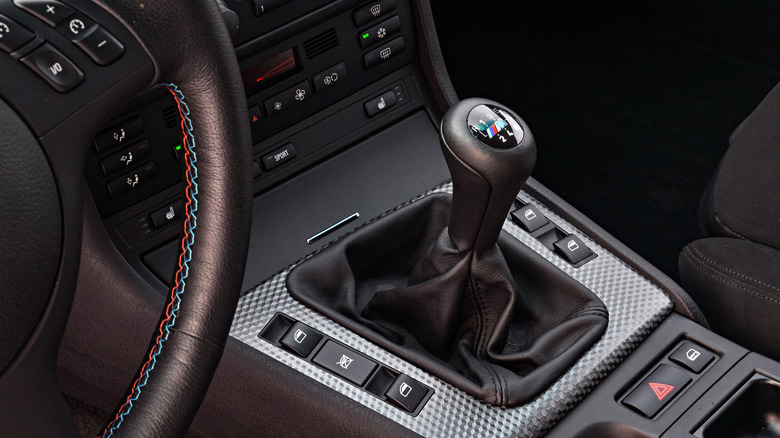
In the world of modern performance cars, the manual transmission is gradually becoming obsolete. In fact, here's a list of the few cars you can get with a manual in 2025. There's a simple reason for this: most modern automatic transmission-equipped cars are quicker than their manual counterparts. These days, cars like the McLaren with a dual-clutch setup can execute gearshifts in mere milliseconds.
It wasn't always like this, and in some obscure automotive spaces, it still isn't. After all, there was a reason why automatic gearboxes were called slushboxes. These gearboxes focused on comfort rather than outright performance. Most early performance gearboxes used torque converters, which sapped power due to fluid friction, and had poor gas mileage. Manufacturers back then focused on EPA cycles for the best possible fuel economy, and automatics used tall gear ratios for better fuel efficiency.
Manuals of that era were just more engaging. If you were skilled enough, you could dump the clutch and hold gears, and shift to the next gear quicker than an automatic. While today's manufacturers offer manual options for the experience, there are a few instances where these boxes turn out to deliver better performance than their automatic counterparts. Driving a stick shift will also teach you a lot more than an automatic ever will. Let's check out a few modern models — and some older ones — with manual-equipped versions that are quicker.
1. Mazda MX-5 Miata ND
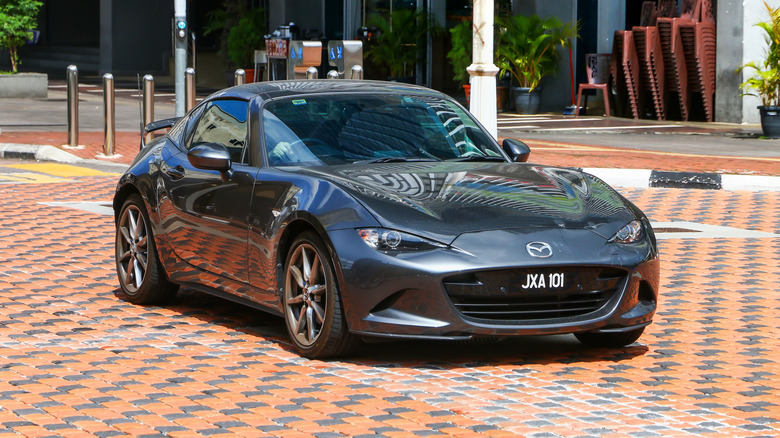
Acting as a fantastic poster child for the "Save the manuals" movement, the modern Miata makes a strong case for stick shifts. In its fourth-generation (ND) avatar, Mazda engineers have made the manual so good that it makes the automatic option feel like a letdown. The manual features comparatively shorter gear ratios, which allow the Miata's 2.0-liter SkyActiv engine stay right in the meat of its power band every time. In fact, the manual Miata RF clocks a 0-60 mph time of 6.4 seconds, while the automatic takes an extra 0.7 seconds.
There are two reasons behind this significant gap: launch and gearing. In the manual, you can execute a high-rpm clutch dump, which the torque converter automatic simply can't replicate. Also, Mazda has geared the manual for performance and overall experience, while the automatics feature taller gear ratios for better fuel economy. With the automatic, you don't just miss out on speed; you miss out on a significant part of the Miata experience.
2. Toyota GR86/Subaru BRZ
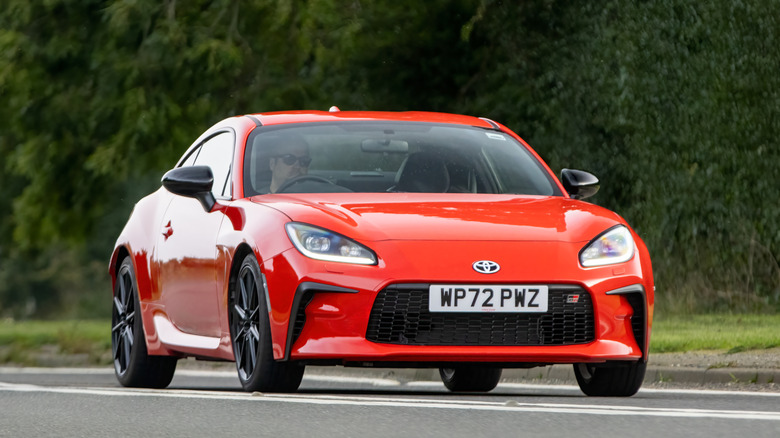
Both the Toyota GR86 and Subaru BRZ were designed from the ground up to be driver's cars. They received a more powerful 2.4-liter engine in 2022 that replaced the 2.0-liter motor, but they retained the same six-speed manual and six-speed automatic with some improvements. Car and Driver tested both the automatic and manual transmission options of the 2022 GR86. The manual GR86 hit 0-60 mph in 5.4 seconds while the automatic did it in 6.1 seconds.
This particular 0.7-second gap in acceleration numbers comes from parasitic loss and weight. The GR86 and BRZ use six-speed torque converter gearboxes. Regardless of modern torque converters suffering from some power loss, this one simply can't match the manual's mechanical efficiency. Also, the manual variant's gearbox features shorter gearing compared to the automatic models and loses about 25 pounds of extra weight. In a lightweight car with a modest output, that's enough to influence performance fairly heavily. As we've previously written, a second-gen BRZ with a manual box is a fantastic car to survive suburbia.
3. Honda/Acura NSX
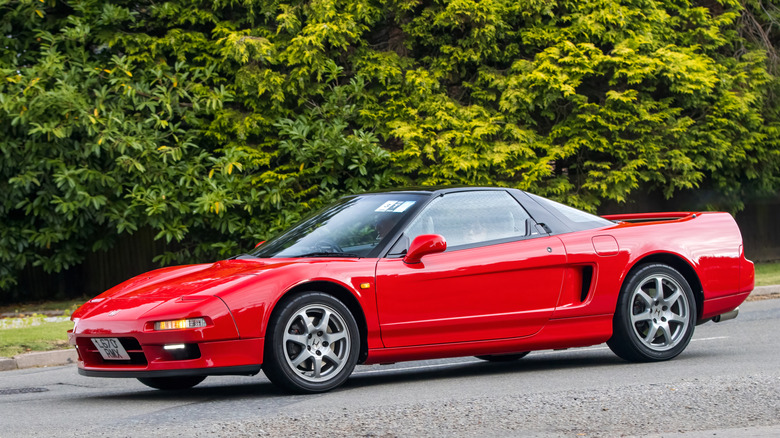
If you were old, rich, and lucky enough to purchase the original '90s Honda/Acura NSX and you opted for the manual, then you made an exceptionally smart decision. The NXS has a special throne in the halls of the best cars ever made. Developed by the legendary Aryton Senna, it was one of the purest forms of motoring you could get your hands on in the '90s, and to skip the precise and engaging five-speed manual for the four-speed automatic was practically a crime.
The gap between the manual and the automatic NSX was as wide as a canyon. The manual hit 60 mph in around 5.6 seconds, while the auto variant took close to 6.5 seconds. That was because, while the manual NSX's 3.0-liter V6 made 276 horsepower, the automatic was capped at 252 horsepower. Even the engine redline was 500 rpm lower than the manual's epic 8,000 rpm limit. The four-speed slushbox was from an era where sporty automatics were almost nonexistent. If the NSX was a Katana sword, the manual gearbox was the handle that held it up, and the automatic was more like a pair of boxing gloves.
4. BMW M3 (E46)
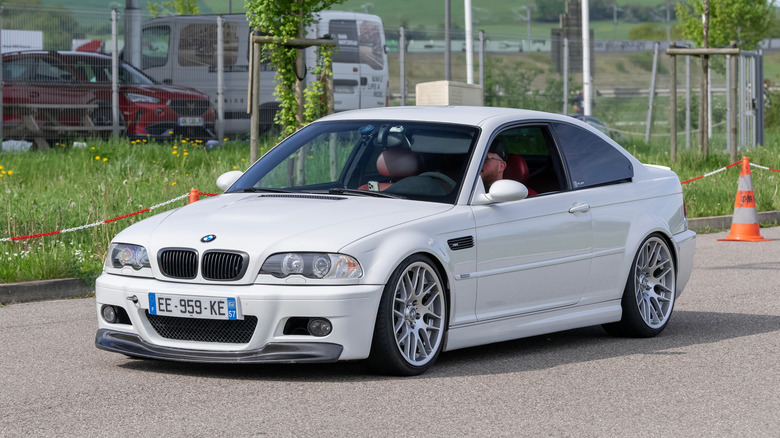
The 2000-2006 E46 M3 is one of the best BMW M cars ever made. It was also the guinea pig for the improved second generation of BMW's automated manual transmission: the Sequential Manual Gearbox (SMG). On paper, the SMG was revolutionary for the era. It used a computer-controlled clutch actuator that shifted gears in 80 milliseconds. In reality, though, driving it in traffic meant undergoing a clunky and jerky experience.
The SMG was essentially a manual gearbox with a robot attached, which made the car 18 pounds heavier. However, drivers had bigger issues with how the launch program wouldn't allow for an aggressive launch to protect the clutch components. Do it manually in the SMG and, most of the time, you had to back off the throttle to reduce wheelspin for positive forward motion.
Car and Driver tests pegged the SMG's 0-60 mph time to around the 4.8-second mark. In contrast, a well-driven M3 with a six-speed manual could hit 60 mph in as low as 4.5 seconds. The manual was faster because it allowed the driver to modulate the clutch for the least amount of wheelspin during launch. With the SMG, the gearbox had a mind of its own, leading to mis-timed shifts and dramatic delays in upshifts. Until a new breed of dual-clutch transmissions took over, the fastest BMW was the one with three pedals.
5. Porsche 911 Carrera 996 (1999)
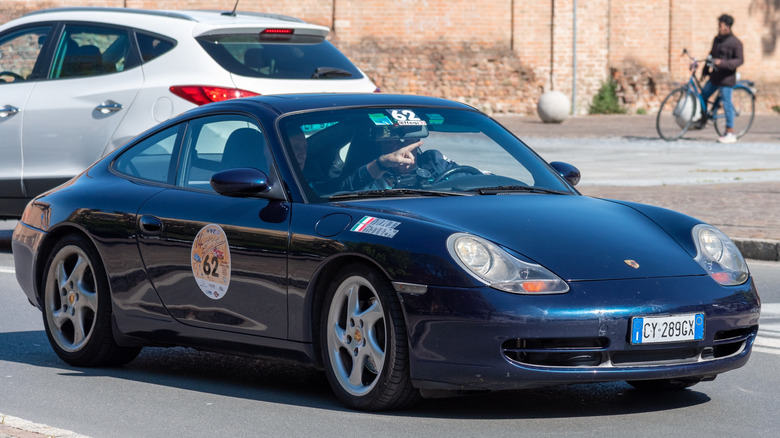
Before the legendary PDK (Doppelkupplung) gearbox, Porsche had the Tiptronic automatic transmission. In 1999, if you wanted the Porsche 911 with an automatic gearbox, you got a five-speed gearbox (or a four-speed in early 964/993) with shift buttons on the steering wheel. It was even seen on a Peugeot sedan. But in no way did the Tiptronic feel like a performance upgrade when you could instead get a six-speed manual.
A 1999 Porsche 911 with a manual gearbox could accelerate to 60 mph in 4.9 seconds. The Tiptronic-equipped one took 5.6 seconds. That's a significant gap for what was meant to be a top-tier sports car. In the '90s, Porsche's manual gearboxes had longer gear ratios to pass noise and emission tests. Despite this, the Tiptronics were so inefficient that the manuals easily out-accelerated them.
The Tiptronic was basically a torque converter with the ability to manually shift gears using buttons on the steering wheel. It simply could not keep up with the 3.4-liter flat-six motor. Even in manual mode, it would automatically upshift near the redline to safeguard the engine or switch back to automatic after a while. At this time, Porsche's automatic offerings lacked the speed and the direct engagement of manuals until the modern PDK dual clutch gearbox came along.