

Why JFK's Infamous Lincoln Continental Was Put Back Into Service Instead Of Getting Scrapped
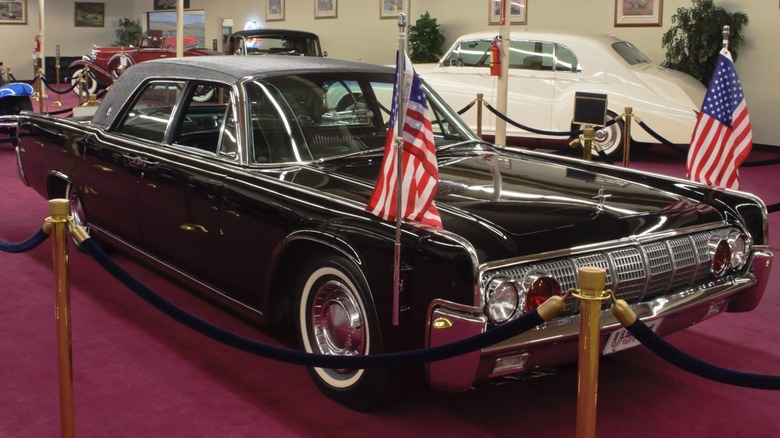
After the assassination of President John F. Kennedy in Dallas on November 22, 1963, his limousine instantly became a piece of evidence. Soon after, and for weeks following, the car was impounded, examined by investigators, and held under tight security. The car was damaged, and destroying it might have seemed a reasonable option. But the federal government faced a practical problem that outweighed symbolism, which was that there was no replacement ready.
The limousine belonged to the Ford Motor Company and was leased to the Secret Service for $500 a year. More importantly, it was the only purpose-built presidential parade car available. Developing a new one was not a quick task. The original vehicle had taken years of planning and customization involving Ford, the Secret Service, and custom body company Hess & Eisenhardt. Starting over would take time the presidency did not have.
Presidential travel could not pause as Lyndon Johnson (who was most definitely a car guy) was sworn in within hours of Kennedy's death, and the demands of the office continued immediately. The government needed a secure, functional presidential vehicle, not eventually, but now. And it couldn't just confiscate another limo from Al Capone. Confronted with that reality, the officials decided to rebuild the existing limousine rather than creating one from scratch.
Rebuilding instead of replacing
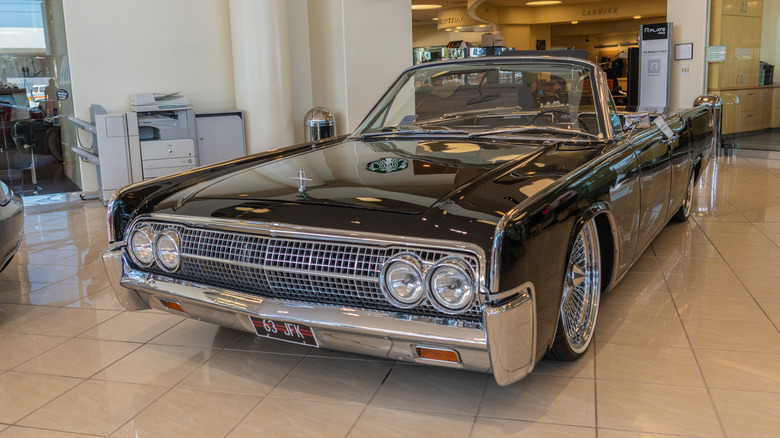
After the limo was released from the investigators' hands, a team representing the Secret Service, military researchers, Hess & Eisenhardt, and Pittsburgh Plate Glass approved a plan to transform it. The project, known as "Quick Fix," was extensive. The rear passenger compartment was completely rearmored. A permanent, non-removable roof was added to support transparent armor. Costly bullet-resistant glass replaced the original panels. Armor plating was added throughout the car to keep it protected. And finally, mechanical components were beefed up to handle the extra weight.
However, the changes weren't limited to protection. The engine was also replaced with a hand-built high-compression unit to restore performance lost due to the added mass. A second air-conditioning system was also installed to compensate for the built-up heat under the sealed roof. Communication equipment was upgraded, and the rear interior was completely retrimmed to repair damage from the shooting and accommodate the new configuration. At the request of President Johnson, the car was repainted, going from midnight blue to black.
From a financial standpoint, rebuilding also made sense. The limo had cost nearly $200,000 to customize in 1961, and the reconstruction exceeded $500,000. Even so, officials determined it was still cheaper and faster than commissioning an entirely new presidential limousine. The rebuilt car returned to service in 1964 as a hardened vehicle shaped by the lessons of Dallas.
Service, legacy, and an uncomfortable continuity
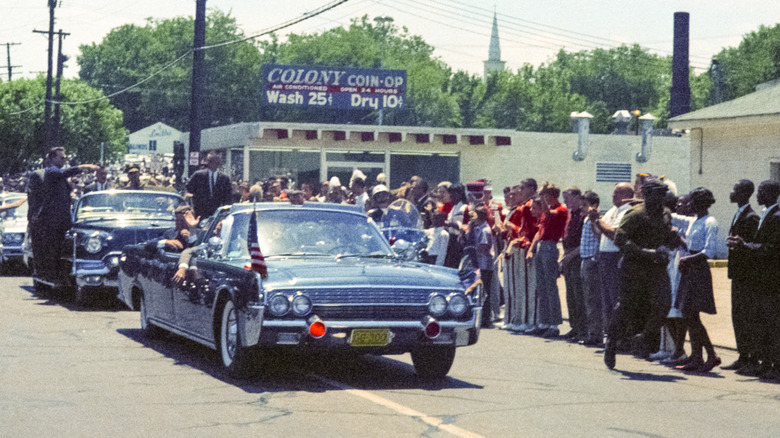
Putting the limousine back into service did not erase its past. President Johnson reportedly disliked riding in it, and his discomfort was widely understood. Yet the car remained part of the presidential fleet because it fulfilled a need. Over time, additional modifications were made, including changes requested by later presidents that reintroduced visibility features such as roof openings. The tension between security and public access never fully disappeared.
The rebuilt limousine continued to serve through multiple administrations, carrying Presidents Johnson, Richard Nixon, Gerald Ford, and Jimmy Carter. Its long service life was unusual, but it reflected how thoroughly it had been transformed. What began as an open parade car designed for visibility became a rolling benchmark for modern presidential protection. After Dallas, no U.S. president would ride in an open-top vehicle again.
When the car was finally retired in 1977, it was placed on permanent display at the Henry Ford Museum of American Innovation in Dearborn, Michigan, where visitors still stand quietly before it. The decision not to scrap the limousine preserved a physical record of how a single day reshaped presidential security and the balance between openness and protection that still defines the office.