

Advancing Federal Motorcycle Bill May Ban Polaris Slingshot And Morgan Three-Wheeler
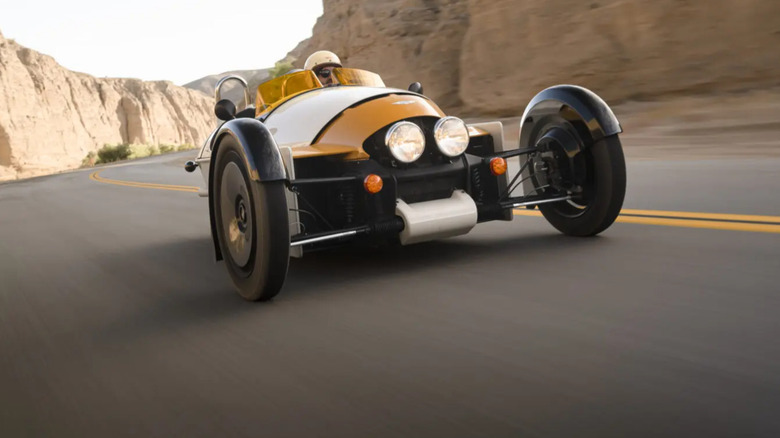
The House Energy and Commerce Subcommittee on Commerce, Manufacturing, and Trade advanced House Resolution 3385 with the goal of updating the definition of a motorcycle. The bill's text is short enough to fit on a post card, but its ramifications could be monumental for the three-wheeled "autocycle" industry, and the tens of thousands of people who already own them, reports Revzilla.
Four Republican lawmakers, Derrick Van Orden (WI-3), Jay Obernolte (CA-23), Scott Fitzgerald (WI-5), and Darin LaHood (IL-16), have co-sponsored the oppressive regulatory bill which would see popular vehicles like the Morgan Super 3, Polaris Slingshot, Campagna T-Rex, and Vanderhall not only illegal to manufacture and distribute, but potentially illegal to register for the road altogether. Existing owners would potentially be left with nearly two tons of expensive machinery they can't use, and thousands of American manufacturing jobs would disappear.
The bill would update the definition of a motorcycle to the following:
In this section, the term "motorcycle" means a motor vehicle, as was originally manufactured, with motive power, having a seat or saddle requiring the rider to sit astride, designed to travel on not more than three wheels in contact with the ground, steering controlled by handlebars, acceleration and braking controlled by handlebar and foot controls and capable of reaching speeds in excess of 30 mph.
This is a much more complex definition than the one that currently exists in section 571.3 of title 49, Code of Federal Regulations. As it is currently written, the federal definition of a motorcycle is quite simple.
In this section, the term "motorcycle" means a motor vehicle, as was originally manufactured, with motive power having a seat or saddle for the use of the rider and designed to travel on not more than three wheels in contact with the ground.
Motorcycle Industry Council opposes
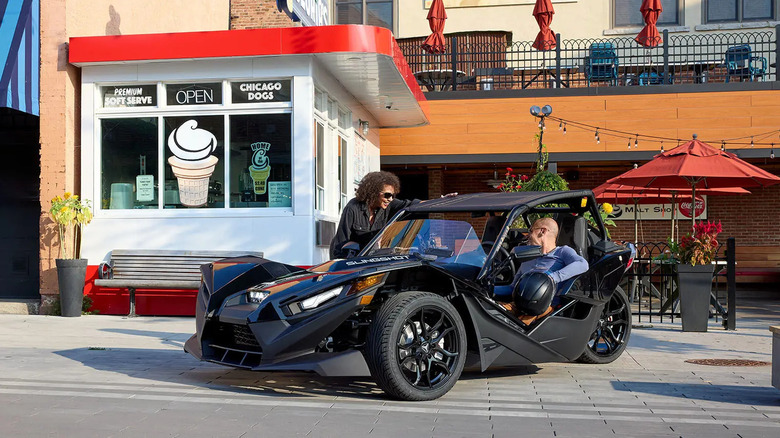
The Motorcycle Industry Council, on behalf of hundreds of companies in the powersports industry, "strongly opposes" this work of government overreach. In a statement released shortly after the subcommittee vote to approve, the MIC called the bill "not a mere administrative adjustment" but a "de facto ban on an established and successful motorcycle market segment." Adding provisions to explicitly include sitting astride and steering with handlebars does indeed seem explicitly for the purpose of banning autocycles altogether.
Autocycles are somewhat divisive among motorcycle enthusiasts and car enthusiasts alike, as they sort of split the difference between the two, and allow manufacturers to sell a "car" that doesn't comply with NHTSA safety standards.
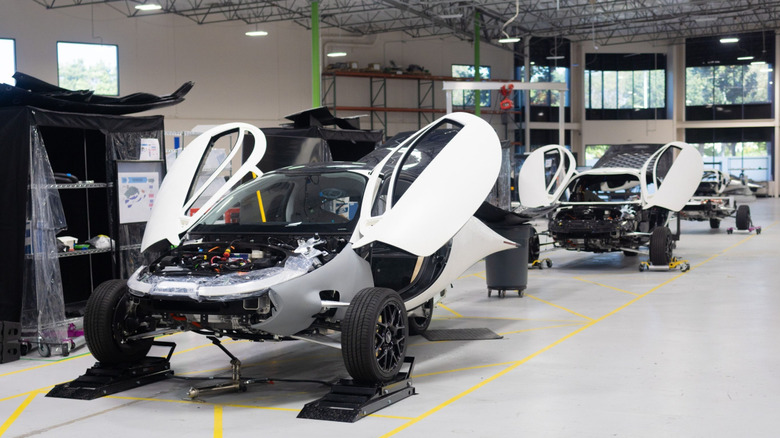
Citing massive financial harm to many businesses, the MIC is urging the federal government to kill the bill altogether. Polaris, for example, directly employs 8,000 Americans, and is responsible to countless suppliers. Because the company builds vehicles in many different segments, it could likely survive the outright destruction of a market it dominates, but it would be severely impacted. Utah's Vanderhall Motor Works, meanwhile employs around 200 people, and would see its entire business case evaporate overnight. It might kill Aptera before they can even get off the ground.
The MIC estimates that the segment generates hundreds of millions of dollars in sales annually, and would lead to "immediate plant closures, the loss of skilled manufacturing and engineering jobs, and a significant hit to dealership revenue across all 50 states.
What would happen to autocycles?
Because of the way many states tie their legal categorization of motorcycles to the federal definition, the MIC worries that the bill, if passed, would invalidate "tens of thousands of current autocycle registrations." Current trikes from Harley-Davidson (a company notably headquartered within spitting distance of Fitzgerald's district), would not be affected by the update, but the requisite to sit astride and steer by handlebars would leave current autocycle owners in the lurch.
The bill was introduced to the House of Representatives nearly a year ago, and it has just now advanced out of subcommittee with a voice vote. This bill has been forwarded to the full Energy and Commerce committee for the next vote. It still has many hoops to jump through before hitting the President's desk for signature into law, but the MIC believes it is better to strangle it in the cradle over allowing it to bloom into a potentially detrimental law.
Jalopnik has reached out to bill sponsor and 3rd District of Wisconsin Representative, Derrick Van Orden's office to confirm the intent of the bill as written, though we have not yet received a reply. We will update this post with the Representative's response if and when one is received.
I, for one, am a fan of autocycles, and hope these machines stick around as relatively inexpensive enthusiast vehicles for decades to come.