

Headers Vs. Exhaust Manifolds: How Do They Affect Performance?
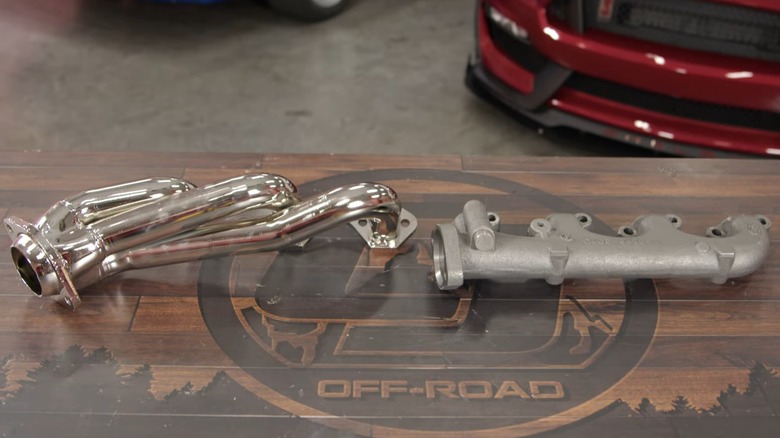
Upgrading the exhaust is one of the first steps many take when they want to boost their car's performance. One of most obvious choices in this regard is to install a header in place of the stock exhaust manifold, which definitely does give your vehicle a bit more oomph. But manifolds have their own case to make.
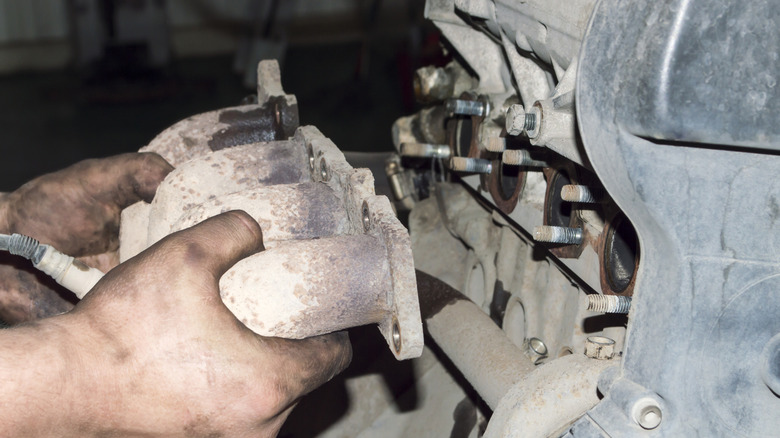
An exhaust manifold is the starting point of the exhaust system, and its job is straightforward — it collects spent gases from each cylinder and routes them into the rest of the exhaust system. A lot is asked of it in other aspects, though. It needs to thanklessly do its job year after year with as little maintenance as possible, reliably fit in tight spaces, bear the brunt of continuous heat cycles, and do all of this noiselessly. Manufacturers keep all of this in mind when designing a manifold, and most factory versions are made of cast iron (which Dodge and Ram still use to make their engine blocks) or stainless steel. They can easily fit into cramped engine bays and withstand whatever the vehicle throws at them.
Headers are a key upgrade for drivers who want more from their engine without major internal work. In simple terms, headers replace the stock exhaust manifold with individual pipes for each cylinder, allowing exhaust gases to exit more efficiently. By improving airflow and reducing back pressure, headers help your engine breathe better, which supports stronger performance and improved throttle response.
Why headers change the way an engine breathes
In a manifold, exhaust from each port is often discharged into a single chamber or short runners, so interaction between the exhaust pulses from different cylinders is quick. While this does smooth out a lot of the noise associated with exhausts, it can also create backpressure. Backpressure is the pressure buildup and resistance created within the exhaust system that opposes the flow of exhaust gases exiting an engine. This poses a problem, because to push the exhaust gases out against this pressure, the pistons have to work harder, losing efficiency.
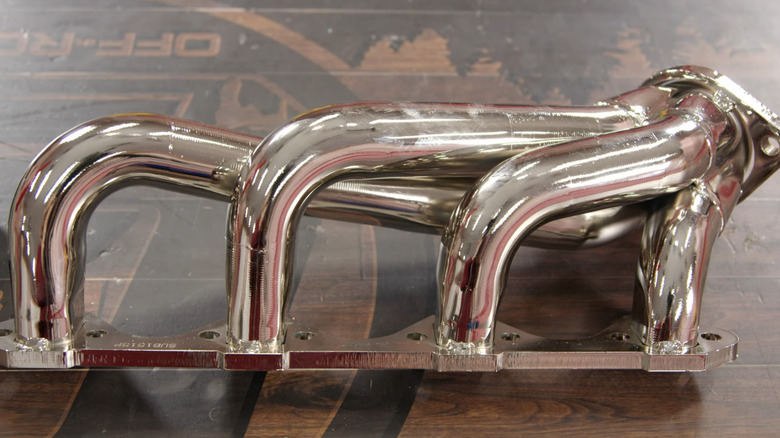
Headers go about their task with a different approach. A separate tube is given to each cylinder, and the exhaust gases exit via the tubes before merging inside a collector, instead of coming together immediately. Using individual tubes also means the length of each tube can be tweaked, thereby controlling how the pulses merge and bringing backpressure down.
Headers with different tube lengths are called unequal headers. Having tubes with unequal lengths allows them to spread torque delivery across different rpm ranges and create a smoother, wider powerband. This header design is also what makes Subarus sound so unique. Equal length headers use pipes cut to the same length so exhaust pulses reach the collector evenly, which can sharpen power within a narrower rpm range.
Choosing between power, packaging, and practicality
The performance difference between headers and exhaust manifolds is real, but it isn't universal. Headers generally deliver more horsepower and torque by improving exhaust flow. They also help with exhaust scavenging, particularly during the brief window when both exhaust and intake valves are open at the same time. When an exhaust pulse travels down a header tube, it creates a low-pressure area behind it. When timed correctly, that low pressure helps pull remaining exhaust out of the cylinder and encourages the incoming air-fuel charge to enter more efficiently.
That said, the gains depend heavily on the rest of the combination. On a nearly stock engine with a restrictive exhaust downstream, the improvement may be modest. On a well-matched setup with good intake flow and a free-flowing exhaust, the benefits are easier to measure and feel.
Manifolds, on the other hand, excel in areas that don't show up on a dyno sheet. They're resistant to warping and cracking. Installation is usually simpler, and heat management tends to be more predictable.
Sound also factors into the decision. Headers preserve sharper exhaust pulses longer, resulting in a more aggressive tone. Manifolds blend those pulses earlier, producing a deeper and more subdued sound. But no matter whether you use manifolds or headers, a cheap exhaust will sound terrible.