

How Ford's Bounty Hunters And F1 Engineers Are Improving Efficiency And Lowering Costs For Its Universal EV Platform
Ford first started detailing its upcoming Universal Electric Vehicle platform last summer, which CEO Jim Farley described as "a Model T moment" for the company. We knew the platform would initially underpin an electric midsize pickup truck that should start at around $30,000 when it goes on sale in 2027, offering more passenger space than a Toyota RAV4 and acceleration like a Mustang. Ford also talked up innovations in its manufacturing that would save weight, money and complexity, but specific details were still pretty slim.
Now the automaker is divulging a lot more info about the UEV platform, and how it's using "bounty hunters" to make the EVs as good as possible. Not bounty hunters in the traditional cowboy western (or "Star Wars") sense, though. Instead, Ford is using the term as a way to make chasing engineering targets more enjoyable and motivating for the teams of people working on them, and to make it more clear and tangible what potential tradeoffs there would be for hitting said targets, and what the impact will be on the customer. From Ford:
Historically, engineers in traditional automotive companies can be siloed in departments that match the component or system they are assigned to. They're expected to advocate for the part they are working on while decreasing its cost, often without the context of understanding how it impacts the customer's experience or performance of the vehicle. For example, the aerodynamics team always wants a lower roof for less aerodynamic drag; the occupant package team wants a higher roof for more headroom, while the interiors team wants to decrease the cabin size to reduce the cost. Usually, these groups negotiate until they find a "middle ground," one that inevitably ends in a tradeoff led by yet another department tasked with making tradeoffs on behalf of the customer.
Bounties change the negotiation, making the true cost of a tradeoff much clearer by connecting it to a specific value tied to the range and battery cost. Now, the aerodynamics team and interior team share the same goal, and both understood that adding even 1mm to the roof height would mean $1.30 in additional battery cost or .055 miles of range. With bounties, each team has a common objective to maximize range while decreasing battery cost — a direct linkage to giving our customers more.
Aerodynamic efficiency
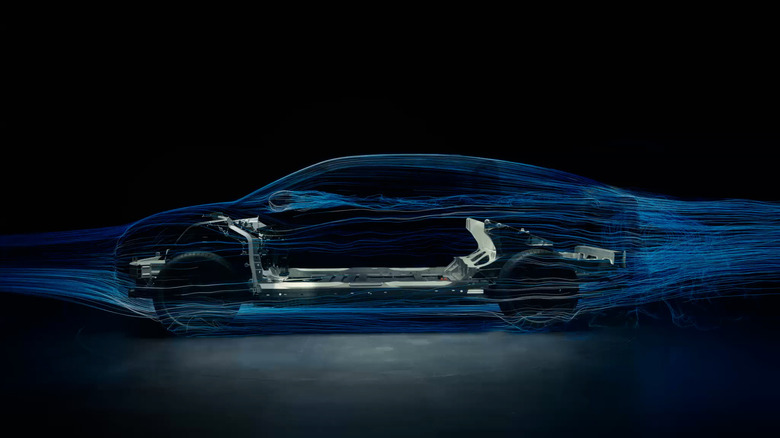
More than half of the aerodynamicists working on the project have come from Formula 1, and the truck's development cycle has been inspired by that race series as well. Normally wind tunnels aren't used until close to the end of a car's design journey, but Ford started using them right when designers first started working on the project. The automaker says its test vehicles use a Lego-like modular construction, where the team could easily swap 3D-printed and machined parts in minutes to test small variations, a boon when full-on prototype parts aren't ready to be made yet.
Ford says the mid-size truck's aerodynamic efficiency is 15% better than any other pickup on the market today; the automaker isn't specifically talking about drag coefficients, but with a Cd of 0.30 the Rivian R1T is the slipperiest truck you can currently buy. If the UEV's battery was put into the most aerodynamic mid-size gas truck currently on the market, the Ford would have almost 50 miles more driving range, a 15% improvement, which could be up to 30% better on the highway.
The roofline has been shaped to shed high-speed air into a teardrop profile over the bed, greatly increasing efficiency. 4.5 miles of range were gained by designing the underbody so that air is guided around the front tires and suspension towards the rear tires, effectively hiding the rear wheels; bolts are flush to the underbody floor, too. Ford also merged the motors for the side-view mirror glass adjustment and power folding mechanism into one actuator, so the mirror body no longer needs wiggle room to move the glass independently. That means the housing could be shrunk by more than 20% and the shape could be more aerodynamic, adding 1.5 miles of range. As one Ford engineer said on a backgrounder call, "the best part is no part, the second best part is the one that does multiple functions."
Simplification
Ford says an EV's battery accounts for 40% of the vehicle's total cost and more than 25% of its total weight, so you really want to keep the battery as small as possible. That's tough in a country like the U.S. that's obsessed with long ranges. The team says the focus on range is kind of like third-row seats in SUVs, where everyone says they need one, but it's only used 3% of the time. We know the truck will use prismatic lithium-iron phosphate (LFP) batteries, which are lower-cost but also hold less energy than most EV battery packs — thus the focus on making sure the truck needs less battery to begin with.
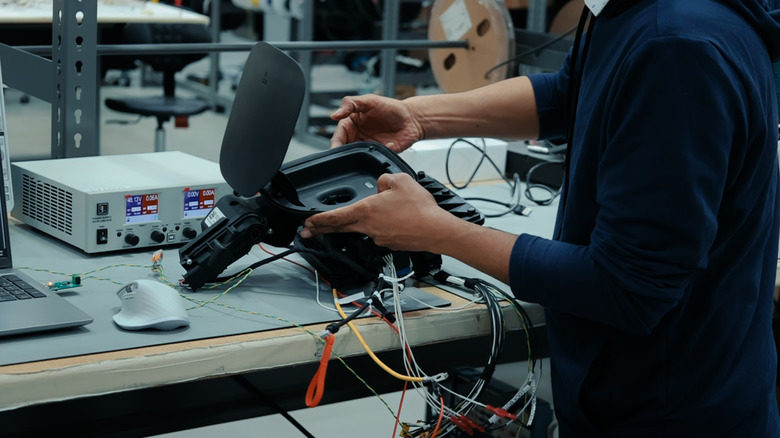
The electrical system has been fully designed in-house by engineers integrated with the rest of the development team, and Ford describes it as "unlike anything else on the market," with improved charging times and battery management performance, as well as bi-directional capability. Instead of 30 ECUs throughout the car like in a typical EV, the UEV's zonal architecture groups everything into just five main modules, and much of its power electronics have been combined into a single compact E-box module. Compared to Ford's current EVs, the UEV's wiring harness is 4,000 feet shorter and 22 pounds lighter. It'll also use Ford's first 48-volt low-voltage system
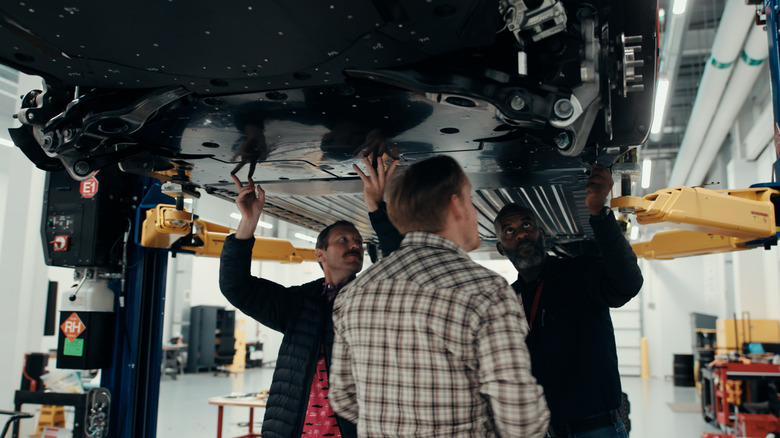
Compared to a typical Ford, the UEV platform has 20% fewer parts and 25% fewer fasteners. In a first for Ford, the UEV will use unicasting, meaning there will be just two main structural parts as opposed to 145 in the Maverick. This will make the body structure "significantly" lighter, and Ford says it's over 27% lighter than other competitors doing unicasting. For ease of repairability, the castings will have dotted lines of where to cut, offering replacement parts that can be glued in.
Coming soon
The bounty hunting team working on the Universal EV platform includes project lead Alan Clarke, who played a major role in Tesla Model S development and almost every subsequent Tesla product before joining Ford in January 2022; executive director of engineering Anil Paryani, a battery and charging system specialist who has worked at Tesla, Honda and Faraday Future; head of aerodynamics Saleem Merkt, who has worked on F1, NASCAR and WRC; Vladimir Bogachuk, who focuses on the structure design and safety and has been a pioneer of advanced manufacturing projects at Ford for a decade; and software lead Luccas Di Tullio, who has almost a decade of experience in the EV industry.
Ford is sticking to its target of a $30,000 starting MSRP for when the UEV truck launches at some point in 2027. It'll be assembled at the Louisville, Kentucky, plant that just stopped building the Escape, with the LFP batteries to come from Ford's BlueOval Battery pack facility in Michigan. The truck's name, design, EPA range and on-sale date will be announced in due time.