

These Are The Most Expensive Harley-Davidson Motorcycles Ever Sold
For more than a century, Harley-Davidson motorcycles have broken speed records, graced blockbusters, served the U.S Army in the Second World War, and have even been ridden by Elvis Presley himself. In shorter words, Harleys are symbols of American engineering. As a result, some samples have commanded truly mind-blowing prices at prestigious auctions such as Mecum – the world's largest annual motorcycle auction held in Las Vegas — and Bonhams.
Ordinarily, motorcycles cost far less than cars – the average bike costs roughly half the price of the average automobile, making four-figure and low five-figure price tags a normalcy. When it does venture into high-end five- and six-figure territory, it starts to get really intense.
For historically significant, rare, or iconic Harleys, these are hardly surprising valuations. One can almost say they are inevitable. Don't expect to see them on the road or tracks, though. Who would splash $1.9 million on a diamond-clothed Harley and willingly subject its tires to such pangs? That said, here are the most expensive Harley-Davidson motorcycles ever sold.
1909 Harley-Davidson Model 5C - $95,000
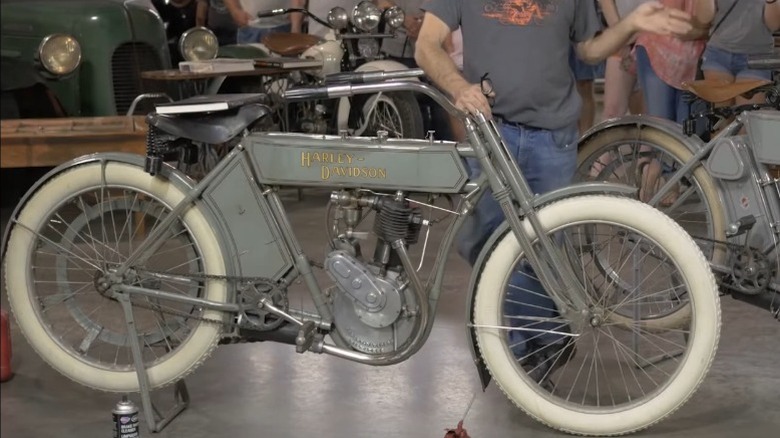
It goes without saying that the 1909 Harley-Davidson is a far cry from a modern bike. Introduced in the company's 5th year of production — hence the "5" designation — it was a single-cylinder machine powered by a 495cc engine. Pushing about 4.3 horsepower, it could run at 43 mph, which was decent for the early 20th century.
With the Model 5 and its variants 5A, 5B, and 5C, Harley-Davidson made its first attempt at diversifying its model lineup. There was actually a fifth: the V-twin Model 5D, but it was short-lived, no thanks to an underwhelming 49.5-cubic-inch engine.
The Model 5C's historical value is enough to fetch a huge sum in an auction. One example, originally owned by a Joseph Delphey sold for as much as $95,000 at Mecum's 2014 Las Vegas auction. Just a year later, another Model C from E.J. Cole's Collection, with engine number 3769, nearly matched this price when it crossed Mecum's block for $92,500. It was the only known 1909 sample with magneto ignition.
2025 Harley-Davidson CVO Road Glide RR (limited-edition) - $110,000
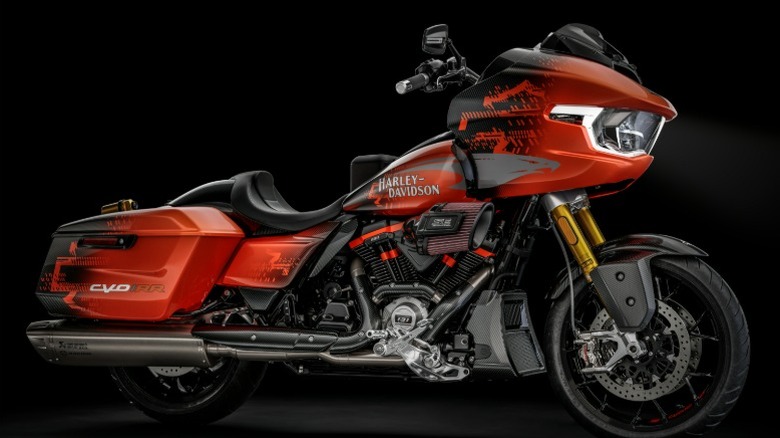
Harley-Davidson has been bringing more power to its baggers for a while now, but the 2025 CVO RR is in a league of its own. It exists first and foremost as a street-legal special package for Harley-Davidson's factory King of the Baggers race machine. When it debuted in March 2025, it was the most powerful two-wheeled monster ever put out by Harley-Davidson. And it still is, thanks to the 131-cubic-inch Screamin' Eagle V-twin engine that powers it. Producing 153 peak horsepower at 5,750 rpm and revving to a lofty 6,500 rpm, the 2147cc powerhouse is the most potent Milwaukee-Eight engine ever installed in a production Harley, decisively eclipsing the 121 V-twin found in the CVO Road Glide.
That race intent extends far beyond raw output. The Harley-Davidson CVO RR is loaded with factory-derived hardware, including the Racing King 6 transmission, a lightweight billet aluminum swingarm, an Akrapovič full titanium 2-into-1 exhaust, and a top-tier Brembo braking package featuring GP4-RX CNC front calipers and T-Drive floating rotors.
The Bagger inspiration trickles down to the visual spectrum as well. Racing Orange livery that fractures into tiny Bar & Shield motifs across the main bodywork contrasts nicely with the carbon-fiber weave and a bold white Screamin' Eagle script. Typical of such a six-figure marque bike is a premium touring ethos, with a high-end Harley-Davidson audio system powered by Rockford Fosgate, featuring three-way 6.5-inch speakers. Production of the CVO Road Glide RR is capped at just 131 hand-assembled examples, exclusive enough to justify the $110,000 manufacturer's suggested retail price tag.
1940 Harley-Davidson EL Knucklehead - $220,000
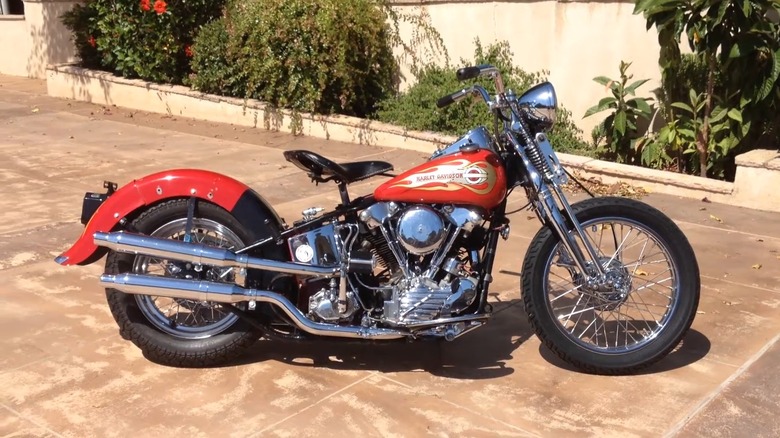
Introduced in 1936, the Knucklehead is so named for the engine's distinctively rounded, fist-like valve covers. And the Knucklehead's engine packed a punch (no pun intended). It was Harley-Davidson's first overhead-valve V-twin, producing around 40 horsepower from either a 61- or 74-cubic-inch displacement for the 1936 and later 1941 spec models, respectively. Popularity went skyward when Joe Petrali took it to a world record speed of 136.2 mph at Daytona Beach on March 13, 1937.
With such a legacy, it should hardly be surprising that collectors have long eyed the Knucklehead. Despite over 41,000 units rolling off the production line between 1936 and 1947, examples have regularly sold for close to and over six figures.
Pre-2021, Knuckleheads selling for over $100,000 were a rare sight. Bar the record-breaking $220,000 commanded by a 1940 EL "Greenie" Knucklehead at Mecum's 2020 Las Vegas auction, only three previous sales had ever seen a Knucklehead exceed $100,000: $181,500 at Las Vegas in 2014, $159,000 at Bonhams in 2014 for the same world-record "Greenie," and in 2019, one sold for $132,000 in Las Vegas. But all that changed in dramatic fashion at Mecum's 2021 Las Vegas auction, where 11 Knuckleheads surged well above the benchmark.
1912 Harley-Davidson 8A Twin - $236,000
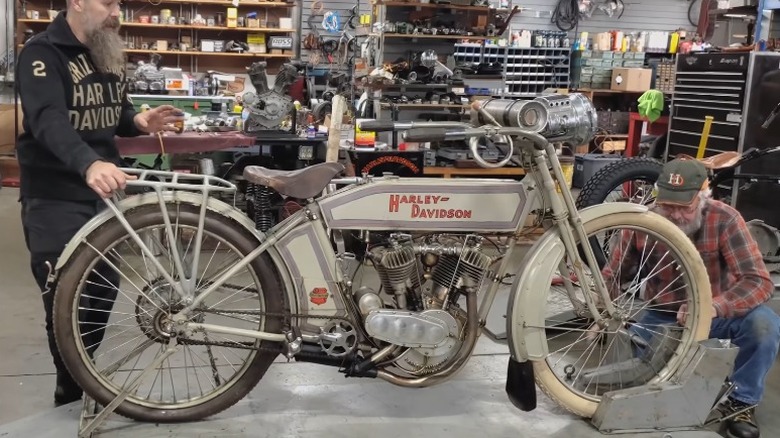
For enthusiasts, 1912 was the year Harley-Davidson introduced its first 61-cubic-inch model. It was also the year that the company's Model 8 series rolled out. These included four single-cylinder 30-cubic-inch options (8, X8, 8A, X8-A), two 50-cubic-inch models (8D V-twin and X8-D), and a V-twin 61-cubic-inch X8-E.
A "Silent Grey Fellow" sample from Jerry DeMill's Collection, sold for $27,000 in 2012. An even rarer twin-cylinder 8A model with belt drive and idler wheel from E.J. Cole's 220-strong collection fetched $236,000 3 years later at Mecum's 2015 auction in Las Vegas. The latter sale was more than twice the initial estimate of $100,000 and etched its name in motorbike-collector history.
1912 models featured a radically new frame design that lowered the riding position. A full-floating seat with up to 4 inches of suspension-enhanced comfort and a reliable Sager-Cushion spring fork paired with valanced front fenders, improved stability, control, and comfort.
2013 Harley-Davidson FXD Dyna Super Glide (Pope Francis) - $327,000
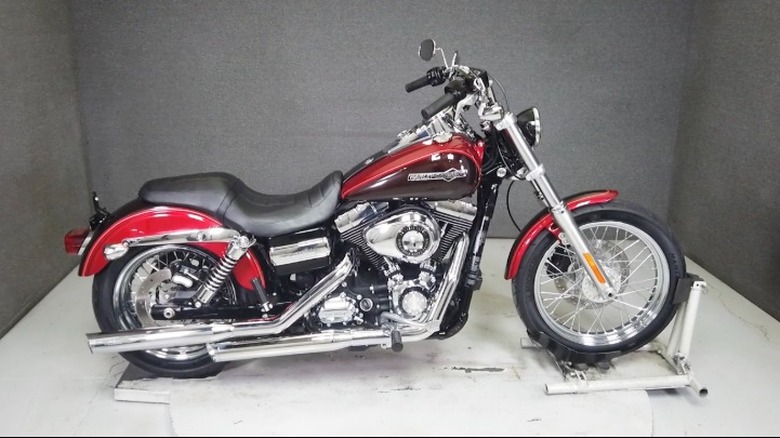
Ordinarily, a 2012/2013 Harley-Davidson FXD Dyna Super Glide, fine motorcycle though it is, has no business costing anything beyond five figures. When the Pope himself appends his signature on one, however, that five-figure price (precisely $13,000 at the time of its debut) is bound to leap to six.
It happened in Rome in June 2013, when Pope Francis signed a leather biker's jacket and the fuel tank of a Dyna Super Glide, both presented by Harley-Davidson to mark the brand's 110th anniversary. And both fetched jaw-dropping prices at a Bonhams auction in Paris the next year: The jacket sold for $77,485, and the Super Glide went for $327,000. All proceeds from the sale were donated to Caritas Roma, a pastoral organization of the Diocese of Rome dedicated to providing aid and shelter for the needy.
Whoever bought the Super Glide acquired a 1584cc Twin Cam 96-powered steel-chassis beast, running on a six-speed manual Cruise Drive transmission. Strong pulling power on steep roads comes from an engine producing 94 pound-feet of torque at just 3,000 rpm. Other features include an electronic sequential port fuel injection (ESPFI) system, final belt drive, a chrome exhaust with dual staggered shorty mufflers, and, in the case of this sample, a Harley-Davidson Certificate of Conformity and a Papal Certificate.
1959 FLH Duo-Glide Panhead (Jerry Lee Lewis) -$385,000
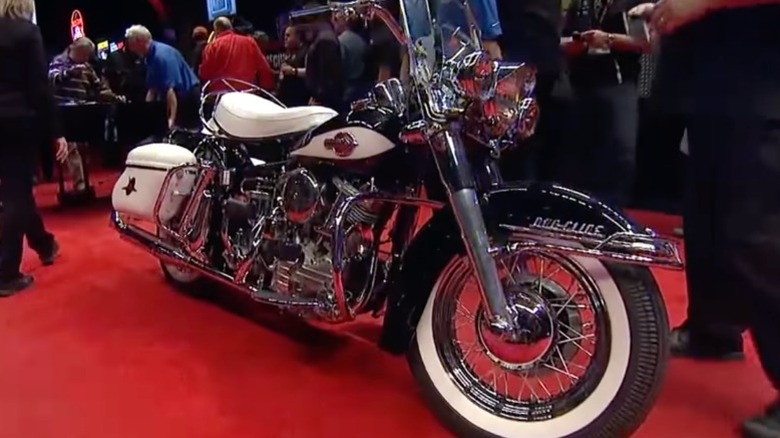
Sold at Mecum's 2015 auction for $385,000 (far below the $1 million estimate touted by president Dana Mecum), this was one of two special-edition FLH Duo-Glide Panheads that the brand gifted to two music icons in 1959. The example on sale was gifted to Rock n' Roll legend Jerry Lee Lewis, while the other went to the King of Rock Elvis Presley. What did the buyer get aside from the obvious bragging rights attached to a Jerry Lee Lewis cruiser? A 60-horsepower Panhead V-Twin engine boasting only 2,257 in mileage!
Beyond their amusing nicknames, the FLH Panhead is closely related to the Knucklehead, as it was essentially an upgraded evolution of the earlier model. Key upgrades include aluminum cylinder heads at the engine top end that sported distinctive pan-shaped rocker covers, internalized oil lines, and hydraulic valve lifters.
The ex-Jerry Lee Lewis example is a "Hydra-Glide," so-named for its new wishbone frame with bowed front down-tubes and a hydraulically damped telescopic front fork. Lewis called his 1959 Panhead "a fine motorcycle" on Mecum's auction page, and he said he rode it everywhere. However, what was good in the 1950s mightn't be so for the 2020s. In other words, some modern-day riders may find the bike underwhelming when compared with recent models.
Harley-Davidson FHA 8-Valve Racer - $423,000
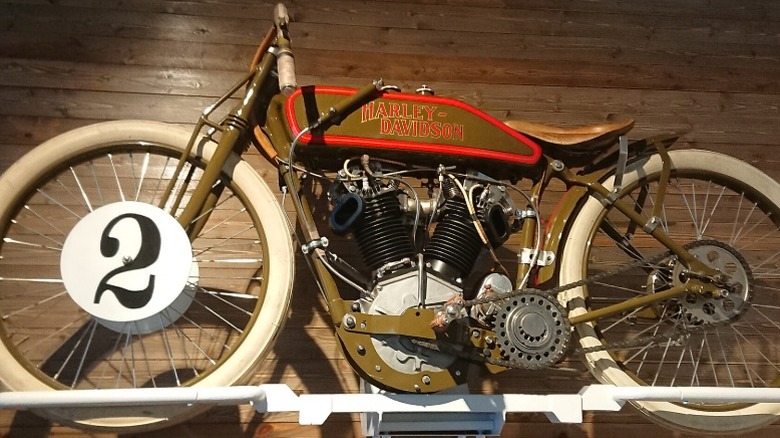
This sample bike broke the Australian auction record when it sold for $600,000 Australian dollars (about $423,000 USD at the time) at Shannon's Melbourne Spring Auction on September 21, 2015. When it crossed the block, it ranked as the 10th most expensive motorcycle ever sold at auction.
Such a high price comes by reason of the FHA 8-Valve V-Twin racer's extreme rarity even during its heyday: Fewer than 50 units were produced, and each sold for $1,500 in 1916, about $44,600 today when adjusted for inflation. They were Harley-Davidson's statement entry into the racing business, which was hitherto dominated by rival brands Indian and Excelsior.
The story of the 61-cubic-inch, 8-valve V-twin racer is one of "a prophet is not appreciated in his hometown." That's because before racing regulations evolved, these machines were the standard-bearers of Harley-Davidson's factory race team. Purpose-built for competition and marketing dominance, it announced its arrival with a win at the Dodge City 300-mile race. Thus, when the American Motorcycle Association stifled F-head and multi-valve racers in favor of production-based Class C side-valves, Australia did not follow suit. Eight-Valve engines thrived on Australian oval tracks, thanks to higher compression ratios from the racing fuel blends they ran on rather than pure gasoline.
1907 Harley-Davidson Strap Tank - $715,000
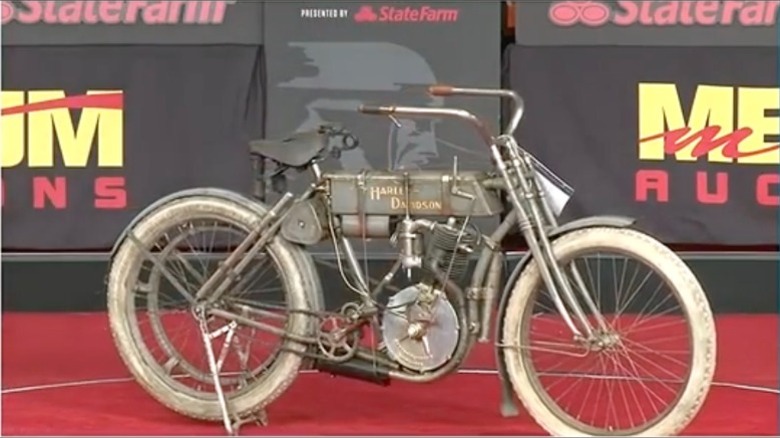
Motorcycle enthusiasts and historians would recognize the Strap Tank as one of the earliest models from the then-4-year-old Harley-Davidson company. Much like the Panhead and Knucklehead, the Strap Tank's name came from a distinctive design choice, this time not the engine, but the nickel-plated steel bands securing the fuel and oil tanks.
The most famous Strap Tank is the ex-E.J. Cole Collection sample. E.J. Cole himself purchased it in 1993 for $140,000 from the original owner, Leo Bongers' estate, and he later sold it for $650,000 at Mecum's 2015 Las Vegas auction — $715,000 after auction fees are added. This made it the most expensive ever for any Harley-Davidson, although it wasn't the top-priced bike of that auction — this honor went to a $852,500 ($775,000 hammer price) 1915 Cyclone board track racer that Steve McQueen once called his motorcycle.
It may sound surprising, but the $650,000 hammer price of the 26.8-cubic-inch, 4-horsepower Strap Tank was considered "cheap," given that it was initially valued at a million bucks! And it had all the features to back such a tag. Serial number 2037 indicated that it was the 37th of 150 bikes that the company produced in 1907. Plus, the rare unrestored status, evident in the telltale patina, makes it a collector's prize.
1908 Harley-Davidson Strap Tank - $935,000
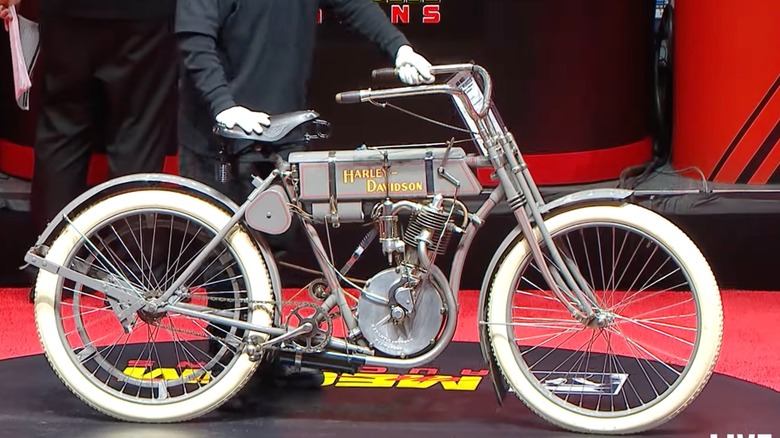
8 years after one Strap Tank set the record for the most-expensive Harley-Davidson motorcycle ever sold, another Strap Tank raised the bar higher. The 1908 example was sold at Mecum's 2023 Las Vegas auction for a record-breaking hammer price of $850,000 – with buyer's fees included, the total price reached $935,000.
Strap Tanks are rare by nature, but this motorcycle is especially significant, as it comes from a year when Harley-Davidson began to scale production. After building just 150 motorcycles in 1907, output rose to approximately 450 units in 1908, boosted by the publicity from Walter Davidson's victory at the Brass and Horns race. This almost-million-dollar sample is one of only 12 surviving examples of the latter, and it spent 66 years in the hands of motorcycle collector David Uihlein, who found it gathering dust in a barn in 1941. Brought back to life by Paul Freehill, it remains exceptionally original, retaining its correct engine belt pulley, tank, seat cover, and wheels.
Harley-Davidson Easy Rider Captain America chopper - $1.3 Million
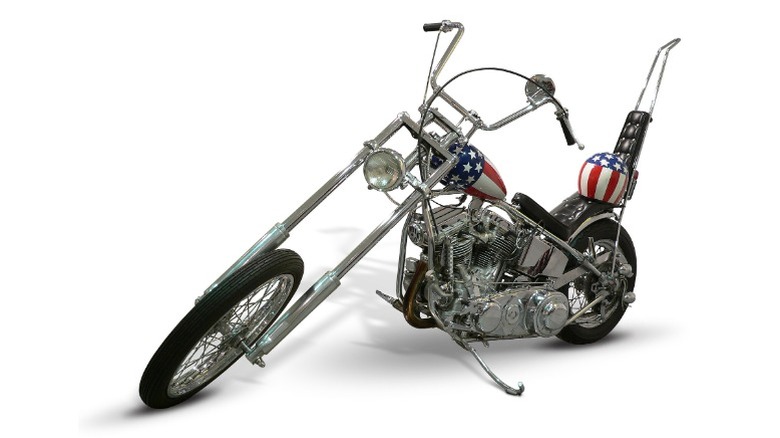
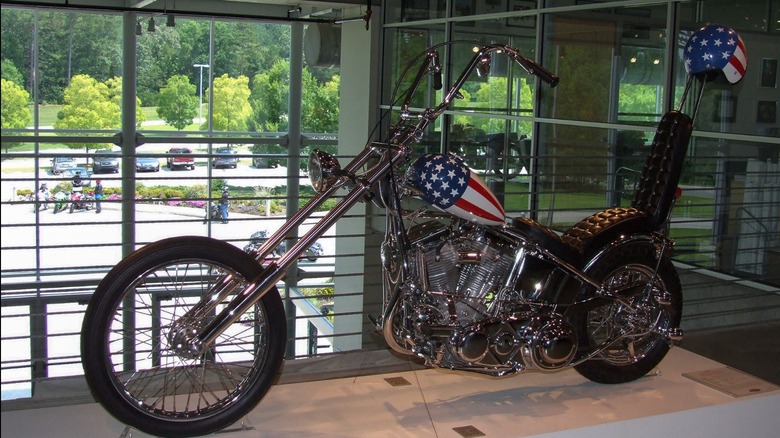
You know a chopper carries serious cultural weight when it's nicknamed "Captain America" and wears the star-spangled banner motif on its tank. This bike was one of two customized Harley Davidson Panhead choppers — the other being the "Billy Bike" – built for and featured in Dennis Hopper's 1969 cult classic film "Easy Rider."
It's no exaggeration to call Captain America one of the most memorable motorcycles in cinema. Choppers were certainly a thing pre-1969, but "Easy Rider" firmly etched the image of long-forked, sissy-bar customs into the imagination of mainstream audiences. Wyatt, Peter Fonda's character, rides it in a cross-country search for freedom, which ends with the bike crashing in the final scene.
With such cultural impact, it's no wonder it's one of the first motorcycles to sell for over a $1 million, having fetched $1.35 million at a 2014 auction. At the time, the stripped-down Hydra-Glide-turned-Captain America, built by Cliff Vaughs and Ben Hardy, was the most expensive motorcycle ever sold.
It is the only surviving example of the original four bikes re-purposed for Hopper's film, with the other three lost to theft. But even its whereabouts post-"Easy Rider" is as fragmented as its chopped design. Some believe that the $1.35 million bike is merely one of many replicas running around.