

The History Of Mazda's Most Famous Rotary-Powered Car
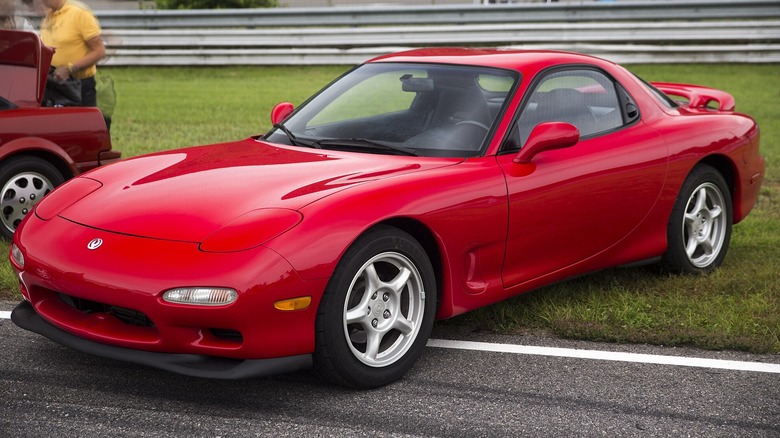
Defined by its iconic design, balanced driving dynamics and signature rotary heart, the Mazda RX-7 stood as one of Japan's most ambitious sports cars. Over its three-generation lifespan, the RX-7 proved that even a tiny Japanese automaker like Mazda could challenge Europe's sports car establishment — not by chasing displacement or cylinder counts, but by leaning into a lightweight engineering ethos.
A rare blend of motorsports prowess, cult following and a strong aftermarket scene has helped cement the RX-7's place across nearly every corner of car culture as its aged gracefully into icon status. And with a power train as unconventional as the RX-7's, it's no surprise this car has a fascinating story.
This wasn't Mazda's first go at a sports car powered by the precarious rotary motor, nor would it be its last — yet it was the moment everything finally came together. What ultimately had to go right to make the RX-7 Mazda's most famous rotary-powered car?
The innovative rotary motor sparked a frenzy in the 1960s
The story of the modern-day rotary engine begins with Felix Wankel, a German engineer who spent time working for Daimler-Benz and BMW before building a workshop funded by the government to pursue his unconventional concept. It was Wankel's 1929 patent that laid the groundwork for today's rotary blueprint.
Although Wankel is often credited as the father of the rotary engine, his work drew heavily from earlier rotary concepts dating back several centuries. His true contribution was not inventing the idea, but refining it for modern applications — particularly in improving efficiency and reliability for the engine's 20th-century rise.
What history often overlooks is that Mazda wasn't the first automaker to embrace the rotary. That honor goes to German automaker Necharsulm Stickmachinene Union (NSU), which partnered with Wankel in 1951. Together, they developed the rotary design for mass production. Wankel continued to file additional patents ahead of the release of the 1964 NSU Wankel-Spider — the first rotary- powered production car.
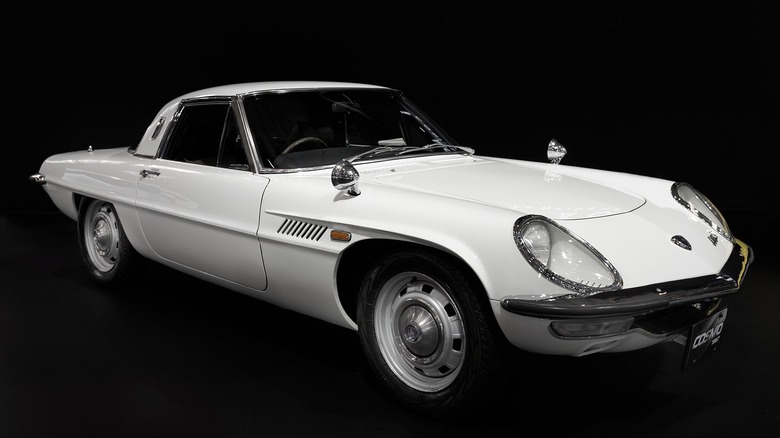
While this was going on, Mazda agreed to a license with NSU and Wankel. This allowed the three institutes to collaborate on research and prototyping while ensuring Mazda possessed rights to using the rotary in its cars. NSU eventually merged with Auto Union to form Audi and Mazda took center stage, bringing the Mazda Cosmo Sport to market in 1967.
This marked the beginning of a rotary-powered sports car lineage that Mazda itself might not have foreseen. The Cosmo Sport served as Mazda's halo car for a new era, and a symbol of the company's commitment to the rotary. Mazda could finally think bigger — and that eventually led to the RX-7.
The arrival of the RX-7 shook the sports car world
Mazda's Cosmo Sport proved the rotary wasn't just a commuter-car curiosity, but a legitimate competitor in the sports car landscape. Through the 1970s, Mazda used everyday vehicles as rolling test beds, fitting two-rotor 10A, 12A, and 13B engines into everything from the REPU pickup to the Capella compact sedan — also called the RX-2.
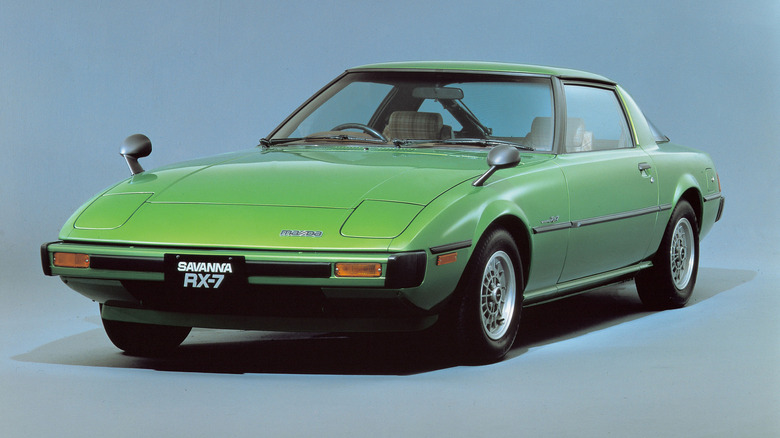
When Mazda rolled out the Savanna RX-7 in 1978, it marked a turning point not only for the company, but for affordable performance cars. Here was a lightweight rear-wheel-drive sports coupé powered by a rotary engine, offered at an accessible price. Drawing inspiration from Lotus, Mazda gave the RX-7 a clean, timeless style. Looks aside, the RX-7's front-midship layout placed the 12A twin-rotor motor comfortably behind the front axle and allowed for a near 50-50 weight ratio.
Mazda refreshed the RX-7 in 1981, most notably making the five-speed manual standard across the board. This shift also changed the car's internal designation from SA to FB.
The RX-7's lightweight formula instantly set the RX-7 apart, and it became a dominant force on the racetrack in the United States and beyond with International Motor Sports Association (IMSA), British Touring Car Championship (BTCC) and Australian Touring Car Championship (ATCC) wins — just to highlight a few. Ultimately, Mazda sold over 470,000 SA and FB RX-7s globally. The tiny-rotary-engine-powered sports coupé had produced mighty sales, and validated Mazda's ambitions — yet the best was still to come.
Mazda perfected a future classic
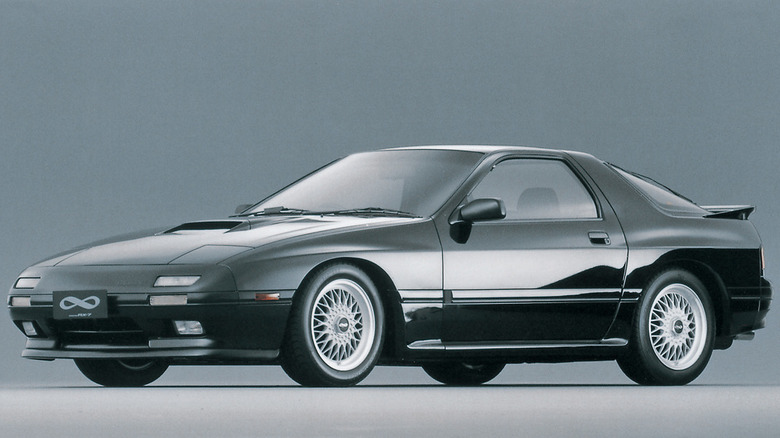
Mazda's second rendition of the RX-7 arrived in 1986 in the form of the FC. Now coming standard with the iconic 1.3-liter 13B motor, the FC produced more power to sustain a body that had noticeably gained some weight. The styling was more mature and took cues this time from Porsche's 944.
The second generation RX-7 gained attention as a legitimate alternative to European sports coupés with a more luxe cabin than the past generation and a turbocharged option the following year. Motor Trend was quick to crown the 1986 RX-7 as that year's Import Car of the Year. Similarly to its predecessor, the FC RX-7 left behind a legacy in motorsports with an IMSA GTO manufacturer's title in 1991. Across its seven-year run, Mazda produced north of 272,000 FC RX-7s — a decline from the first generation's sales figures.
Mazda's rotary magnum opus was the last of the RX-7 lineage, the FD. Introduced in 1993, the FD RX-7 displayed sculpted curves, sharpened performance and an all-in sports car ethos. The FD fully embraced the 13B-REW turbocharged motor, which now came standard across all models. The car's performance hiked all the way to 255 horsepower, right into the thick of the 1990s sports car mix with fellow Japanese authomakers like Toyota and Nissan.
FD prices hiked significantly, and Mazda sold less than 14,000 in the United States before pulling the car from the U.S. market in 1995. Internationally, the final generation of RX-7 trotted on until 2002. Although the RX-7's departure was not as storied as its arrival, the car quickly ascended to modern classic status.