

Does The 80% Rule Still Apply To EVs Today?
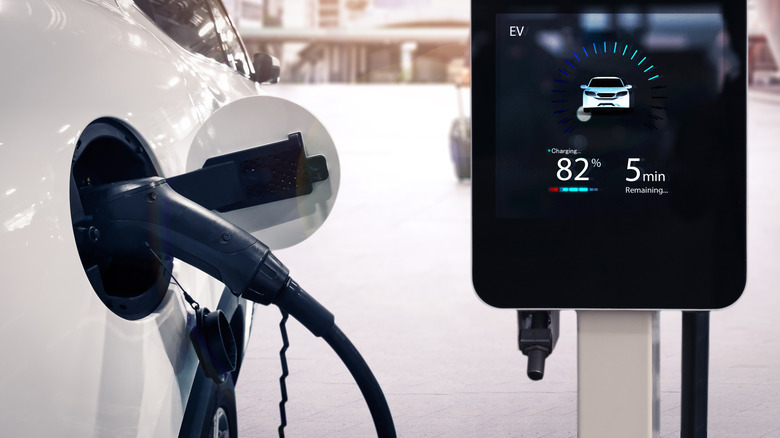
If you have an electric car, truck, or crossover, then you've probably heard about the 80% rule, which pertains to the battery charge level. Refusing to recharge your battery all the way makes sense, and there are two reasons why. First, being 100% packed with electrons is not exactly good for long-term battery health, and consistently recharging until reaching the century mark could be degrading the battery quicker than intended. On top of this, charging rates tend to slow once the battery reaches 80%. Recharging an EV battery is unlike filling a tank with gas since batteries don't absorb electrons at constant or linear rates. They tend to absorb energy much more slowly when they're nearly full.
Most EVs can DC fast charge to 80% in 20 minutes or so. The folks at EV Pulse confirmed this in a charging test using a dual-motor Hyundai Ioniq 5, and it took them 18 minutes to refill the car's 77.4 kWh battery from 10% to 80% using a 350 kW charger. However, it took an extra 30 minutes for the battery to go from 80% to 100%.
The logic behind the 80% rule for EVs is simple: You'll breeze through your journeys faster if you recharge to that point, continue driving, and find another charging station instead of waiting for a full charge. Indeed, that rule still applies for EVs today, but it's not quite as all-encompassing. In fact, you might be able to get away with keeping them at 100% for longer depending on the battery type.
The benefits of LFP batteries
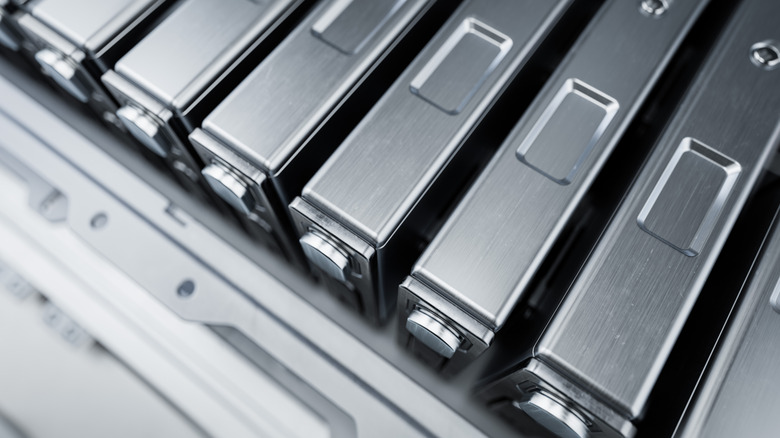
Modern EVs can have an LFP (Lithium Iron Phosphate), NMC (Nickel Manganese Cobalt), or NCA (Nickel Cobalt Aluminum) battery. Knowing which your EV has is crucial, since not all battery chemistries react favorably to full charging. For instance, it's better to limit the state of charge of LFP batteries at higher ambient temperatures. In other words, EVs with LFP battery packs (like the Ford EVs) can keep recharging to 100% with fewer chances of degradation in cooler or temperate weather conditions. But when the temperature rises, keeping it at 80% is healthier for the battery in the long run.
A 2023 Frontiers study about the calendar aging of lithium batteries shows that the capacity and power can degrade at double the speed when temperatures exceed 113 degrees Fahrenheit and their charge is maintained above 90%. So, keeping your LFP battery at 80% in hot weather is good for longevity. That being said, it won't hurt too much if you reach 100% charge from time to time. What will hurt, however, is repeatedly fast-charging using Level 3 chargers, so keep that in mind.
The 80% rule applies to NMC and NCA batteries, too
As it turns out, the 80% rule applies more heavily to EVs with nickel-based NMC (like the Ioniq 5) and NCA battery packs (like the Tesla Model S). That's because nickel-based batteries can degrade as much as 30% faster when kept at a full state of charge. What this means is keeping the charge levels at 80% or 90% — especially in warmer climates — is healthier for any NMC or NCA battery.
We're not saying it's the end of the world if you like seeing that 100% state of charge from your electric car. Then again, charging it to that level more often (regardless of whether it's LFP, NMC, or NCA) could lead to a higher rate of degradation. If you have an EV with an LFP battery, recharge the battery as required and only fully charge it to 100% once weekly to maintain its health.
On the other hand, NMC and NCA batteries are at their best when kept at 90% charge. But it wouldn't hurt to reach 100% every month or two to assist in more accurate cell balancing and BMS (Battery Management Calibration) calibration. In short, the 80% rule remains applicable to modern EVs, and adhering to it will lead to shorter recharging breaks, more efficient charging, and less battery degradation.