

Harley-Davidson's Model Codes Aren't As Random As They Seem – Here's What They Mean
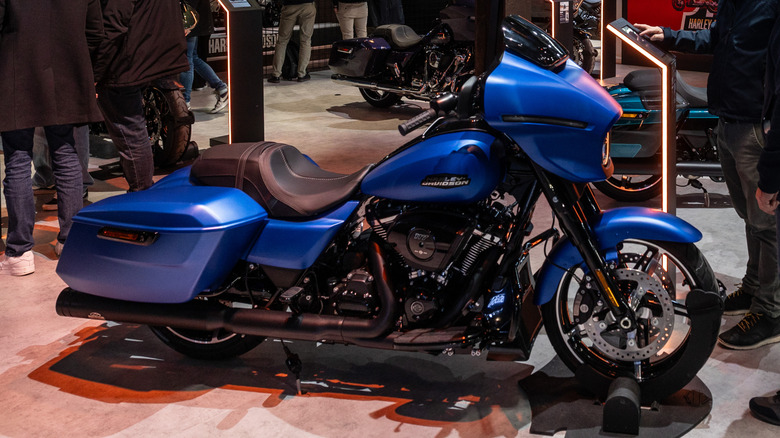
If you spend a lot of time around Harley-Davidson bikes, you'll notice a peculiarity among these American motorcycles. Each model has a code consisting of letters and numbers. However, these codes are not random. They tell you a lot about the particular motorcycle.
In fact, if you are well versed in the Harley code language, you don't even have to look at the motorcycle to know if it is a tourer, a cruiser, or a roadster. The number code follows a rigid hierarchy, with the starting letter representing the engine, followed by the front end, frame, and model features. For example, the code FLFB is reserved for the Fat Boy, where F stands for Harley's Big Twin engines (the Milwaukee-Eight lineup in this case), L stands for large front tires and a fat front end, and FB stands for Fat Boy.
Harley-Davidson may not be the oldest American bikemaker (it isn't Indian either), but its code-naming tradition goes way back to the first motorcycle that the company ever made in 1903. It was called Serial number 1. Later examples include the Flathead, the bikemaker's 45-cubic-inch V-twin that had the code name DL, and the Knucklehead (E, ES, and EL). The code names were simple back then. E stood for the the Knucklehead motor, L meant a higher compression engine, while S stood for sidecar compatibility.
However, later on, the letters used for code names began to see some overlap. Also, like the evolution of Harley-Davidson's legendary Orange and Black logo, the codes became complicated over time, as the company introduced new motorcycle models, engines, and styles.
The first letter is for the engine
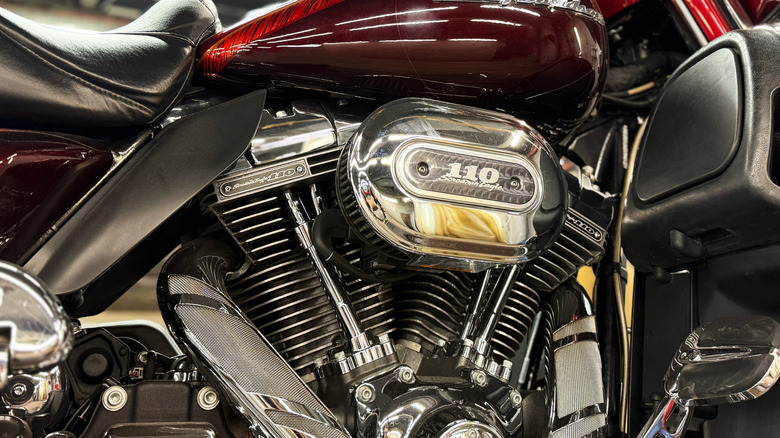
The first letter in Harley-Davidson's code jargon signifies the V-twin engine family. While older engines like the had specific code names, the later engines were generalized into size categories. Some notable examples are the Knucklehead (E), F head (J), 45 and 55-cubic-inch Flathead (K), Big-twin Flathead (U), and the military model 45-cubic-inch side valve Flathead (WLA).
The letter F denotes the big engines in the Harley lineup. F represents Harley's heavy hitters, which, in current times, is the Milwaukee-Eight engine family. Some examples are the FXSB (Softail Breakout), FXSTC (Softail Custom), and FXDF (Dyna Fat Bob). Then there is the X, which is designated for Harley's Street (XG) and Sportster family(XL). Typically, these are motorcycles featuring unit construction engines where the engine and transmission share a single housing. Notable examples are the XG750 (Street 750), XG500 (Street 500), XL1200 (Sportster 1200), and XL883N (Iron 883).
The letter V was reserved for the bikemaker's VRSC V-Rod family. This special motorcycle featured a radical departure from Harley-Davidson's air-cooled V-twin lump back in 2002, with a Porsche-designed liquid-cooled V-twin dubbed the Revolution engine. Examples are the VRSC (V-Rod) and VRSCR (Street Rod). Then, there is the R, which represents the modern Revolution Max engines. These high-tech, liquid-cooled V-twins power the likes of the Pan America and Harley's modern Sportster family. Some examples are the RA1250S for the Pan America 1250 Special and the RH1250S for the Sportster S.
The second letter is for the front end
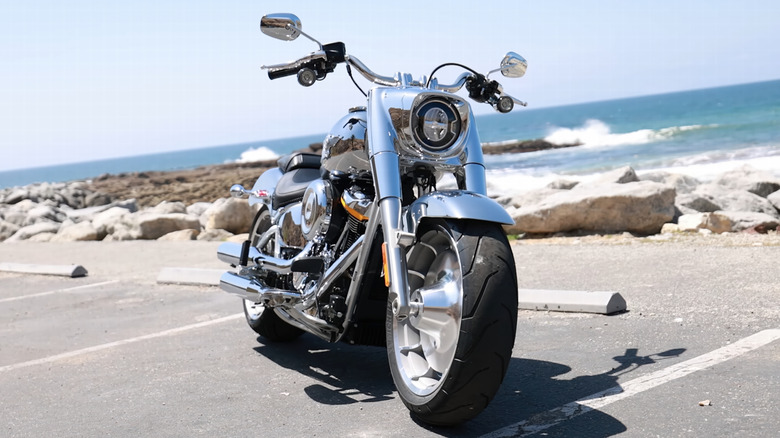
Here, the front end covers the front tire and forks. If the second letter is L, it signifies a large front end, meaning a fat front tire and heavy-duty Hydra-style fat front forks. Some common examples are the Fat Boys and Heritage Classic motorcycles, including the FLHSC (Heritage Classic 114), FLHR (Road King), FLHT (Electra Glide), and FLST (Softail).
Then, you have the X that signifies a sportier, narrower front tire and skinnier front end. The X is usually reserved for motorcycles having sportier handling characteristics or featuring a special construction. Some examples are the FXDB (Dyna Street Bob), FXDL (Dyna Low Rider), FXSB (Softail Breakout), and FXSTC (Softail Custom).
Harley's Adventure line is represented by the letter A. An example is the RA1250 code for the Pan America 1250, where R stands for the Revolution Max engine, and A stands for Adventure. The numbers in the code represent the engine capacity, which, in this case, is 1250cc. Other numerical examples in Harley motorcycle codes are XG750 (Street 750), XL883 (Sportster 883), and XL1200C (Sportster 1200 Custom).
The third and fourth letters are for the frame and intent
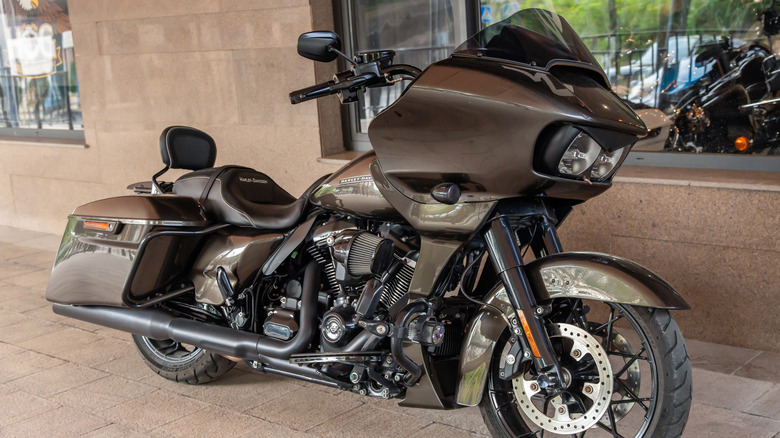
The third and fourth letters denote the motorcycle's frame style and intent, whether it is meant for cruising or touring. The ones with the suffix ending with H or T are the big motorcycles, where H stands for highway and T for touring. These motorcycles feature heavy-duty frames designed to carry the extra weight of the fairing, luggage, and panniers, and they ensure that you and your passenger travel in utmost comfort. Some examples are the FLHTC (Electra Glide Classic), FLHX (Street Glide), and FLHRXS (Road King Special).
The ST stands for Softail. These motorcycles feature frames that have the look of a vintage hardtail (no rear suspension) motorcycle, but have the rear suspension hidden inside the frame for a comfortable ride. A few notable examples are the FLST (Softail), FXSTB (Night Train), and FXSTS (Springer Softail). Harley also had the Dyna lineup, which was represented with a D. These motorcycles featured a rubber-mounted engine and were quite popular in the Club style motorcycle scene. In 2018, Harley-Davidson merged the Dyna into the Softail lineup.
There are other suffixes as well. Those include the C for custom or classic-styled models, S for Springer or Sport, and SE for Screaming Eagle, reserved for Harley-Davidson CVO (Custom Vehicles Operation) models. Let's talk segments now.
Grand American Touring, Trikes, and Sportsters
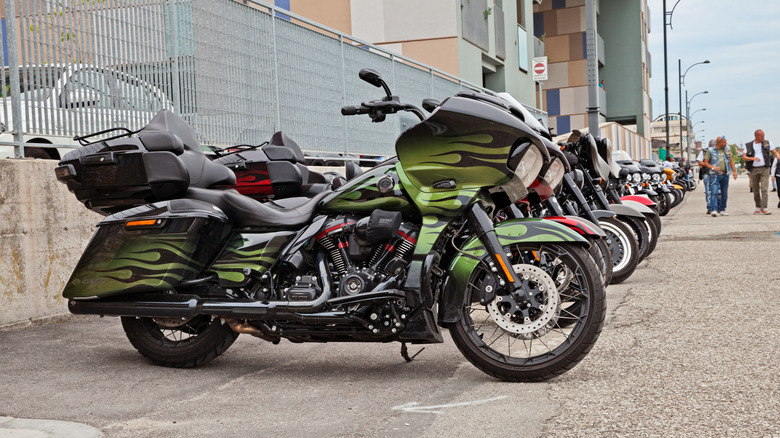
These are the great American baggers, the long haulers, and motorcycles whose code names start with FLH. One example is the FLHR (Road King), where the F denotes Harley's big V-twin engine, L stands for a fat front end with a fat front tire, and H represents its highway touring intentions, signifying that it has a touring frame. In the FLHX (Street Glide), the X stands for custom styling. This motorcycle gets a unique Batwing fairing that's directly mounted on the forks. This may seem complicated as X is mentioned in several instances. However, it is all about the placement. X as the first letter denotes engine type, as the second or third letter denotes front end type, and as the last letter signifies custom or special styling.
For the FLTR (Road Glide), the the TR combined together is specific to the Road Glide model that can be recognized by its unique frame-mounted "Shark nose" fairing. Unlike the Street Glide, this fairing remains fixed even when you turn the handlebars. In the FLHTK (Ultra limited), the K stands for its limited-edition trim level. This motorcycle has all the bells and whistles of a tourer, including a "Tour-Pak" luggage carrier. In terms of hierarchy, these are some of the biggest, baddest Harley-Davidson motorcycles out there.
Trikes are another special breed where the letter T at the latter part of the code soup stands for trike. Some examples are FLHTCUTG for Tri Glide Ultra and FLRT for Freewheeler.
The new Sports lineup feature the liquid-cooled Revolution Max engines. These include the Nightster (RH975), Nightster Special (RH975S), and Sportster S (RH1250S). The RH in RH1250S sets it apart from older XL Sportsters.
Cruisers and Adventure motorcycles
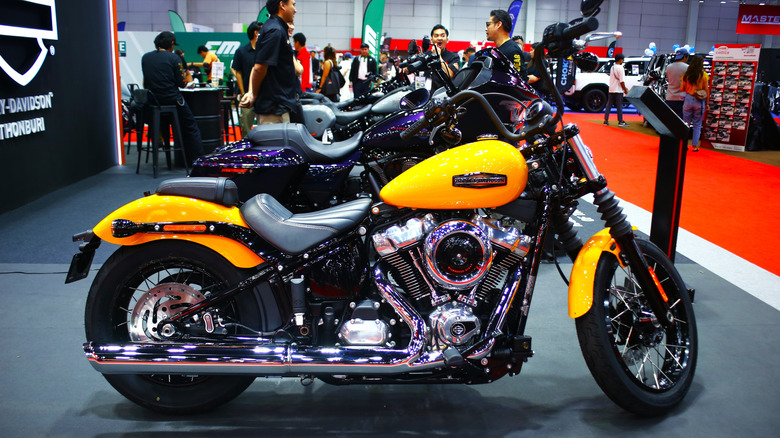
Harley-Davidson's cruiser lineup consists mainly of motorcycles featuring Harley's big V-twins with the modern Softail frame, but with either a fat (FL) or narrow (FX) front end. These include the FLFB (Fat Boy), where FL stands for the large V-twin and fat front end and FB for Fat Boy. In the FXLRS (Low Rider S), the FX stands for big engine and narrow frame, but the L here is to be clubbed with the RS to represent Low Rider S.
You may think of Harley-Davidson as a traditionalist brand, but the American bikemaker has never been afraid of experimenting, and Harley has owned quite a few motorcycle brands over the years. Harley recently started moving toward modernization with its new liquid-cooled Revolution Max motor, and the motorcycles underpinned by it get a new code as well. For example, in the RA1250S (Pan America Special), the R stands for the Revolution Max engine, while the A stands for adventure motorcycle, 1250 stands for engine displacement in cubic capacity, and S represents special.