

No, Motor Oil Doesn't Come From Dinosaurs
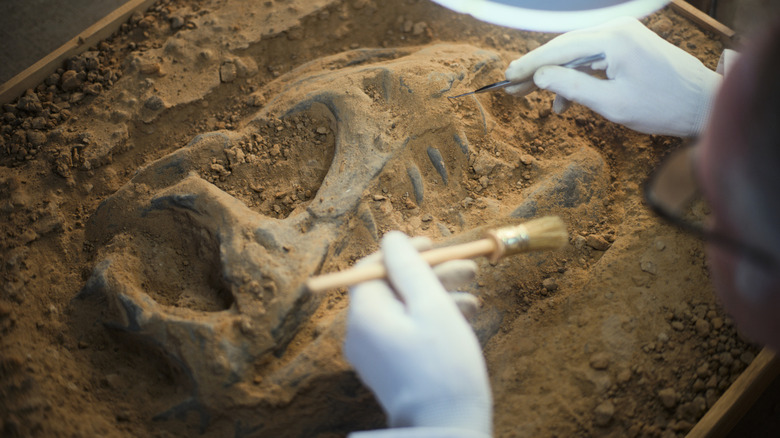
It's been a long-held misnomer that our vehicles run on what was left behind by dinosaurs. And this isn't the only bit of fiction surrounding the lifeblood of an engine. There are several motor oil myths that just won't go away, despite attempts to dispel them.
Oil is formed by decaying organisms, but not the massive dinosaurs that used to walk the Earth. In fact, per YouTube channel EDGE Science, more than half of the petroleum trapped in the Earth is from rocks dating back to the Jurassic and Cretaceous period, when dinosaurs were still around. The miniscule microalgae from oceans are responsible for oil deposits, as they pass away and sink to the sea floor. Then, these dead organisms pile on top of each other and sediment forms layers over them. This creates an environment of both pressure and heat as bacteria break down the remains.
This process creates different byproducts such as natural gas, but oil only forms within a narrow set of conditions called the "oil window." This makes it challenging to recover, as the sweet spot is over 1.8 miles down at a temperature near 194 degrees Fahrenheit. When these deceased organisms are closer to the surface and at lower temperatures, they will produce Kerogen. Conversely, deeper depths and greater temperatures are more likely to produce gas. This is partially why it's important to recycle used motor oil, as it can be re-used to help environmental conservation efforts.
Where did the whole notion of dinosaurs creating motor oil come from?
It's impossible to pinpoint when exactly this myth was born, but there are a few culprits that likely played a part. First of all, the term "fossil fuels" probably led quite a few people astray. Dinosaurs are one of the better-known examples of fossils, but they aren't the only examples of fossils out there — just the most popular. (And for those with an extremely healthy amount of disposable cash, you can buy a dinosaur skeleton, though it could run up to $6,000,000.) In reality, even a large marine dinosaur wouldn't produce the same effect as the phytoplankton once it died and came to rest on the ocean floor. Scavengers like fish and worms would break down the animal quickly, leaving nothing left for humans to use as fuel.
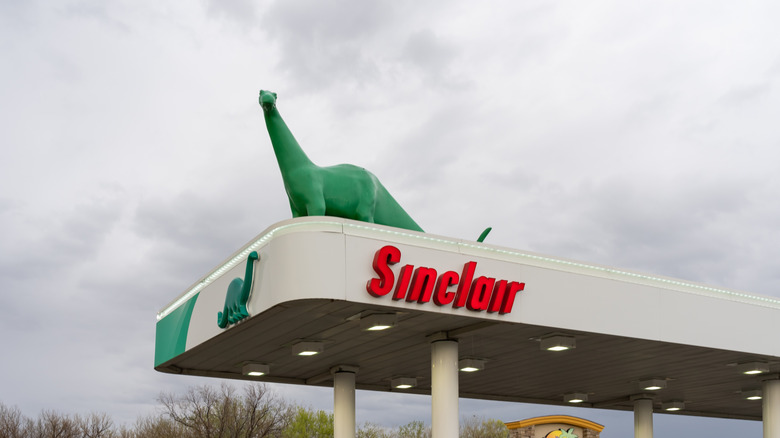
Arguably, a company and its mascot might be more responsible for the confusion surrounding oil and dinosaur fossils. Sinclair, a U.S. oil company, decided to introduce a green Brontosaurus named "DINO" to its advertising in the 1930s. DINO took off in popularity, and Sinclair further cemented the connection between oil and dinosaurs when it sponsored a major exhibit at the 1933 World's Fair, which showcased life-sized replicas of the ancient beasts. DINO appears as a logo on Sinclair gas station signs and as a smaller 3D model near some of its fueling pumps. The green dinosaur even appeared in the Macy's Thanksgiving Day Parade as a giant inflatable balloon.