

6 Cars You'll Always Associate With Steven Spielberg Films

There's much debate about which are the best cars to play roles in movies. Steven Spielberg's movies have no shortage of contenders for cars that should receive recognition. Some of the cars used in Spielberg movies are iconic because of the epic scenes surrounding them, others for the stage they offered for the telling of a dramatic story, and at least one that fit the part so well it's instantly recognizable as the star of the show.
Throughout Spielberg's long career, he's used cars to convey the personalities of heroes and villains. In one classic movie, it was his guidance that led to the path of selecting what would become the perfect time machine. He was even instrumental in bringing us a car that could be from the future.
Some of the cars used in Steven Spielberg's films have reached the status of cultural icon. The "Back to the Future" DeLorean DMC-12 is a prime example. However, there are cars from throughout his career that you'll always associate with Spielberg films once you've experienced them.
Steven Spielberg's directorial debut
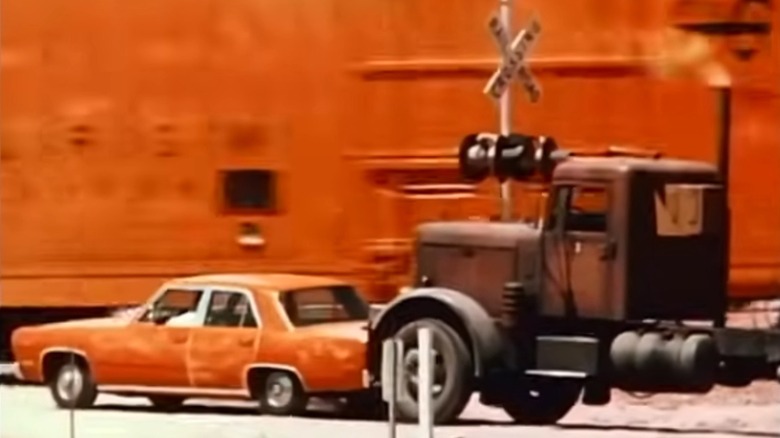
Spielberg launched his career as a movie director with the scariest car movie of all time, the made-for-TV "Duel." Released in 1971, "Duel" stars a 1971 Plymouth Valiant De Luxe and Dennis Weaver as David Mann, a businessman traveling through the desert of the American Southwest to meet a client. Along the way, Mann passes a slow-driving trucker in a dilapidated tanker truck, portrayed as a 1955 Peterbilt 281, although other model years were likely used in the production. The trucker takes offense at being passed and begins to stalk Weaver's character in a fit of road rage.
From there, Mann must pilot his dusty red Valiant De Luxe through the desolate landscape trying to evade the truck driver's murderous intentions. Although it's likely that the Valiant Mann drives features the nearly indestructible 225-cubic-inch slant-six engine and TorqueFlite three-speed automatic transmission, with under 60,000 miles according to shots of the odometer, the stress of outrunning the tanker up a steep grade causes the radiator hose to fail at the worst possible time.
You'll have to watch the movie for more details and to see if the Valiant (and Mann, of course) survives. Once you've watched "Duel," you'll never be able to look at another early-1970s Plymouth Valiant without thinking of the classic film that put Steven Spielberg on the map.
The 1973 Dodge Polara from The Sugarland Express
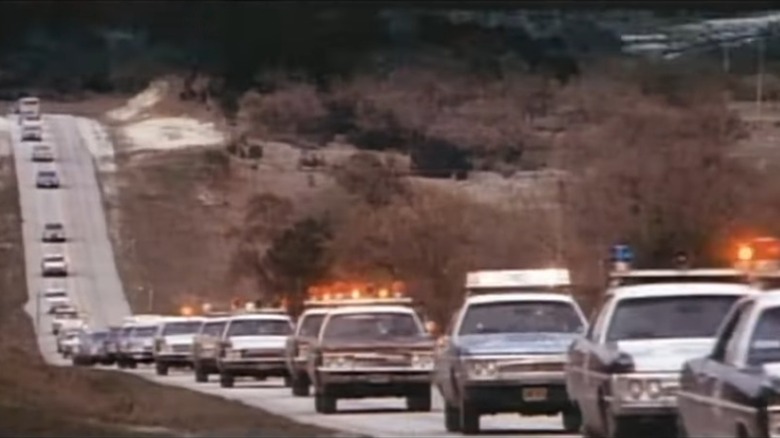
The first big-screen movie Spielberg directed, "The Sugarland Express," was released in theaters in 1974. The movie centers around Lou Jean Poplin, played by Goldie Hawn, who leads authorities and vigilantes on an epic chase across Texas after breaking her husband, Clovis (William Atherton), out of prison. They kidnap Maxwell Slide (Michael Sacks), a rookie Texas state trooper, and steal his 1973 Dodge Polara police cruiser. While the movie includes a large number and variety of vehicles, the Polara is in the middle of the action for most of it.
A 1970s Dodge Polara police car likely came with dual exhaust connected to a 440-cubic-inch V8 fed by a four-barrel carburetor. It would have had around 280 horsepower and 380 pound-feet of torque. In addition to the top-spec engine often found in police cars of the time, the Polara cruiser would have special tires, a TorqueFlite automatic transmission, a limited-slip rear-axle differential, and extra-heavy-duty suspension, electrical, and cooling systems. In addition, some Dodge police cruisers had a cutoff switch for the air conditioner compressor to free up more power during high-speed pursuits.
The DeLorean DMC-12 from the Back to the Future franchise
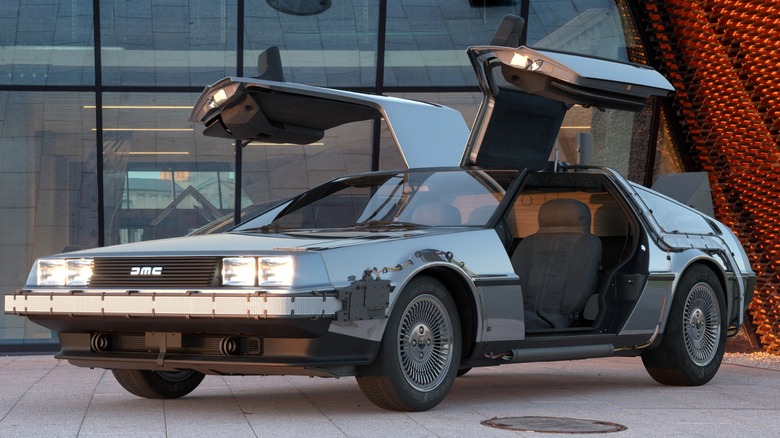
While some consider Doc Brown's DeLorean among the most overrated movie cars of all time, there are few who'd argue that it's not iconic. Even Motor Trend calls the DeLorean time machine "one of the most iconic movie cars ever created."
Spielberg didn't direct "Back to the Future," instead being credited as an executive producer. However, it was Spielberg's vote against using a refrigerator as the time-traveling vehicle, as suggested by the original script, that led to using the DeLorean DMC-12.
The DeLorean DMC-12 fit the time-machine concept well. Its gull-wing doors and bare metal exterior made it look like a car that had already traveled back in time from the future. However, its poor quality construction and underpowered 2.8-liter V6 engine land it squarely in overrated territory and likely led to the demise of the DeLorean Motor Company.
The DeLorean Motor Company produced the DMC-12 for three model years, starting in 1981 and ending in 1983. The original "Back to the Future" movie, which hit theaters in 1985, used three 1981 DMC-12s, cars A, B, and C, each with a specific purpose. The A-car, or "Hero Car," is the only one to make it through filming the trilogy unscathed as the C-car's rear portion was dismantled to allow filming interior shots and the B-car was ultimately destroyed by a ... Sorry, no spoilers.
Steven Spielberg gave us two cars to remember with Jurassic Park
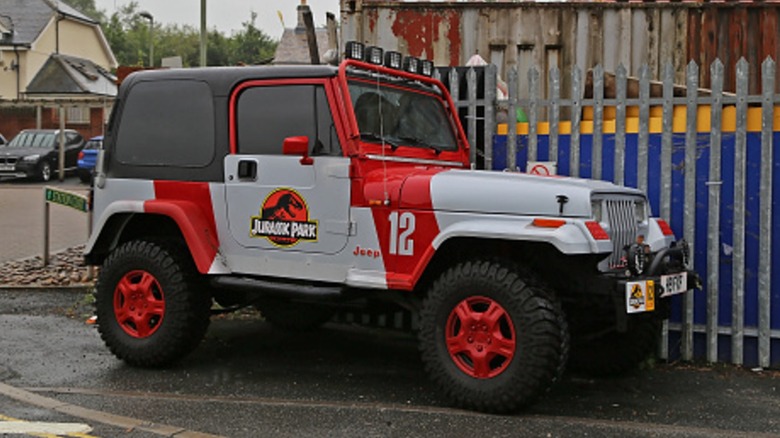
Director Spielberg propelled two 1992 model-year vehicles toward cultural icon status with the 1993 release of the original "Jurassic Park," the Ford Explorer and Jeep Wrangler. Other than being classified as SUVs, "Jurassic Park" may be the only thing the two have in common, as the Wrangler is widely known as one of the best SUVs for going off-road, and the Explorer is not.
While neither Ford nor Jeep mass-produced any "Jurassic Park"-edition vehicles, both SUVs are popular enough to inspire re-creations built by fans. Jeep made it easy with a limited-edition "Jurassic Park"-themed graphics decal package for 2018 to 2024 Wranglers and 2020 to 2023 Jeep Gladiators timed to coincide with the movie's 30th anniversary. However, the decals don't exactly replicate the graphics used on the movie Wranglers.
The lack of professional graphics for the Ford Explorer doesn't stop enthusiasts from re-creating the iconic SUV.
However, it seems that most "Jurassic Park"-themed Explorers lack the viewing bubble present in the movie.
Unlike the "Jurassic Park" Explorers, which were essentially self-driving autonomous theme-park rides, the movie's Jeep Wrangler Saharas were fully functional off-road vehicles. Park officials — and villains — could use the Wranglers to freely roam the island the park called home.
The futuristic Lexus 2054 from Minority Report
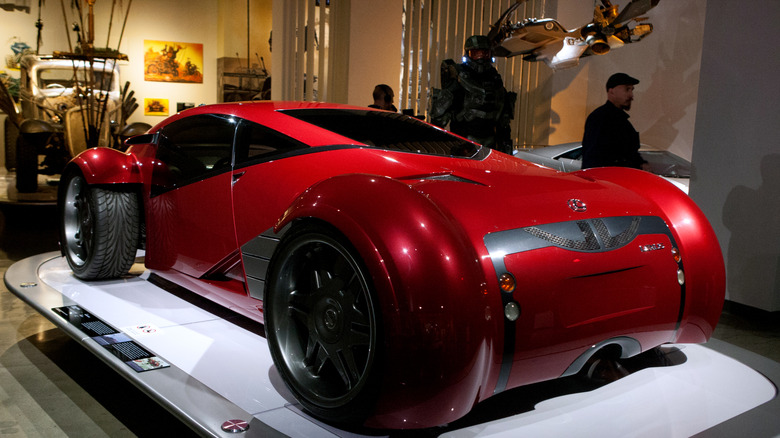
Near the top of anyone's list of fictional cars they wish were real is the Lexus 2054 from "Minority Report." The 2002 movie, directed by Spielberg and starring Tom Cruise as John Anderton, is set in the once-distant future in the year 2054. Spielberg's inspiration for partnering with Lexus came from his personal 4x4 Lexus SUV.
The Lexus 2054 is introduced in the movie as it is assembled on an automated line around Anderton before he ultimately speeds away in the completed car, escaping those trying to arrest him for a murder he has yet to commit. Later scenes including the Lexus are less intense, with Anderton shown driving the futuristic car through the countryside as he works to prove his innocence.
The Lexus press release for the car's appearance at the 2002 British International Motor Show reports the car features a drive train containing 47 batteries, an electric drive motor, and a gearbox with four forward speeds and reverse. Its interior features seating for two occupants within its "cab-forward" design. While some of the car's features shown in the movie, such as the instrumentation and head-up display, were added during post-production using special effects, it is a functional vehicle with real doors, tilt steering, and reclining seats.