

IAT Vs. OAT. Vs. HOAT Coolant: What're The Differences And Which Type Do You Need?
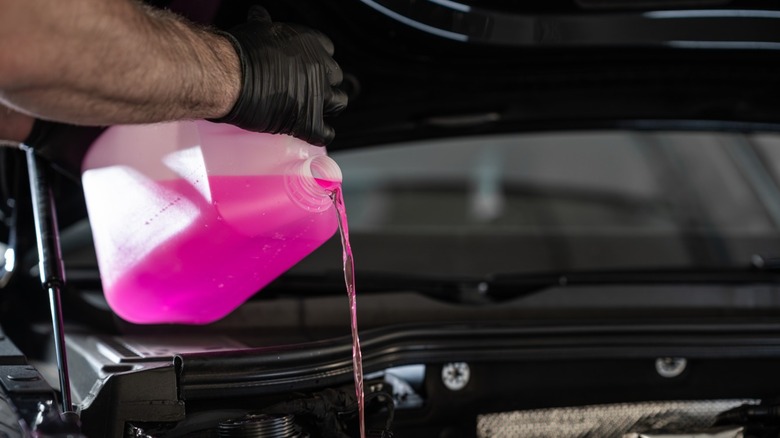
Remember when nearly all coolants used to be green? Now they seem to come in every color of the rainbow. Are they all really that different? What sets them apart, and how do you know which ones to use?
The old green coolant you remember is called IAT, standing for inorganic additive technology, and it's still around. It's used today in older vehicles. However, most modern passenger cars use OAT or HOAT coolants. All of these types of coolant have a base of ethylene glycol or propylene glycol mixed with water. What makes them different are the additives. OAT coolants use purely organic additives, while HOAT coolants use a hybrid version of OAT and IAT. IAT coolants are great for combating corrosion in older cars, while OAT coolants last much longer, which is good since bad things happen when you don't change your coolant on time. HOAT coolants seek a balance between the two.
Which one should you use? That's already been decided by the manufacturer of your car. So, always consult your owner's manual to determine which coolant is right for your vehicle. Don't just go by the color, because the color of a coolant is just the result of whatever dye the manufacturer decided to put in it. And never mix one type of coolant with another, since this can cause additive drop off and allow sludge to form in your system. Just go with the specific recommendations for your car, and you'll be okay.
IAT – the OG of coolants
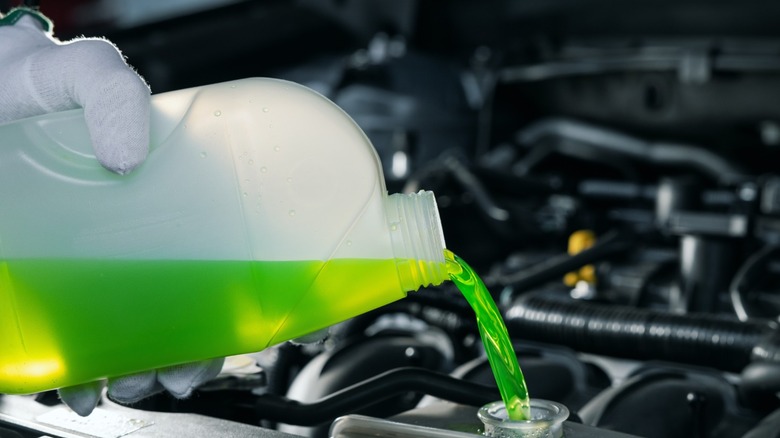
There was a time when picking up the right coolant for your car was pretty simple. Before the mid 1990s, nearly all vehicles took IAT coolants. At that time, picking an antifreeze from the store shelf was a more about which brand you trusted, rather than which type you needed.
Older engine blocks were made of cast iron, along with brass and copper radiator parts, unlike the aluminum engine blocks in modern cars. And so, while like most coolants, IAT is a mix of ethylene or propylene glycol and water, inorganic inhibitors like silicates and phosphates are added to it instead of the organic additives found in OAT or HOAT coolants. The downside to IAT coolants is that they don't last long. They need to be changed every 2 years or 30,000 miles. Silicates and phosphates are sacrificial, meaning that they deplete quickly. If the coolant isn't changed by that time, it can become acidic and damage your car's engine.
Newer types of coolants last much longer, often longer than many drivers keep their vehicles. Does that mean you should upgrade to OAT or HOAT coolants if you have an older car? Check with your vehicle's manufacturer. If your car's manufacturer calls for IAT coolant, then that's what you should use. If you are able to upgrade, flush the IAT before adding HOAT or OAT coolant, since the additive types aren't compatible and will gel into a sludge when different types of coolants are mixed.
OAT – longer lasting coolants with organic additives
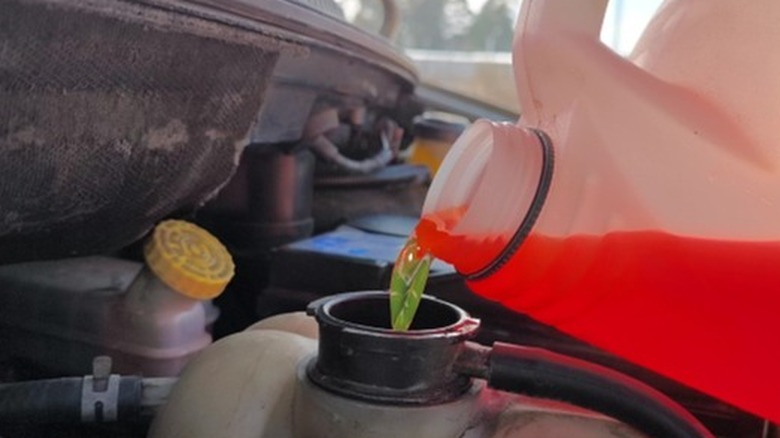
If you've had to top off or change the coolant in a GM vehicle, you've likely used the trademarked orange Dex-Cool coolant, the GM-approved coolant for its all of its modern models. Dex-Cool is an organic additive technology (OAT) coolant, but it's not the only type of OAT coolant on the market, and not all OAT coolants are orange like Dex-Cool. That goes to show why you should never go by color alone to determine whether a coolant is compatible with your vehicle.
OAT coolants don't contain silicates or phosphates like IAT coolants, but instead use organic additives like carboxylate-based organic acids. These additives don't coat the entire system like the ones in IAT coolants do. Instead, they target the corrosion sites specifically. Another advantage of OAT coolants is that you can expect less accumulation of deposits in the system. Also, the organic additives don't deplete as fast as silicates and phosphates, so the coolant itself lasts much longer than IAT coolants, with recommended changes at every 5 years or 150,000 miles for passenger cars, and up to 600,000 miles or 12,000 hours for heavy-duty mixtures.
There are plenty of advantages to organic additives, but they don't have the same anti-corrosion properties that silicates and phosphates do. So, OAT coolants are not necessarily ideal for older engines or some heavy-duty vehicles. In addition to GM vehicles, you'll also find OAT coolant in some VW, Saab, Ford, Chrysler, Fiat, and Jeep models.
HOAT – the best of both worlds
So, IAT coolants are good at preventing corrosion but don't last very long. OAT coolants last a long time but aren't as good at preventing corrosion. Wouldn't it be nice to if there was something in between? Enter hybrid organic acid technology (HOAT) coolants. HOAT coolants take the best aspects of both types and form a long-lasting mixture that acts against corrosion.
HOAT coolants mix in a little bit of phosphate and/or silicate additives to provide greater protection against corrosion. Some only add phosphate or silicates. These are HOAT sub-types called P-HOAT or P-OAT and Si-OAT, respectively. But they are all basically a hybrid version of OAT and IAT coolants. They can last a long time, with changes typically recommended at 5 years or 50,000 miles, though some can go as long as 10 years or 150,000 miles. Of course, you should check even long-lasting coolant from time to time for level and discoloration. Brown coolant indicates you're overdue for a flush, and it can be a sign of other issues, too.
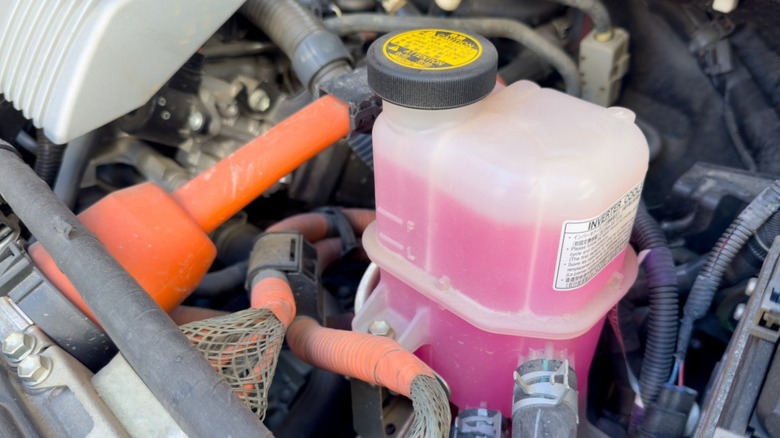
What cars take HOAT coolant? Some Chrysler and Ford models are known to use it. P-HOAT coolants are frequently used by Asian manufacturers like Toyota, Honda, Subaru, Hyundai, Kia, and Nissan. In fact, Toyota brands its own pink version of it. Si-OAT is often blue or purple and found in European models like VW, BMW, Mercedes-Benz, and Porsche.
What about all makes, all models coolant?
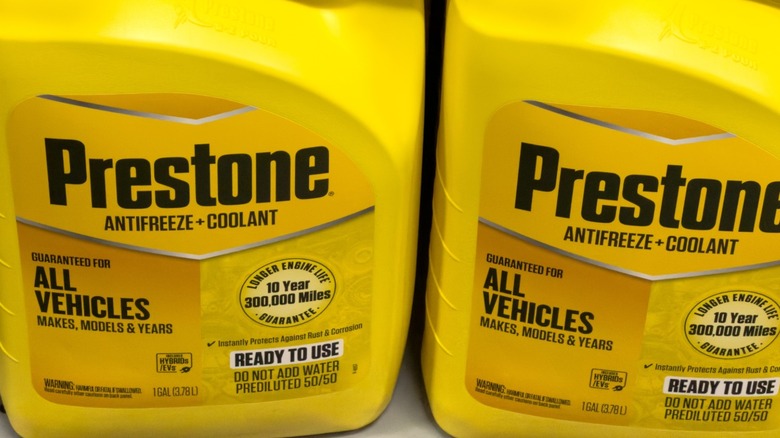
What about that universal coolant that labeled as "all makes, all models"? These coolants claim to be compatible with cars that require IAT, OAT, and HOAT coolants. Are they really that universal?
If you're in a bind with an overheating car and you can't find the coolant that was designed for your vehicle, topping off with universal coolant will probably be okay, especially if you're going to flush your coolant later. But this type of coolant was mainly made for mixed fleets. It saves fleet owners from keeping a bunch of different coolants in the garage. So, there are risks associated with using it in a passenger car. It could even void your warranty. And just because a coolant meets the minimum definition of "compatible" doesn't mean it provides the same protection as the coolant that was actually designed for your car. Some vehicles require very specific additives to protect various engine components. Manufacturers of those cars include Ford, BMW, and Toyota. You should also be especially careful if you drive a high-performance car.
Your best bet is to use the coolant specified by your vehicle's manufacturer. This can usually be found in the owner's manual or sometimes in the info on the coolant's label. The point is coolants are not all the same nowadays. Make sure you use the one that's made for your car. And while you're at it, check out our guide on signs that you need a coolant flush.