

What're The Differences Between Kenworth And Peterbilt Semi Trucks?
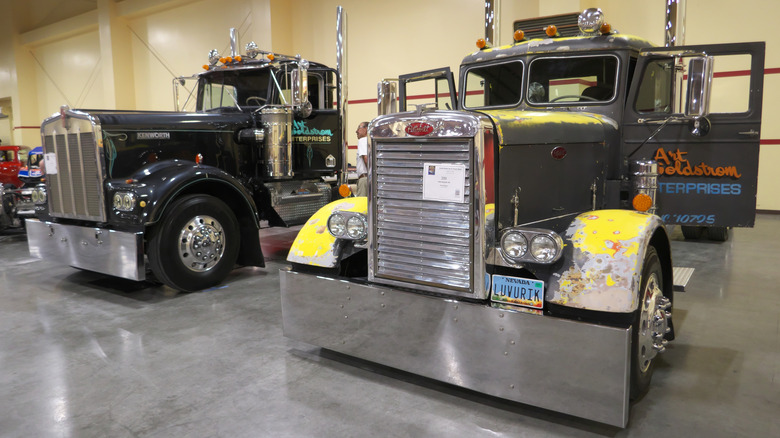
Before we deal with the differences between the Kenworth and Peterbilt semi-truck brands, we have to spend a minute on their very large similarity: Both are owned by the same company — Paccar — and they have been since the late 1950s. The current trucks even share the same engines.
Paccar has a tangled corporate history that includes roots in the Pacific Car and Foundry Company, making the steel for the Seattle Space Needle, and purchasing Kenworth in 1945 to enter the heavy-duty truck industry. Some 13 years later, Paccar bought Peterbilt to bolster its presence in the marketplace. And that's just part of the picture — but looking at every semi-truck brand owned by Paccar would take an entirely different article.
When it comes to distinguishing Kenworth and Peterbilt, the official company line focuses on geography. According to Paccar, "Kenworth Truck Company builds premium commercial vehicles for sale in the U.S., Canada, Mexico and Australia and for export throughout the world," while "Peterbilt Motors also designs, manufactures and distributes premium commercial vehicles in the US and Canada."
Anecdotal evidence in the United States indicates both are quality choices. Kenworth is considered more of a no-nonsense brand with lower costs, but also fewer deluxe features and a lower resale value. Peterbilt trucks have a reputation for going beyond work-focused features with a car-like range of creature comforts. So you could say Kenworth is the Toyota to Peterbilt's Lexus.
Peterbilt for power, Kenworth for efficiency
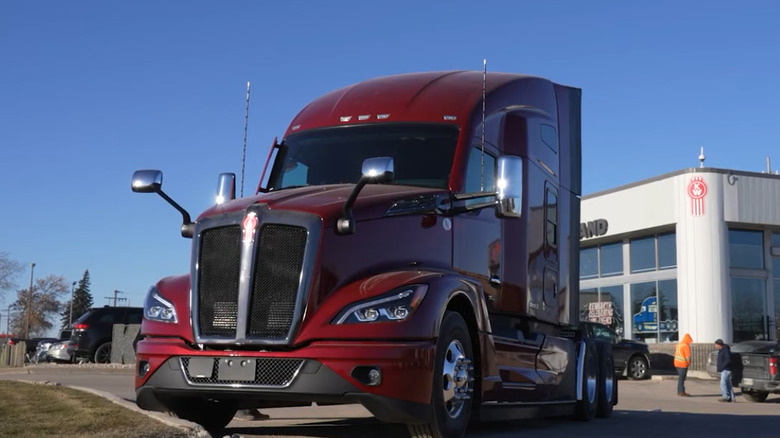
We've mentioned that Peterbilt and Kenworth trucks rely on the same engines, yet they're not always tuned the same way. Consider the brands' primary long-haulers, the Peterbilt 579 — a successor to the 379, the same kind of semi truck as Optimus Prime — and the Kenworth T680. Each is available with Paccar MX-13 12.9-liter inline-6 engine, and the motor can deliver up to 605 horsepower and 2,050 pound-feet of torque for the Peterbilt truck. It's capped at 510 hp and 1,850 lb-ft in the Kenworth. Perhaps unsurprisingly, it's the same story — with the same engine and same output specs — when comparing the Kenworth W990 and Peterbilt 589 longhood trucks.
One notable outlier, though, is in the HD EV segment. Here the Peterbilt 579E and Kenworth T680E ride with the same Paccar electric power train that makes the same output for both applications: up to 605 hp and 1,850 lb-ft. Kenworth does seem to have a slight efficiency edge versus Peterbilt for its flagship EVs, as the T680E checks in with a manufacturer-reported range of 200-plus miles and the 579E is listed with a range of 100 to 200 miles.
Diesel efficiency numbers are trickier to discover. Kenworth and Peterbilt pretty much stick to generalities, although Kenworth indicates the newest T680 is up to 7% more efficient than the model it replaced. A search of the internet does show many sites — including Fleetsworld — emphasizing Kenworth's efficiency over Peterbilt's.
Luxury and technology
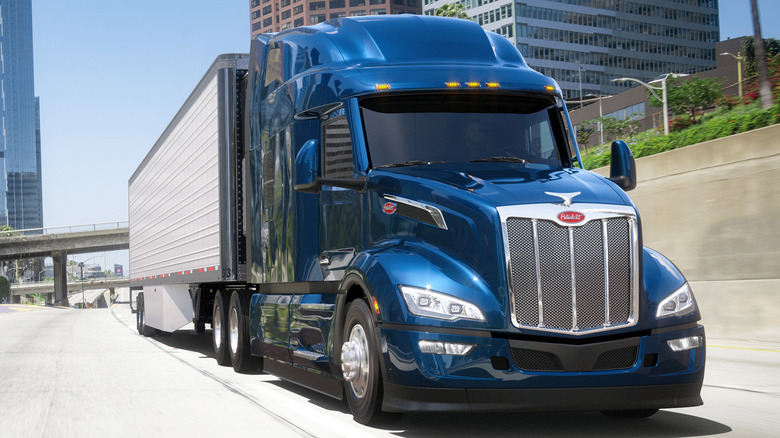
We can also go straight to the ol' horse's mouth to get an idea of the differences in positioning between Peterbilt and Kenworth. For instance, in promoting the Peterbilt 589 we touched on above, its maker calls it "the ultimate reward" backed by quality, elegance, precision, and style, with a dose of "industry-leading fit and finish" adding to its beauty. It almost sounds like a description of a German luxury sedan. (Of course, there are pros and cons to buying a German car, too.)
The Toyota/Lexus comparison we started with is apt here as well. For example, you can get heated/ventilated massage seats in the Toyota Sequoia and the Lexus LX alike, but you probably won't confuse the two. So it goes with the cabins of trucks like the Peterbilt 579 and Kenworth T680, which offer much the same driver-assistance technologies, luxe seating appointments, and infotainment setups, only with differing degrees of upscale ambience.
Just check out their accommodations behind the front row. The Kenworth Driver's Studio for the T680 — a 76-inch sleeper setup — appears like a nice place to spend downtime. After all, it can be bought with a 180-degree swiveling passenger seat complemented by a swiveling table and a TV mount capable of handling a 28-inch flatscreen. Meanwhile, the UltraLoft of the Peterbilt 579 can be optioned with the same goodies, but it's a slightly larger 80-inch sleeper configuration and can fit a 32-inch TV.
Any Jalopniks out there with seat time in one of these trucks? We'd love to hear about your experiences.