

Diesel Vs. Gas Engine Maintenance: What Typically Costs More And Why?
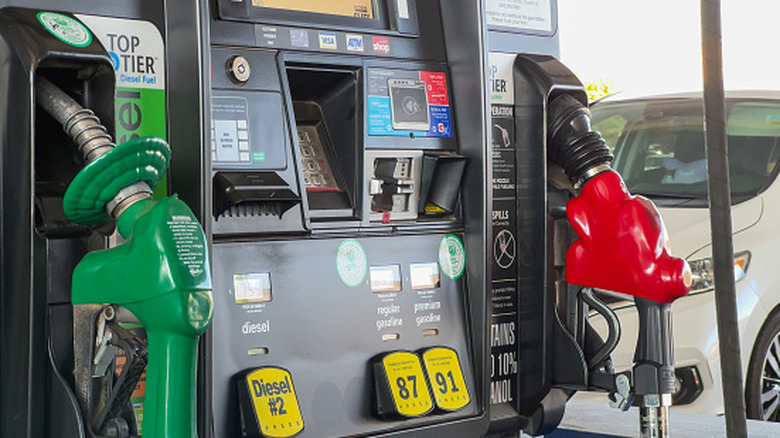
Gasoline and diesel engines are very different. The former rely on spark ignition while the latter use compression ignition. Diesel engines typically run at much higher compression ratios than gasoline engines, which is why they're often heavier and more robust. While diesels are generally considered more durable, this comes at a cost. In terms of maintenance, diesel engines are, on average, more expensive than gasoline engines.
Sure, gas engines require more frequent servicing, but the cost per visit is much less than that of diesel engines. The reason gasoline engines require frequent upkeep is that they have high engine speeds relative to diesels. There are other factors too. For instance, spark plugs (depending on the engine, material, and usage) typically require replacement after 20,000-30,000 miles, while glow plugs can last over 100,000 miles.
Diesel itself is a lubricant and gasoline is not, which is why putting gasoline in a modern diesel engine is much worse than putting diesel in a gas car. The fuel's lubrication property, in addition to robust internals, helps diesel engines run longer intervals between oil changes.
Relatively speaking, gasoline engines are less complex than diesels – diesel parts like fuel injectors, filters, glow plugs, and DEF (Diesel Exhaust Fluid) don't really come cheap. And although gas engines have spark plugs, filters, and require oil changes, these are comparatively cheaper. Also, the coolant and engine oil specs of diesel and gasoline engines are different, as diesels typically run at higher operating temperatures and pressures.
Breaking down maintenance and running costs
Something else to note is that diesel is heavier and more viscous than gasoline, and not as refined. Plus, diesel is hygroscopic, meaning it has a tendency to attract water. So most diesel engines rely on multi-stage filters (primary and secondary) that are much more efficient at filtering out the impurities, as opposed to the ones you'd find in a gasoline engine. Also, diesel engines are commonly seen having additional water separators often (but not always) integrated into the filter itself.
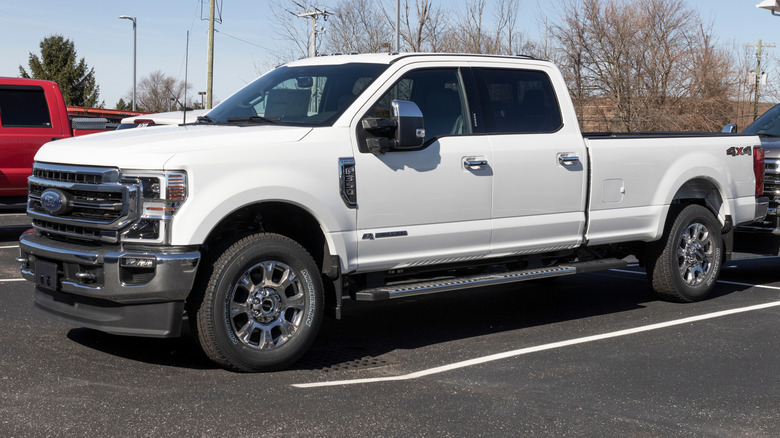
To better understand diesel versus gasoline maintenance costs, let's compare a 2020 F-350 Super Duty in its 6.7L diesel avatar against the 6.2L gasoline model. Quick disclaimer: the figures are based on Edmunds' True Cost To Own set to Phoenix, Arizona.
Over a period of five years, the diesel F-350 costs $9,426 in maintenance, while repairs stand at $4,484. On the other hand, the 6.2L F-350 is roughly a grand cheaper ($8,311) to maintain, with repairs amounting to $3,647. That's just the maintenance and repair side of things, and these can change significantly based on your use case.
While diesel engines are typically more efficient than gasoline engines, that's not the whole story. Diesel prices have typically been on the higher side versus gasoline, but the difference is quite substantial over a five-year period. The gasoline F-350 is estimated to consume roughly $16,000 worth of fuel over five years, while the diesel F-350 is looking at a fuel bill north of $18,000. If you tow a lot and rack up many miles, a diesel makes more sense, but otherwise, stick to gasoline trucks.