

Here's How Much Weight The Ford F-150 Has Gained Through The Years
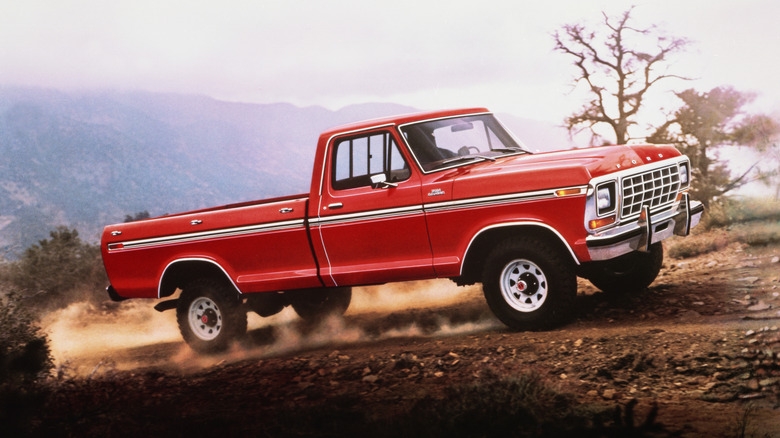
Ford really transformed the American pickup truck industry when it launched its F-Series line of trucks way back in the late 1940s. It first arrived very much in the same way that pickup trucks had always arrived — geared towards hard work — which meant it was capable but basic, with little in the way of amenities or creature comforts.
As the years progressed, so did the F-Series. It wouldn't be until 1975 that the now ubiquitous F-150 would hit the scene, as a way of blending the best of both worlds between the heavy-duty F-250 and the light-duty F-100. Before long, the F-150 established itself as the hot-seller of the group, ultimately replacing the F-100 entirely and heading out on a mighty run that, to date, spans 51 years.
Throughout those last five decades, much has changed in the way of the F-150. Engines have come and gone – some naturally aspirated, some boosted, some even diesel – and the physical nature of the truck has changed somewhat too. Chrome bumpers were dropped, extra doors were added, fancy features and a smattering of comfort-oriented niceties made their way into the F-150. The result of all this growth is that the evergreen F-150 fluctuated an awful lot throughout the years in terms of weight.
So let's highlight the key points along that journey, starting out with the very first '75 F-150 and leading us right up until the modern day-variant. Along the way, we will revisit key generations and turning points in the F-150's history in order to see how the Ford measured up on the scales throughout its legendary tenure as America's favorite pickup truck.
The early years
Ford was clever with the F-150 when it was first introduced back in 1975. New emissions regulations applied to vehicles with gross vehicle weights south of 6,000 pounds, which meant the installation of catalytic converters and use of unleaded fuel. This resulted in reduced performance, which would likely deter buyers, so Ford ensured the all-new F-150 skirted around these rules.
Upon launch, the truck sported a gross vehicle weight of 6,050 lbs – just hefty enough to avoid these new rules, but not so chunky that the weight hampered performance or stood on the F-250's toes. This approach worked well for Ford; just two years later, the F-Series was America's best-selling pickup truck line, outperforming Chevrolet, and things have remained this way even since.
Although information on these older trucks is a little scarce in comparison to newer models, multiple sources show that these first F-150 models sported curb weights in the region of 3,800 lbs, with 4x2 models coming in a little lighter, at around 3,000 lbs and up.
But of course, different specifications would have seen the scales move around a little. The first-gen F-150 (sixth-gen F-Series) was available with a smattering of six- and eight-cylinder engines, so the exact weight depended on how the truck was specified.
Square-body F-150 trucks saw the scale readings drop
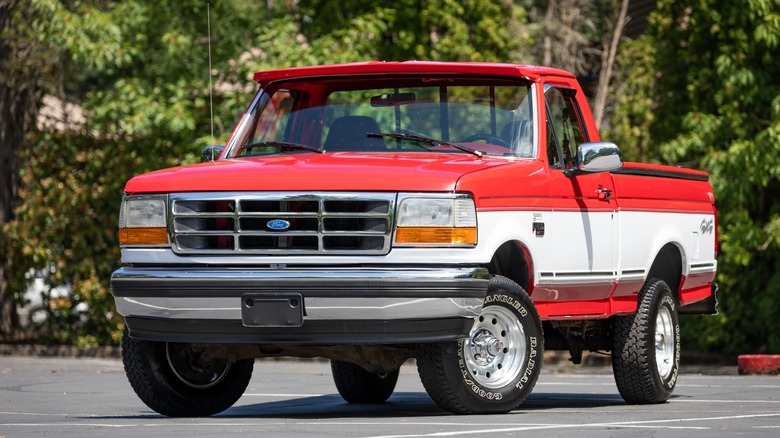
Ford introduced the first square-body F-150 in 1980. This look continued throughout the seventh, eighth, and ninth generation, concluding in 1997. As is typical with automotive evolution, when vehicles get revised and renewed, they get larger, sport more standard equipment, and generally pack more capability than previous models. This generally sees curb weights climb, and the F-150 is no exception to the rule.
Most sources point to the square-body generations of F-150 tipping the scales between 3,400 and 4,000 lbs, with extended bed and four-wheel drive versions sitting on the heavier side of things. This isn't worlds apart from what the earliest F-150 models used to weigh, even though more was packaged into these newer trucks.
Period brochures demonstrate that the F-150s of this era still boasted similar GVW ratings though, with 6,000 lbs and upward being the norm for four-wheel drive models.
The new millennium brought about many new changes for the F-150
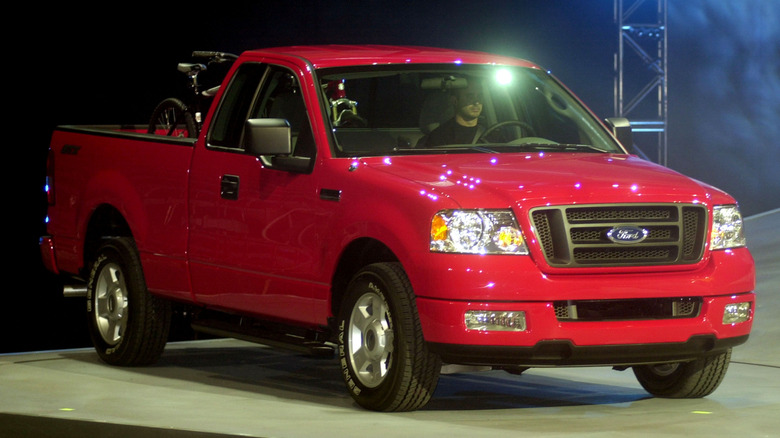
By the time the new millennium was looming, square-body trucks had enjoyed their day in the sun, and it was now time for something new to take over. Enter the rounded bumpers and soft-looking front fascias of the late 1990s and early 2000s — a style which hasn't quite entered the realm of charming retro just yet, unlike the angular designs that preceded it.
Despite the change in appearance, the F-150 continued to impress in the way it always had done. Perhaps the main changes here were the continual shift from work-tool to family truck, so buyers could expect plusher interiors and more amenities, and so the weights went further up.
Late-tenth and early-eleventh generation trucks regularly weighed in at around 4,000 lbs in their base guise, with four-wheel-drive and SuperCrew models sitting closer to 4,600 and 4,700 lbs, depending on the model year. By the end of the eleventh generation, the heftiest F-150 trucks were checking in north of 5,000 lbs, with examples like the 2008 5.4-liter V8-powered SuperCrew model edging ever closer to 5,500 lbs.
EcoBoost power saw the F-150's personality change
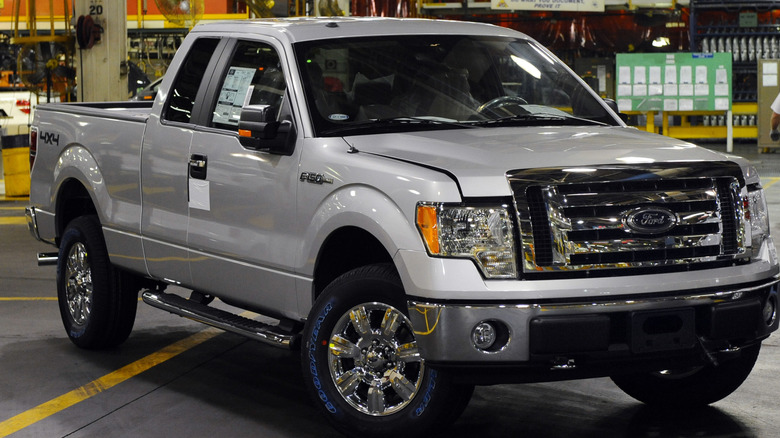
As the F-150 entered the 2010s and its twelfth generation, big changes were afoot. While the tried and tested naturally aspirated V8 engines would continue, the range also began to make way for new EcoBoost engines. This is when turbocharging tech became the norm in the F-Series world, and with that came a variety of other tweaks.
For starters, the EcoBoost engines were new designs which made use of advanced materials. The addition of boost meant smaller engines could do the job of older ones, and the majority of the engine's construction was made of aluminum – noticeably lighter than the old-school iron V6 lumps that preceded it.
Regardless of this change, the difference in weights between previous generations and the later twelfth-gen models was nominal, likely due to an increase in standard equipment and altered dimensions. The last model year of the eleventh-gen F-150 sported a curb weight of between 4,524 and 5,481 lbs, whereas the new twelfth-gen models tipped the scales between 4,707 and 5,584 lbs. The EcoBoost-available models in the latter half of that generation's run exceeded 4,680 lbs.
Modern F-150 trucks aren't as chunky as they look
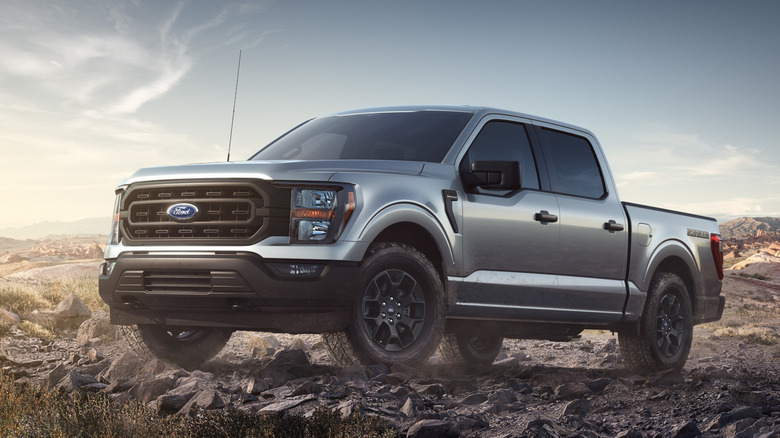
Fast-forwarding to the modern day, we can see that the weight of a Ford F-150 has changed steadily throughout the years. Those very first models, again, tipped the scales at roughly 3,000 to 3,800 lbs. Thanks to packing way more tech, sporting hybrid drivetrains, and boasting far more plush interiors, a brand-new F-150 in 2026 has a curb weight of somewhere between 4,300 and 5,900 lbs.
The lightest F-150 trucks are those with smaller engines and simpler body styles. Regular cabs, 5.5- or 6.5-foot beds, and pure ICE power will net you a truck that tips the scales considerably under 5,000 lbs. As you start specifying SuperCab or SuperCrew body styles, longer 8-foot beds, and in particular the hybridized EcoBoost powertrains, the curb weights soon soar past 5,000 lbs.
The F-150 Raptor R weighs in at 5,910 lbs, with the heaviest regular F-150 being motivated by the torquey PowerBoost hybrid drivetrain, at 5,608 lbs with a 6.5-foot bed and SuperCrew cab. With 700 horsepower on tap, the Raptor R still manages to be scary quick, despite its near-6,000-pound heft.