

Never Jump Start A Modern Car Without Checking For These Things First
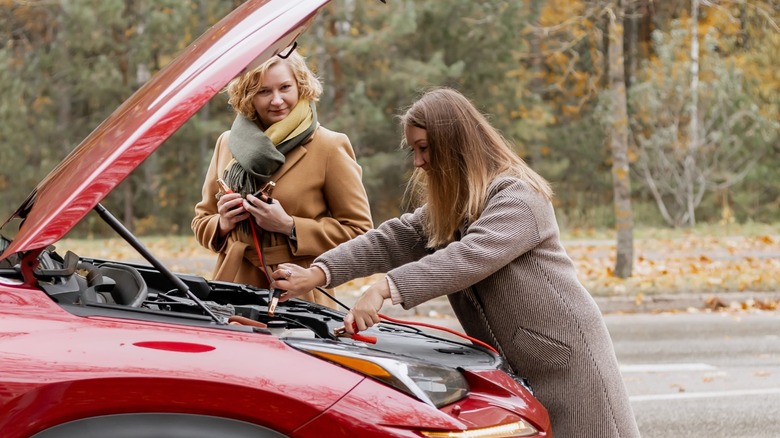
Remember the days when you didn't have to think about what to do next if your car battery died? You just pulled out your trusty jumper cables and took care of it. Things aren't quite that simple anymore with modern cars. Nowadays, vehicles have a lot of complex electronics, not just in the dash, but under the hood as well. These electronics can be damaged in a jump start between two cars.
There's also the placement of the battery and whether you should even use it in a jump start. Many car companies have moved the battery away from the engine bay and want you to use remote terminal posts instead of the battery itself when performing a jump start. Hybrids and EVs are their own monsters entirely, with their own set of rules about jump starting (some manufactures even prohibit using them to jump start another vehicle). And then there's the question of whether the donor car should be running while setting up for a jump start.
All of this can be resolved, of course, by checking the owner's manuals of both cars involved in a potential jump start. The manual will tell you if your car should be used in a jump start. If there are any special requirements, like using remote terminals instead of the battery, the manual should tell you that as well. Whatever the case, you may want to check out our guide on how to tell whether you need a jump start or new battery.
When the battery isn't even under the hood
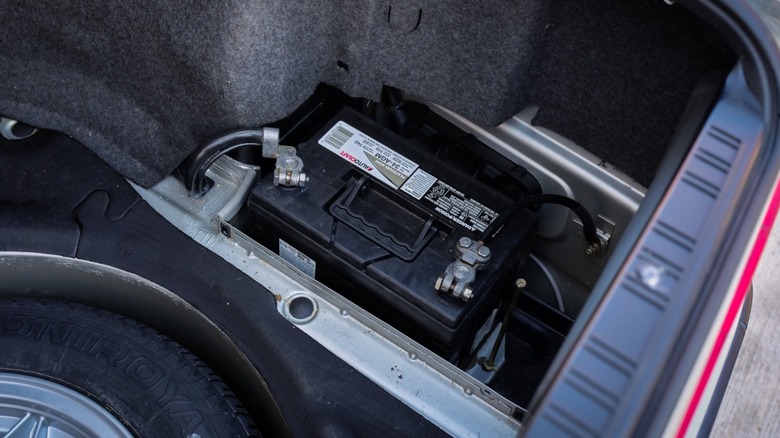
Have you ever been ready to jump start someone else's car only to open the hood of their vehicle to find there's no battery in the engine bay? Some manufacturers have taken the battery out of the engine bay and have hidden it in the trunk or under a seat.
Why? Actually, this game of hide the battery has a couple of purposes. First, while the trunk isn't exactly cool all the time, especially in the summer, it's much cooler than the engine bay when the car has been running. Stowing the battery in the trunk helps to keep it from overheating. The other reason has to do with weight. A lot of weight gets placed under the hood. Sending the battery to the back helps to even that out. Do we like it? No. But those are the reasons some car companies do it that way.
So, how do you jump start a car like that? Instead of the battery being under the hood, there are typically terminal posts where you can connect the cables. If your car is equipped with these, use them instead of the battery when jump starting, even when the car's battery is under the hood. This helps the protect the car's computers from being fried. Some manufacturers have hooked a battery health monitor up to the negative terminal of the battery. So, connecting straight to the battery could interfere with a correct reading.
Should the cars be turned on?
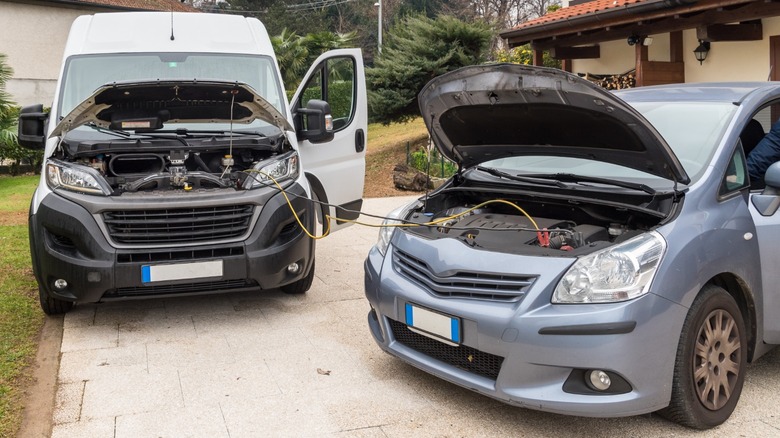
There always seems to be some confusion about whether the donor vehicle should be turned on. Back in the day, we'd connect the cables while both cars were turned off, then turn on the donor vehicle and let the car with the dead battery sit a little bit and soak up the power from the donor battery before turning on the ignition. Sometimes, we'd rev the donor car to help things along. After a few minutes, we'd try to turn on the dead vehicle.
Have things changed for modern cars? Not that we can find. Just about every guide we found pretty much recommends jump starting cars in that order. Some even included the step about revving the engine of the donor vehicle. But not all cars are the same, so it's important to check your owner's manual to determine whether your vehicle should be turned on when jump starting.
One thing that was stressed in the guides that we found was the order in which the cables are connected. Generally, you start with connecting one of the red cables to the positive terminal on the dead battery. Then, connect the other red cable to the positive terminal on the donor battery. Next, connect one of the black cables to the negative terminal on the donor battery. Finally, ground the other black cable to an unpainted metal surface of the donor vehicle, away from the battery.
Should you jump start an EV or Hybrid?
We recommend checking your owner's manual before using your car to jump another or having your own vehicle jump started. That goes double if one of the cars is an EV or Hybrid. Jump starting hybrids is risky because they have two batteries: a high-voltage lithium battery that helps power the motor, and a regular 12-volt battery to power all of the traditional parts, like the stereo and ignition. The 12-volt battery also used to start the high-voltage lithium battery. If the hybrid vehicle is jumping or being jumped, make sure you connect the cables to the 12-volt battery, not the high-voltage one. This may be a challenge, since the 12-volt battery can be in the trunk or under a seat. And remember to stay away from anything that is high voltage.
However, check with your manufacturer first. Kia says point blank, "Do not jump start another vehicle with your hybrid vehicle. Jump starting another vehicle will damage the hybrid vehicle's 12 volt battery." So, read your owner's manual.
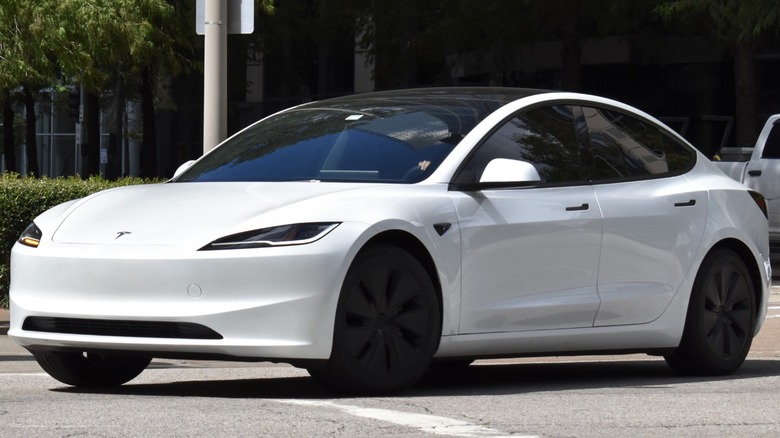
What about an EV? Again, check with the manufacturer to learn whether you can use it to jump another vehicle or if its 12-volt battery can be jumped. Tesla says in its Model 3 manual, "Model 3 cannot be used to jump start another vehicle. Doing so can result in damage." So, there you go. And you should never use one EV to jumpstart another EV.
What to do when you're not supposed to jump start your car
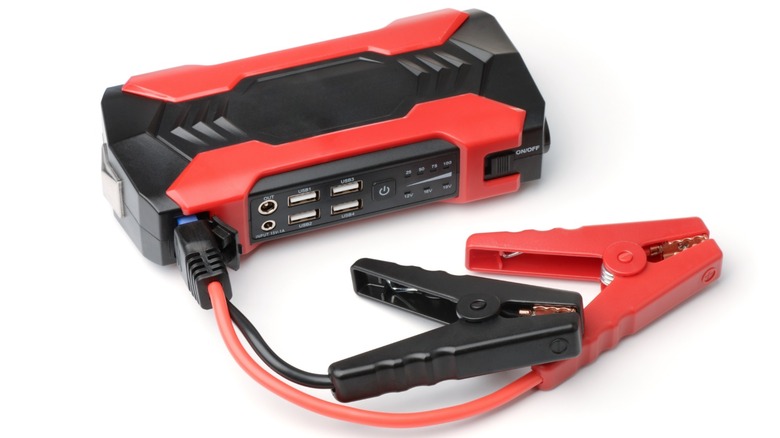
What if your owner's manual tells you not to jump start your battery or use it to jump start another car? What can you do? It's commonly recommended that you use a portable jump starter instead. We use one, and we can tell you that the right booster seems like it can jump a dead battery faster than another car could. They are fairly inexpensive as well. But more importantly, many of these boxes regulate voltage, prevent feedback, and protect the alternator of the donor car.
They work much like jumper cables, but without the second car. You just connect the red cable to the positive battery terminal and the black to the negative, then start your engine, which you should be able to do almost right away. Quickly disconnect the cables and let your car run for several minutes so the alternator can fully charge the battery. The booster itself is rechargeable, and we've been able to do multiple jumps before having to re-charge ours.
There are other reasons to carry this little box around. What if your battery dies and there is no one else nearby? Sometimes, your car battery dies when you're parked in a place that's hard for another car to access. Plus, it's nice knowing you have the independence of not having to rely on the help of strangers if your battery dies.
Why modern cars are this way
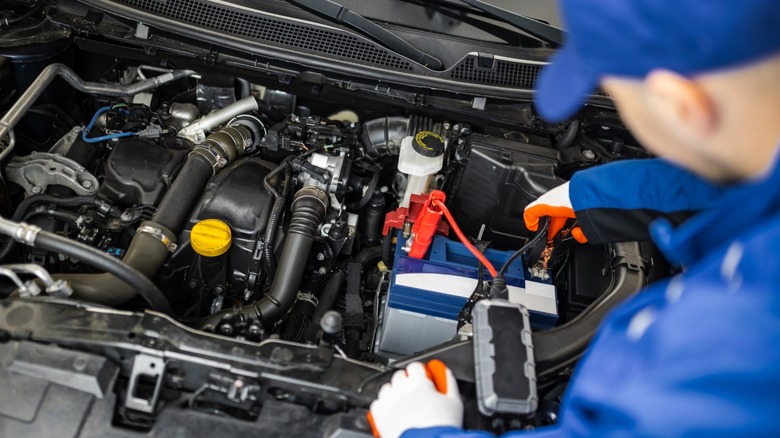
So, why is a simple jump start such an issue with modern cars? It's partly because new vehicles are built with tiny computers called engine control units (ECUs). These little units manage lots of things, from air intake to ignition timing, and they're sensitive. A jump start with another car can blow one of these units or cause them to reset, resulting in the check engine light turning on and multiple codes needing to be cleared.
Jumper cables allow power to flow freely, leaving both cars vulnerable to a power surge, which can cause several problems. Some have reported these surges causing damage to a car's traction control system, power steering, airbag system, and the start/stop system. There's also the possibility of voiding your warranty if you execute a jump start incorrectly. And, of course, we mentioned how some cars connect a battery monitoring system to the 12-volt battery, which a jump start can interfere with.
There are two important takeaways from all of this. The first is that you should always check your car's user manual before executing a jump start on a modern vehicle. Secondly, spend a few bucks on a portable jump starter, and carry it with you in your car. That should eliminate most of the concerns we mention here. It may not be as simple as it used to be, but jump starting is still very doable today in most cases.