

What's The Difference Between Ford's Boss 429 And 429 Super Cobra Jet Engines?
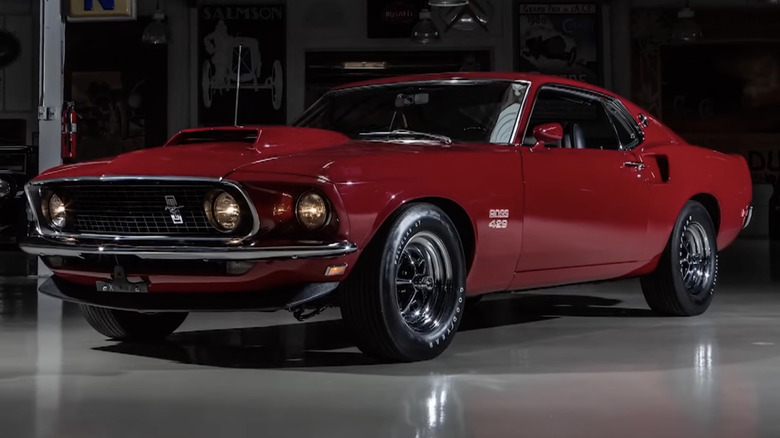
Birthed during the golden era of American muscle, the Boss 429 and 429 Super Cobra Jet (SCJ) are among Ford's most iconic motors of all time. Because of their shared displacement, era and appreciation in the automotive community, these two motors are often lumped together. However, this couldn't be farther from the truth. These two big blocks find their roots in very different sectors of motorsports, opposite tales with equally opposite ways of getting there.
Since the Boss 429 was built to adhere to NASCAR regulations, Ford had to stuff the 7.0-liter V8 into the petite Mustang, which it sold as the Boss 429 Mustang between 1969 and 1970. Meanwhile, the 429 Super Cobra Jet was built around an entirely different engineering ethos that prioritized straight-line dominance on the drag strip — Ford offered the motor in both the Mustang and the Torino with their top of the line Drag Pack trims.
Despite the fundamental differences in the craft and intent of the 429 Boss and 429 Super Cobra Jet, both are among the most capable motors ever sold. In their era, they were a never-before-seen performance benchmark in two of America's cornerstone motorsports.
The Boss 429 was a NASCAR motor with a license plate
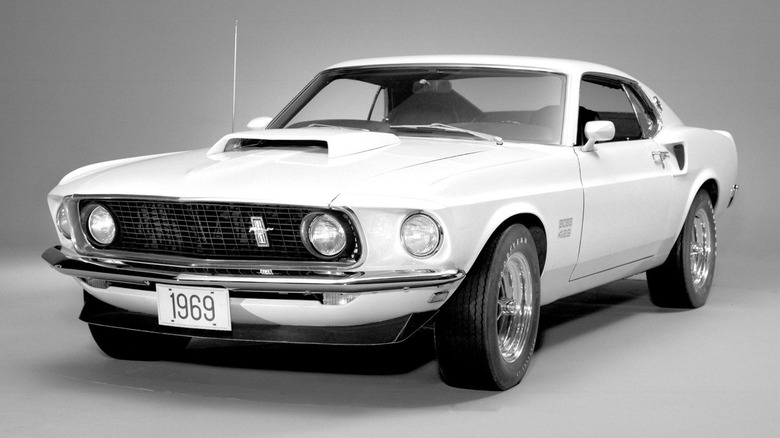
Based on Ford's mass-production 385 series, the Boss 429 was built at the height of Ford's NASCAR rivalry with Chrysler. NASCAR rules required that any engine used in competition was to be sold in a minimum of 500 road-going cars, which meant Ford had to find the right platform to fit its purpose-built stock car motor.
For production, Ford chose the Mustang, which once was offered with the 289-cubic-inch small block as its largest engine option. The 429 demanded substantially more room in the engine bay; the strut towers were widened, the car's battery was moved to the trunk, and air conditioning was omitted entirely. The now famous Boss 429 Mustang was a distinct departure from the initial canvas, and the functional hood scoop highlights its larger-than-life presence. Notably, the production Boss 429 was rated at 375 horsepower, but many will tell you it was pushing closer to 500 horsepower.
The Boss 429 Mustang is the only production car to feature the Boss 429 motor. At its core, it was a naturally aspirated 7.0-liter V8 engineered around stock car optimization. This meant larger cylinder heads with canted valves to move as much air as possible at high speeds.
This kind of engine architecture favored sustained wide open throttle operation, the kind of exertion that NASCAR demanded around ovals. It also explains why the Boss 429 could feel surprisingly subdued at low speeds — an exact opposite of what Ford pursued with the Super Cobra Jet. Nowadays, the Boss 429 represents a bygone time when Ford was willing to bend a street car around a race motor just to satisfy a rulebook.
The 429 Super Cobra Jet was purpose-built for the quarter-mile
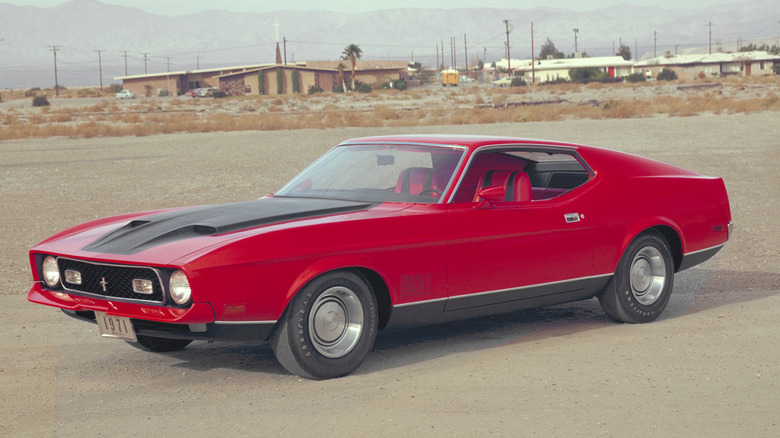
Similarly based on the 385 series, the 429 Super Cobra Jet — and the lesser 429 Cobra Jet — were built for the booming quarter-mile drag racing scene, a wildly different performance arms race than stock car racing. Instead of prolonged high-revving strain, the SCJ was built for the quarter-mile.
Internally, the 429 SCJ had several differences from the 429 Boss. The SCJ delivered a more robust quarter mile oriented experience for buyers thanks to forged internals, a more aggressive camshaft and a larger carburetor — among other things. These characteristics made it a weapon on the drag strip and the motor found itself transplanted into a handful of different cars.
Starting in 1970, the 429 Super Cobra Jet would first find itself in the Ford Torino Cobra and Mercury Cyclone Spoiler. 1971 would see the SCJ in the facelifted Mustang Mach 1. The Super Cobra Jet was exclusively paired with the Drag Pack option on all three of these cars. The production motors were again underreported at 375 horsepower, and similarly to the Boss 429, the 429 SCJ made more than what was marketed.
At the end of the day, the 429 SCJ molded a reputation for hitting hard off the line where races were won in seconds, not hours. Where the Boss 429 demanded space and rpm to shine, the SCJ made its presence known immediately — exactly what drag racers wanted. Long after the 429 Super Cobra Jet left dealership floors, it still remained a reliable performance option in the drag racing ranks.