

Two F-15s Refuse To Retire, Join NASA's Quesst For Civilian Supersonic Instead
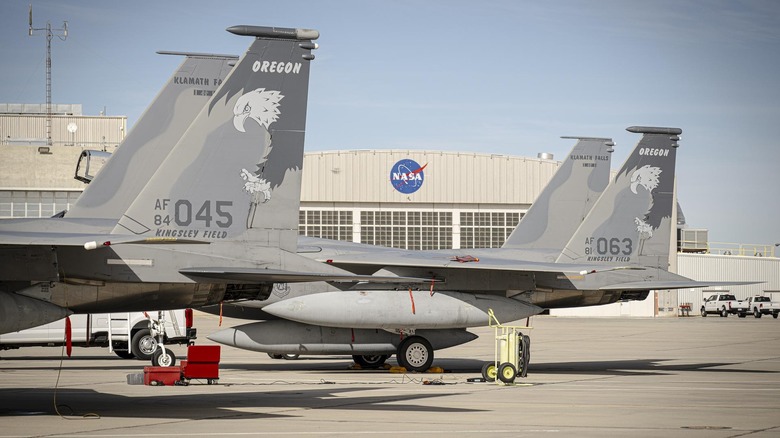
You know the type — the guy who finally hits retirement age, but just can't sit around the house doing nothing. He goes out, desperate to feel needed again, and finds a new place to work that appreciate his skills. He has a top speed of Mach 2.5, a max takeoff weight of 68,000 pounds, and a bunch of tall tales from his youth that are probably mostly fiction. Yes, your friend is a Boeing F-15C/D Eagle, and he's not going to take his forced exit from the Oregon Air National Guard lying down. Instead, he's going to help NASA bring supersonic civilian flight to the masses. And he's bringing a friend.
NASA has announced the acquisition of two F-15s from the 173rd Fighter Wing, which is in the process of transitioning from the older aircraft to new F-35As. Not content to watch these young whippersnapper planes take all the glory, the F-15s will be kitted out with sensory and data collection gear. It will also get some upgrades to enable it to reach an altitude of 60,000 ft. This combination of speed and height make the F-15 ideal as a chase plane for the X-59, the remarkable long-nosed test aircraft for NASA's Quesst mission. The X-59 flew for the first time in November and will soon begin full testing to see if it's strange design can reduce a destructive sonic boom to a meager sonic 'thump.' When that happens, somebody's going to need to follow above and behind and take readings. Somebody who could have gone back to the quiet life, but just can't give up the opportunity for one last mission.
The old eagles are at NASA
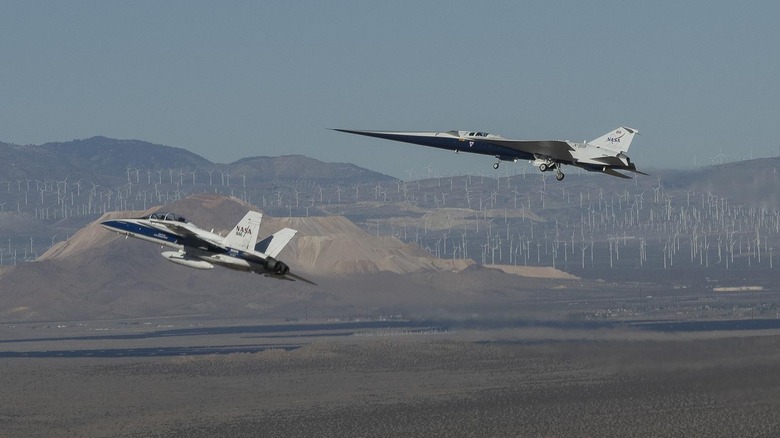
NASA has a long history with the F-15, dating back decades. In fact, NASA is still, now, today, in the year of our Lord 2026, flying an F-15B from 1974, per The War Zone. In civilian life, these Eagles have assisted with all sorts of research. But the priority now is the X-59, which only the F-15 can plausibly keep up with.
For their part, the C/D variants of the F-15 are grizzled old men being pushed out of service. The new F-15EX will keep the airframe in service, but the old ones are most likely destined for the Boneyard. These two from the Oregon Air National Guard will keep serving the country in a non-combat capacity, potentially helping us get supersonic commercial flights again one day. The main reason we don't have those now is because the business model is so limited, and that in turn is because supersonic flights are not allowed over land. The sonic booms have a nasty habit of blowing out windows, which is a problem in, say, a city. If NASA's Quesst mission can really mitigate that issue, and overland supersonic becomes feasible, a whole new and much faster world opens up.
So, let's all give a teary-eyed salute to these two brave planes that will now fly – wait, what's that? One of them is actually going to be cannibalized for parts? You mean one of the F-15s is actually eating the other one? Umm... let's just not mention that bit. Uh, America! Science!