

10 Of The Greatest 'Coke Bottle' Style Muscle Cars Of All Time
Coke-bottle styling found its way into automotive design via an unlikely source: Studebaker, a struggling automaker that failed to survive the 1960s. In a desperate bid to save the company, Studebaker hired designer Raymond Loewy to create a grand tourer that would modernize its image. What Loewy and his team created would be counted among the most influential car designs of all time, the 1962 Studebaker Avanti. The radical new car's proportions would influence sports car and muscle car design for the rest of the decade and beyond.
The Avanti's style was distinctive in several respects, including its flat, grille-less front end and its expansive greenhouse glass. But its side profile was its most famous innovation. The car's flanks bulged upwards and out over the wheel arches, both in the front and the rear, but narrowed in the middle where the doors were. This gave it the shape of a Coke bottle on wheels, a sharp break from the flat or slab-sided style of most cars up to that point.
The result was a muscular idiom that made the car look fast even standing still, which made it perfect for the muscle car era that dawned just after the Avanti's debut. Over the course of the 1960s, one car after another received Coke-bottle styling, from sports cars like the Chevy Corvette to personal luxury coupes like the Buick Riviera. But perhaps no group of cars epitomized Coke-bottle styling better than muscle cars.
1966-1967 Pontiac GTO
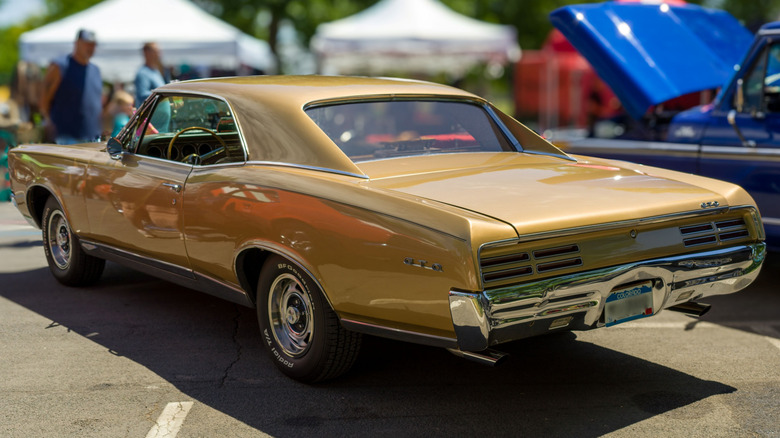
Pontiac's faux-racing GTO is widely credited with kicking off the muscle car revolution in 1964. But competition in the segment soon grew fierce, and by 1966, it was time for an update to the GTO's styling. The '64 GTO (and the Tempest it was based on) featured more traditional styling, with an almost perfectly straight waistline running from nose to tail, complete with mostly flat fenders, doors, and quarter panels. But in 1966, Pontiac's designers updated the GTO with Coke-bottle styling elements.
The style shows most clearly in a rear three-quarter view of the car. The beltline makes a distinct upward sweep after passing the doors, and the rear quarter panel bulges over the wheel arches before narrowing to sharp styling features on either side of the trunk, almost like vestigial tailfins. Paired with the new GTO's fastback roofline, it offered a very muscular look befitting the power under the hood. Other exterior revisions included a front bumper that followed the contours of the nose and a split grille design.
The '66 GTO came in coupe, hardtop, and convertible versions. A 335-horsepower, 389-cubic-inch V8 served as the standard engine, while a Tri-Power variant with three Rochester two-barrel carburetors produced 360 hp. For even more power, an optional Ram Air kit could be shipped with the car for dealer installation. Transmissions included a standard column-mounted three-speed manual, a floor-mounted heavy-duty Dearborn three-speed, and a pair of Muncie four-speeds. Floor-mounted shifters came from Hurst.
1966-1967 Chevrolet Chevelle & Chevelle Malibu
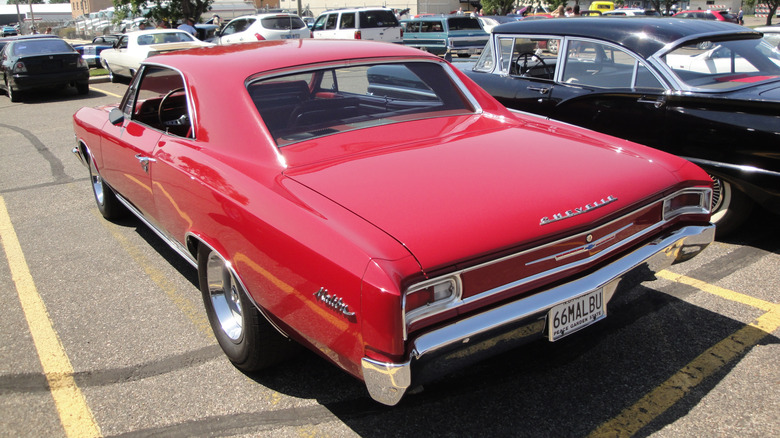
The midsize Chevy Chevelle debuted in 1964, and soon received a huge personality transplant via potent V8 engines. This new entrant into the muscle car wars became known as the Chevelle Malibu SS, one of our favorite muscle cars with the best names. The Chevelle rode the same GM A-body platform that underpinned the Pontiac Tempest and its GTO variant, so like the Tempest and GTO, it also got an update for 1966. This redesign incorporated Coke-bottle styling elements.
Gone was the Chevelle's original boxy profile, replaced by a wider, more contoured appearance. This curviness came from its Coke-bottle elements, including noticeable fender bulges that swept upward and flared out over the wheel arches, giving the Chevelle a muscular and narrow-waisted look. Flying-buttress rear pillars and front fenders that leaned forward beside the headlights gave the Chevelle the look of a snarling beast ready to leap. The grille and front bumper received updates, as well.
The Chevelle backed up its looks with plenty of power, thanks to a range of V8 engines. These included 230-, 283-, 327-, and 396-cubic-inch engines, most of which offered multiple configurations and a range of horsepower. The largest of these power plants gave its name to the SS396, a beast that offered 325, 360, and 375-hp variants. With a base price of just $2,276, the Chevelle Malibu SS396 was affordable muscle available in both coupe and convertible body styles.
1967 Ford Mustang
We might court some controversy by including the Mustang on this list of Coke-bottle muscle cars, given that many people mark a distinct difference between a muscle car and a pony car like the Mustang. However, even Car and Driver and Hot Rod Magazine refer to pony cars like the Mustang and Camaro as muscle cars, and who are we to gainsay them? So the Mustang makes our list.
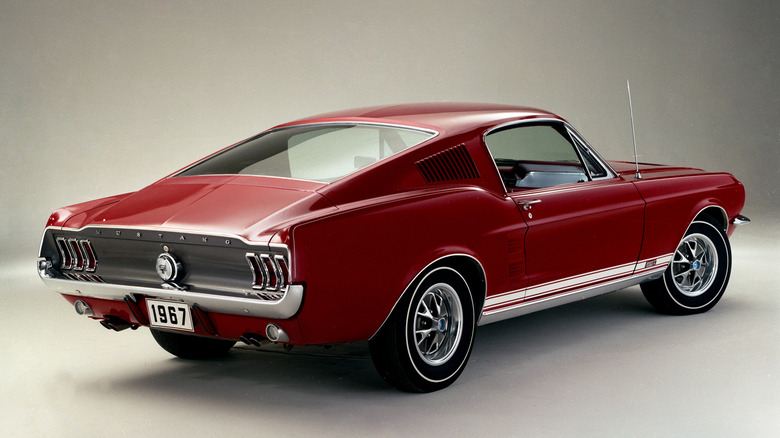
The Mustang arguably had elements of Coke-bottle styling right from its 1964 debut, thanks to a slight rise in the beltline in the rear quarters. This was most evident in fastbacks, where the rising fenders flowed into the sloping roof. However, like other cars we've looked at so far, the intense competition in the segment drove a mid-cycle redesign in 1967. The new design was similar to the original but more aggressive. Combining its muscular haunches with the indented doors gave the car a narrow-waisted look, lending the '67 model its Coke-bottle appearance.
The exterior changes were modest, but the 1967 Mustang featured a game-changer under the hood. A wider engine bay made room for Ford to fit the 390-cu-in "Thunderbird Special" V8, as well as a 428 in the GT500 model. The 390 produced 320 hp, significantly more than the previous year's 289-cu-in V8 and even more than the '65 Shelby GT350, making the Mustang a legitimate muscle car for the first time. The Shelby GT500 upped the ante even further with 355 hp. This is the Mustang Nicolas Cage stole in "Gone in 60 Seconds."
1969 Chevrolet Camaro
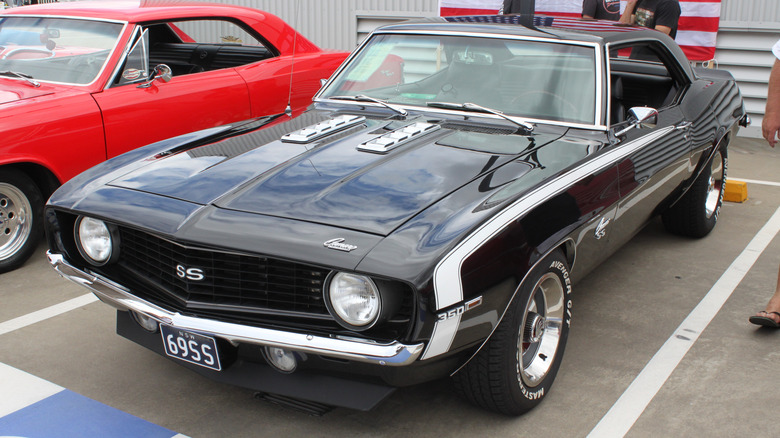
As long as we're on the topic of pony cars, let's cover the Camaro. The Camaro tried to one-up its Mustang rival in everything, including its curves. Right from its first year in 1967, the Camaro had Coke-bottle design language, resulting from fender lines that bulged over the wheel arches. These bulges combined with a beltline that dropped downwards along the doors to meet the rising rear fenders, narrowing the car's waist and giving the impression of a beast crouching and ready to spring.
As with other cars of its time, the Camaro got a mid-generation sheetmetal update just two years after its launch and only one year before a total redesign in 1970. The 1969 Camaro wasn't dramatically different from the '67 and '68 models, but subtle changes included more prominent rear fenders for a wider stance, along with character lines trailing from the wheel arches to give the impression of speed. Looking down from a front three-quarter view, the 1969 model's Coke-bottle shape is quite noticeable.
The '69 Camaro was offered in several models, including the Rally Sport, SS 350, SS 396, and Z28. It offered an almost dizzying array of engines, including a pair of inline sixes along with V8s in 302-, 307-, 350-, 396-, and 427-cubic inches, the latter only available via the Central Office Production Order (COPO) program that allowed dealers to order cars not listed on the Camaro's official spec sheets. A convertible Camaro paced the 1969 Indy 500, as the 1967 model had previously done.
1967 and 1970 Plymouth Barracuda
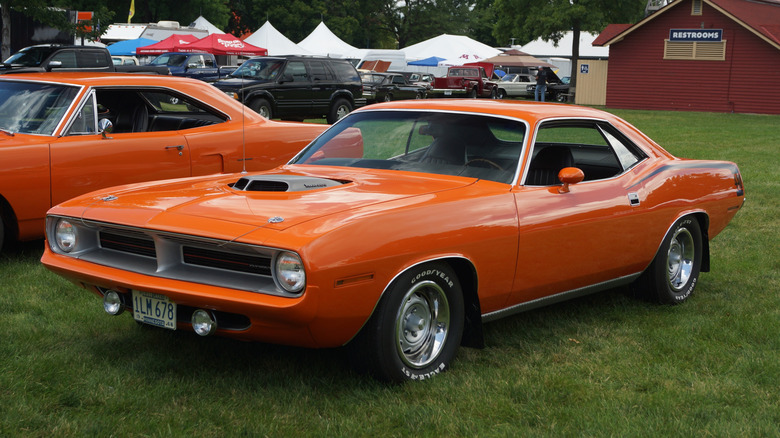
The original 1964 Plymouth Barracuda actually beat the Mustang to market as the first of what we now call pony cars, arriving in dealerships 16 days before the Ford. However, that first generation of Barracuda, based on the Plymouth Valiant, was a somewhat stodgy, slab-sided vehicle, distinguished mainly by its bubble-shaped rear windshield. In 1967, the homely Barracuda got a makeover and went from ugly duckling to a swan, courtesy of Coca-Cola.
The new Barracuda featured a clean design with bulging fenders and hints of Italian influence. Unlike the Mustang and Camaro, which both had long-hood, short-deck dimensions, the Barracuda had more balanced proportions, especially visible in its notchback Hardtop Coupe configuration. Fastback and convertible models were also offered. The biggest engine available that year was a relatively modest 280-hp, 383-cu-in V8.
As the Barracuda evolved, though, it became one of the premier muscle cars of the era. The all-new 1970 Barracuda rode on the new Chrysler E-body platform, which was a shortened, widened version of the B-body platform found in cars like the Dodge Challenger. This new platform was larger than the Barracuda's pony-car rivals, making it closer to midsize muscle cars. Its wider, more aggressive stance gave it one of the most striking appearances of its era. That model year also saw the debut of the high-performance 'Cuda model, which offered a range of engines that topped out with the 425-hp, 426-cu-in Hemi V8.
1968 Dodge Charger
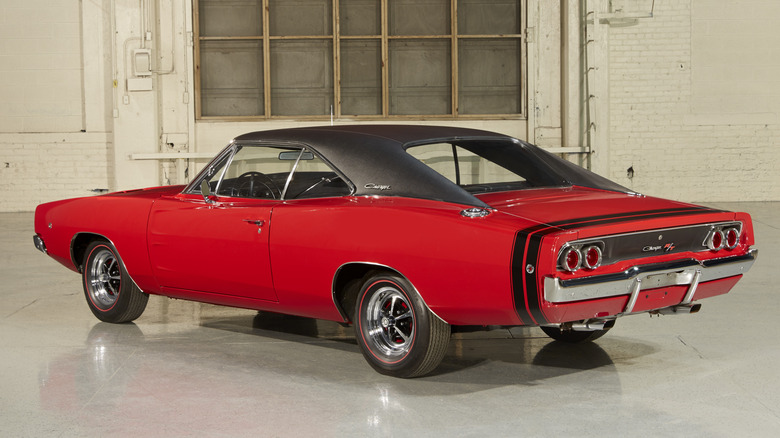
The second-generation, 1968 to 1970 Dodge Charger may be one of the most famous vehicles of the muscle car era, thanks to its appearance in the Steve McQueen movie "Bullitt" and its starring role in that Gen X Friday night favorite, "The Dukes of Hazzard." Much of the car's charisma comes from its Coke-bottle design, which was new for the second-gen Charger in 1968. If ever a car could look tough and beautiful at the same time, the Charger was that car.
The redesign traded the 1967 model's flat sides and long, sloping fastback for graceful fender flares that arch over the wheel wells in front and back, producing a rising and falling beltline that resembles rolling waves. Combined with hidden headlights and character lines indented into the doors, the Charger is hard to mistake for any other car. The public loved it, and sales boomed.
Of course, the Charger's performance was no small part of its appeal, too. While it offered a rare slant-six engine and a modest 318-cu-in V8, it's far better known for its bigger engines. These included a 383-cu-in V8 that generated up to 330 hp and a 440-cu-in, 375-hp Magnum V8. But perhaps most famously, this Dodge came with a 426 Hemi engine making 425 hp and 490 lb-ft of torque. A 1970 Charger with the 426 Hemi and a four-speed with a pistol-grip shifter is the Holy Grail for Charger collectors.
1970 Ford Torino
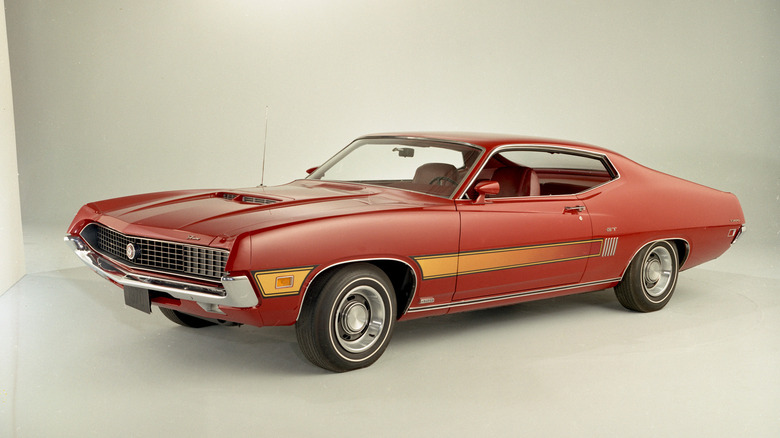
The 1969 Ford Torino fastback had a rather chunky profile, especially in the rear quarter panel area, but it had nearly straight lines everywhere else. For the 1970 model year, a dramatic redesign changed that with aerodynamic Coke-bottle styling. Its front fenders rise over the wheel arches, then trail off into a character line that swoops down through the doors all the way to the rear fenders. The rear quarter windows kink upwards into the roof pillars, emphasizing the huge rear quarter panels that trail down into fenders that hang way over the rear wheel arches.
The overall effect is pretty striking, making the car look wide, muscular, and vaguely threatening. It was a huge improvement over the dated 1969 model, and Ford pitched it as having been "wind shaped," although, like most advertisements, that may have been based more on image than reality. Still, it was eye-catching, especially on trim levels with the egg-crate grille and hidden headlights.
The Torino delivered performance, too, especially in its Torino Cobra guise. This model offered a choice of two engines: the 360-hp 429 Thunder Jet or the 370-hp Cobra Jet. There was also a Torino Super Cobra Jet model, which was officially rated at 375 hp, but knowledgeable folks have always believed that's an underestimate, with the actual power being over 400 hp. An optional Drag Pack provided an engine oil cooler, an upgraded rear axle, and a "No Spin" differential.
1970 Buick GS 455
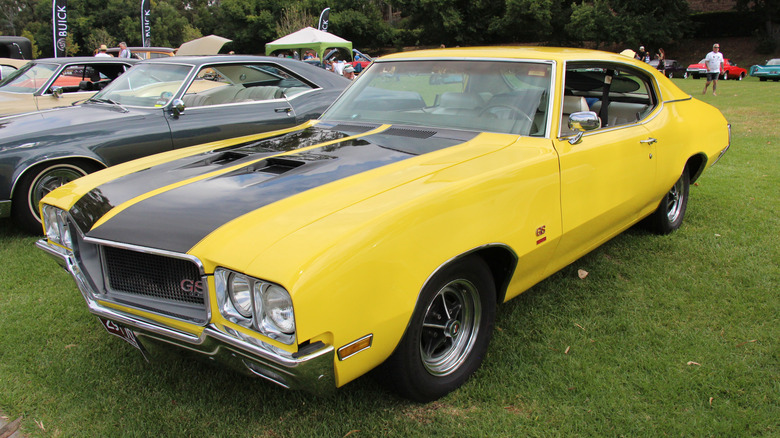
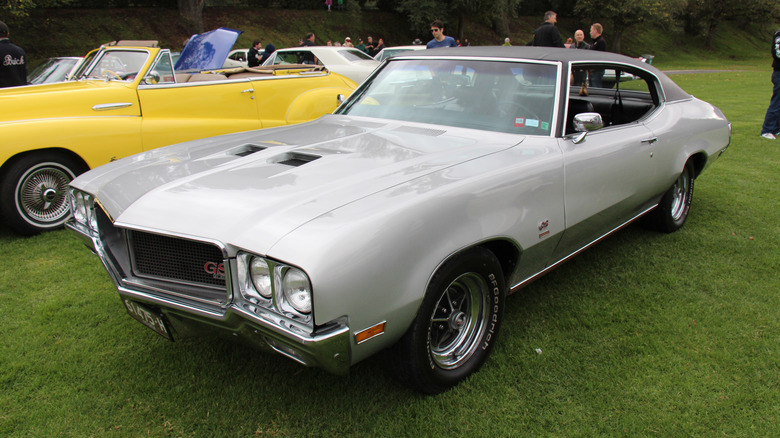
GM's A-body platform included the GTO and Chevelle that we encountered earlier, as well as the Buick Gran Sport (GS) and Oldsmobile Cutlass in its various flavors like the 4-4-2. The platform got a makeover across all brands in 1968, resulting in more curvaceous bodies than the 1964 to 1967 models. The Buick GS 455 exemplifies the new style, with its Coke-bottle proportions complemented by the A-body platform's new long hood/short deck profile.
It's a shame that the GS 455 often languishes in the shadow of its more famous cousins, like the GTO, because it wore its new style very well. The 1970 model received a refresh that set it apart even more from other A-bodies, with distinctive curves to its sheet metal and a serious muscle-car front end that looked both clean and aggressive. Its sporty looks weren't deceptive, either, because the GS 455 was a serious performer.
The "455" in its name refers to the monster V8 under the hood, all 455 cubic inches of it, generating either 350 hp or 360 hp with the Stage 1 performance package. Unofficially, though, it may have had 420 hp, or even more. It also generated an earth-shaking 510 lb-ft of tire-smoking torque. This setup was good for a 0-to-60 time of just 5.5 seconds and a 13.38-second quarter-mile time.
1970 Mercury Cyclone
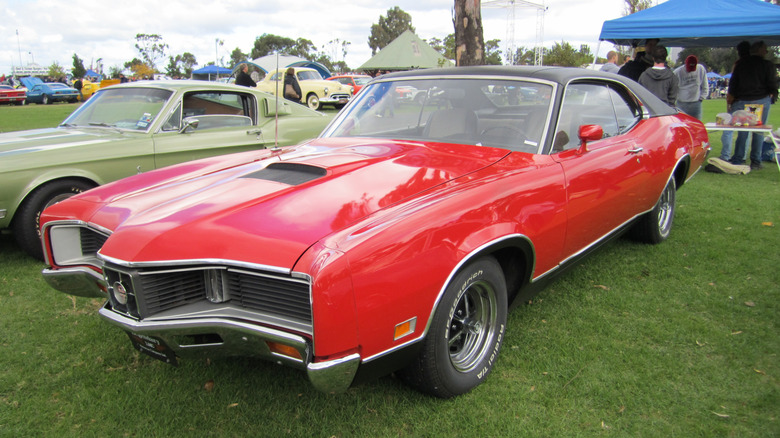
The Mercury Cyclone lineup, based on the Mercury Montego, received an extensive redesign for 1970, which introduced a curvy Coke-bottle look. This wasn't a skin-deep change, either, but rather a functional one. Along with the new curves, the Cyclone received a slightly longer wheelbase, a noticeably wider track, and a lower center of gravity. Combined with the Competition Handling package, this gave the Cyclone some serious performance chops. The Cyclone's range of engines backed that up with raw horsepower.
At the top of the hierarchy was the Cyclone Spoiler, which came standard with Ford's 429 Cobra Jet engine with a Ram Air system, good for 370 hp. This was the same motor available in the Ford Torino Cobra we examined earlier, and just as with the Torino Cobra, the Cyclone Spoiler also offered an upgrade to the 429 Super Cobra Jet with its underrated 375 horsepower. This engine came with a choice of upgraded performance axles.
Power reached the Spoiler's rear wheels through a close-ratio four-speed manual transmission designed to handle high torque and fast shifting via a Hurst shifter. An automatic was also available. The Cyclone Spoiler with a manual shifter could run 0 to 60 in 6.4 seconds and a quarter-mile in 14.5 seconds. For a muscle car, it was also relatively upscale, with Hi-Back bucket seats and an optional woodgrain center console.
1971 Oldsmobile 442 W-30
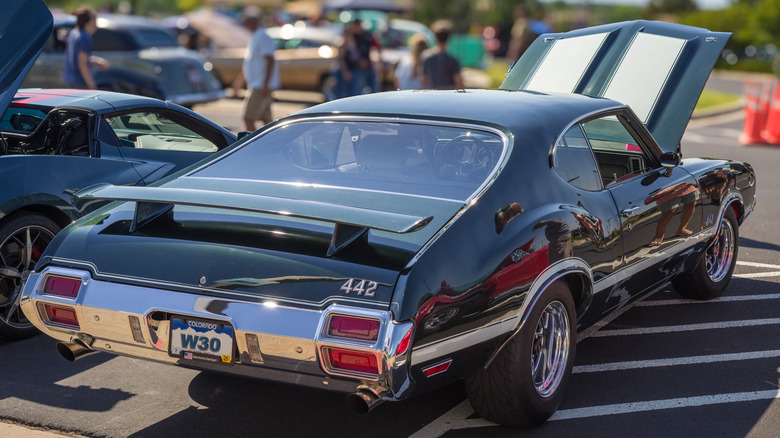
Like other GM A-body cars, the Oldsmobile Cutlass lineup received a makeover for its second generation, giving it classic Coke-bottle proportions. Its bulging fenders complemented a fastback profile with a large C-pillar. This styling, combined with the A-body's long hood/short deck dimensions, gave the Cutlass a classic muscle-car profile, whether in coupe, hardtop, or convertible form. The second-gen lasted from 1968 to 1972, with the high-performance 4-4-2 model sold throughout that time.
There's a convoluted history behind the Oldsmobile 4-4-2 (or 442) name, but originally it meant a four-barrel carburetor, a four-speed transmission, and dual exhausts. By the 1970s, the specs had changed, but the name remained the same, with the 1971 4-4-2 W30 perhaps being the culmination of the 4-4-2 line. Despite an industry-wide shift to lower-compression engines to handle the shift to unleaded fuel, the '71 4-4-2 W30 remained a potent performer thanks to its 350-hp, 455-cu-in Rocket V8.
The W30 option gave the Olds 10 more horsepower than the standard 455 V8. It included a trio of two-barrel carbs, Force Air induction, and upgraded cams and axles. A torque total of 460 lb-ft gave it incredible off-the-line thrust. The quarter-mile run came in at about 13.5 seconds, despite the lower compression, making the 4-4-2 W30 one of the last great performers of the muscle-car era.