

What's The Difference Between The Muncie M20, M21, And M22 Transmissions?
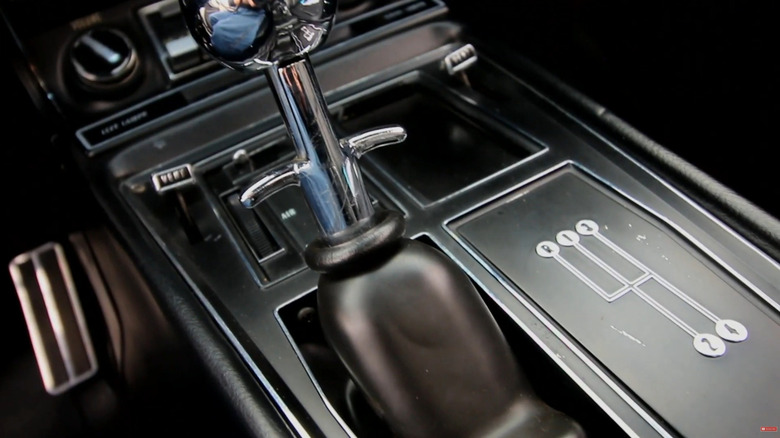
Car buyers had a life-altering decision to make when shopping for General Motors' muscle cars between 1963 and 1974: Select a manual transmission and become one with the car, solidifying the natural order that performance-oriented vehicles require drivers to select their own dang gears, or go with an easily-ignorable automatic transmission and allow their left legs and souls to atrophy from disuse. Those buyers who made the objectively correct choice and checked the Muncie four-speed stick-shift on the order sheet still had another choice to make: Go with the M20, M21, or M22?
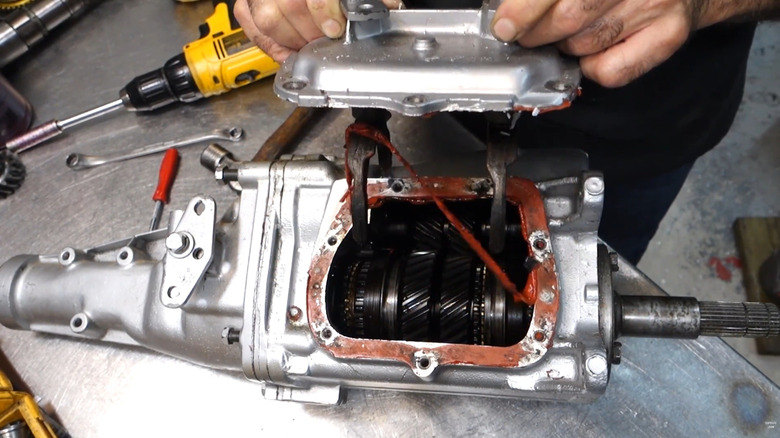
Sometimes other selected options would winnow the offerings for you. Ordering a manual-transmission L88 427-powered Corvette meant getting a Muncie M22 "rock crusher" — no ifs, ands, or buts. Chevrolet wasn't going to risk racers turning weaker M20 and M21s into gear dust. Now, let's peer into the aluminum cases of these storied gearboxes to find out what you'd get when you handed GM your money.
The first, and most obvious difference, is gearing. M20s were "wide ratio" transmissions, while M21s and M22s were "close ratio" transmissions. The M20 gave you a shorter first gear, but a wider spread between each gear, meaning engine rpms dropped more as you shifted. In 1963, the first year for the M20, the ratios were: 2.56:1 first gear, 1.91:1 second gear, 1.48:1 third gear, 1:1 fourth gear, and 2.63:1 reverse. In 1966 these ratios were changed to 2.52:1, 1.88:1. 1.46:1, 1:1 (fourth is always 1:1 in any Muncie four-speed), and 2.595:1 for reverse.
The M21 and M22 had taller 2.20:1 first gears, but the spread stayed tight with their 1.64:1 second, 1.28:1 third, and 1:1 fourth. Both had 2.263:1 reverse gears. To keep from bogging in first, M21s and M22s were usually paired with shorter final drive ratios.
The straight story on the rock crusher
Given the M21 and M22 had the same ratios, they might seem a bit redundant, right? Au contraire, mon ami. The gears inside M20s and M21s had an approximately 30 degree helix angle, while M22 gears were around 20 degrees. Now, you may have heard that straight-cut (or at least straighter-cut) gears are stronger than helical gears. Well, that's not true. Helical gears can actually bear more load due to their longer contact line and reduced tooth bending. The problem is that helical gears put more stress on everything else because they increase axial loads, which are lateral forces. In other words, the case, bearings, and output shafts take the stress that the gears won't. Straight(er) gears take the brunt of the force on themselves. They also generate less heat because the shorter gear teeth spend less time sliding against each other.
Because M22 gears had to avoid buckling as they absorbed big block punishment, GM gave them a higher nickel alloy content. What GM couldn't give M22s was noise canceling technology to eliminate the gear whine. That's one of the major downsides when transmission gears straighten up. Helical gears gently glide against each other, meshing gradually, generating not but a hum. Straight cut gears shove each other against lockers and demand lunch money. Less friction, less heat, more efficiency, more whine (about 10 dB at comparable speeds). Hence the M22's nickname, "rock crusher." Here's what it sounds like:
But, even with the M22's reduced axial load, the relatively weak aluminum case can flex, stretch, and crack. Rebuilders who want strength over originality can use the "Super Case" or the newer "HD Case" from Muncie expert Paul Cangialosi, both of which are cast thicker in known weak spots.
Subtle but super important differences
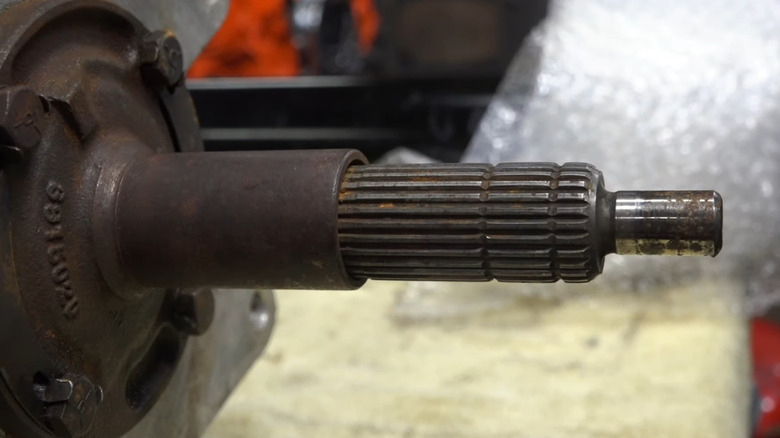
Don't go thinking the only differences are internal. Input shafts were 10-spline (coarse spline) from 1963 through 1970, then beefier 26-spline (fine spline) from 1971 onward, which is good because even de-compressioned '71 454 Corvettes still brought torque to the table. These splines engage with the clutch to grab the engine's power, and to keep your Muncie from snapping input shafts like stale Slim Jims, you want 26 of those fine, load-bearing splines. If a Muncie gearbox has coarse input splines, it'll have a 27-spline output shaft, and those with fine spline input shafts have 32-spline output shafts.
On that input shaft is a gear that meshes with a counter gear inside the transmission, and these gears can have 24, 21, or 26 teeth depending on which transmission they belong to. Only M20s had gears with 24 (1963-1965) and 21 (1966-1974) teeth, while M21s and M22s always had 26-tooth gears. That's a problem for anyone restoring an M22, because you might find an input shaft that fits, but it's from an M21 and has a weaker alloy.
You want the really obscure info? Yes, you do. All Muncie four-speeds with main cases featuring the 3925661 casting number (1970-1974) have drain plugs from the factory, as do all M22s. And if you want to know whether you're looking at an M20, M21, or M22, it might be as easy as ABC. After 1969, Muncie VINs put a letter at the end to identify the transmission: A for the M20, B for the M21, and C for the M22.
Oh, and it's easy to confuse a BorgWarner T-10 for a Muncie as they look quite similar. That's by design, as GM basically aped and improved the T-10 to create Muncies in the first place.