

11 Rare Mazdas You Probably Didn't Know Exist
Most automakers have their niche. Porsche stayed true to its roots with the rear-engine layout when all other automakers abandoned it, Toyota is all about reliability, and BMW has aimed to build the "ultimate driving machine" since 1974. But the appeal of Mazda comes from how no automaker can match its audacity. This is a company that produces a rotary range-extender engine and still manages to boast a cheap and successful sports car in its portfolio. Recently, it also brought the fight to BMW and Mercedes-Benz with inline-six engines and a premium RWD platform.
But that's just the tip of the iceberg. Mazda has been producing fringe vehicles since its inception, and most of them only reached a handful of buyers. But of course, for every eccentric experiment, there is the question of "why did they stop building this car?" Don't worry — it will all make sense once you meet these rare Mazdas you probably never heard of before.
Mazda Roadster Coupe (2003)
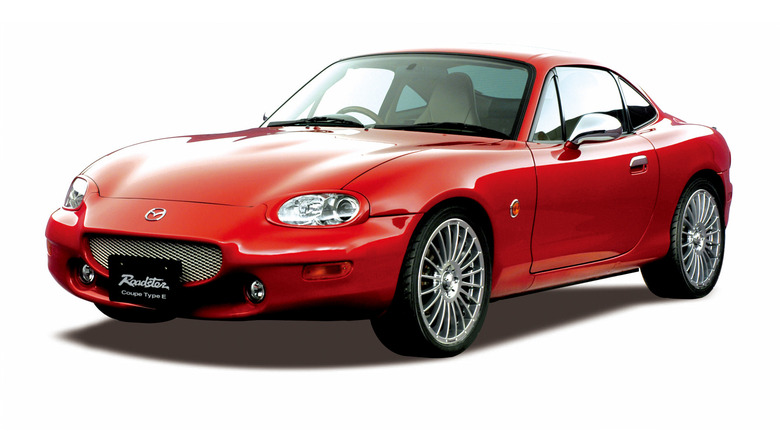
The name of Mazda's 2003 Roadster Coupe is an oxymoron. But really, it's the best designation for the fixed-roof coupe version of the world's best-known roadster. Don't beat yourself for not knowing it even existed; it's a very rare model built only for the Japanese market. Mazda wanted to build more, but fire at one of the brand's factories limited production to just 179 models.
The project was very thought-out, though. Mazda readied four trims: The entry-level Roadster Coupe came with the smaller 1.6-liter engine with 123 horsepower and a five-speed manual. The Type S variant carried the larger 1.8-liter engine with 158 horsepower and a six-speed manual. Drivers that wanted a more focused experience would've chosen the Type A, which came with fiberglass and carbon exterior parts. Finally, there's the Type E, which came with similar fiberglass parts but had a slightly-lower price than the Type A due to only being available with a four-speed automatic and 152 horsepower.
You're probably wondering whether the roof brought any improvements to the car's driving dynamics. Its rarity makes it difficult to confirm this idea, but the roof enhanced the MX-5's body rigidity while adding just around 22 pounds to the overall weight. In theory, at least, the Roadster Coupe should've been sharper to drive than the second-gen NB Miata it was based on. And it might happen again; according to a report by the Japanese Best Car magazine, the next-gen MX-5 will share its platform with the Toyota GR 86 — which happens to be a coupe.
Mazda Parkway Rotary 26 (1974 to 1977)
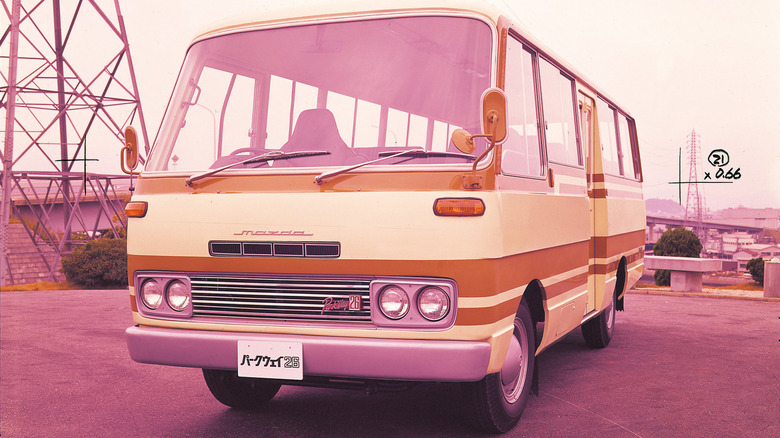
Wankel's rotary engine from the '60s should've been the next great thing in mobility. Small, light, and powerful for its size, it had all the hallmarks of an advanced internal-combustion engine. Unsurprisingly, manufacturers quickly jumped onboard, and the rotary found its way into family cars, sports cars, and high-performance motorcycles. But nobody imagined the rotary as a good solution for commercial vehicles — except for Mazda.
Enter the Parkway Rotary 26, which is the world's only rotary-powered minibus. (And, yes, it also blew our minds when we visited the German Mazda Museum.) For all its advantages, the rotary engine is notorious for its non-existent torque at low rpm. Low-end torque matters in heavier vehicles, but Mazda thought it would be a good idea to borrow the high-revving 13B engine from the RX-3 sports car and put it into a minibus. The twin-rotor, 1.3-liter engine produced 135 horsepower and only 130 pound-feet of torque, which certainly isn't enough for a 26-passenger minibus. Mazda knew this, so it equipped the vehicle with another 1.0-liter engine dedicated to air conditioning alone. Two 70-liter gas tanks were also onboard to make sure everything ran smoothly.
The idea behind this weird combo was to meet the stringent emissions requirements in Japan during the time, which the engine passed with flying colors. The rotary was also smoother than the regular gas and diesel options for the Parkway bus. Still, it wasn't enough to win over buyers, and Mazda only produced 44 units from 1974 to 1977.
Mazda REPU (1974 to 1977)
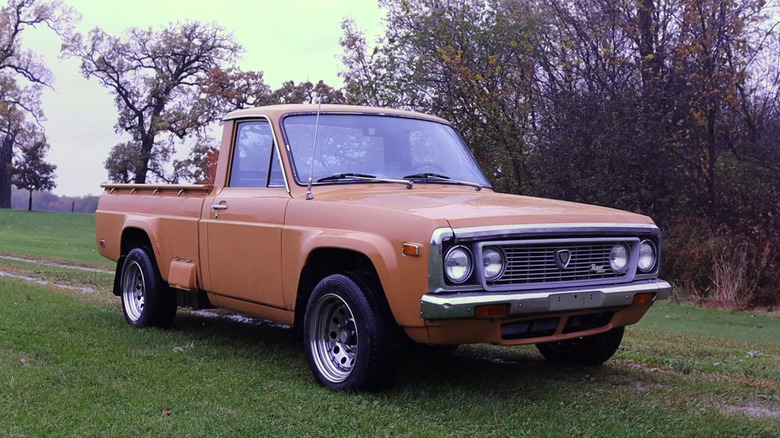
Although not many people know this, the Wankel craze has also reached America's favorite vehicle type, leading to a pickup truck with a rotary engine: the 1974-1977 Mazda REPU. It's not all that surprising when considering how Mazda was using the rotary engine in each of its models during the 1970s, from the RX-2 family car to the RX-7 sports car masterpiece. So, of course, the Japanese automaker tried to tackle the lucrative pickup truck market with its beloved engine.
Mazda wanted to attract enthusiasts with this one-of-a-kind model. The REPU (short for Rotary Engine Pick-up) was based on the B1600 — which came equipped with a regular 1.6-liter four-cylinder — but it also had a six-inch wider rear and five-inch wider front track to enhance handling. Of course, the star of the show was the 1.3-liter twin-rotor Wankel engine, producing 110 horsepower and 117 pound-feet of torque. That was enough for a 0-60 mph sprint of 11 seconds, which was far from a bad result at the time. As a cherry on top, the velvety rotary revved to 7,000 rpm.
This model carries the echoes of an enthusiast car, but buyers at the time weren't so convinced — probably due to its abysmal 16.5 mpg fuel economy rating. In the end, Mazda only sold around 15,000 units in the U.S. and Canada. The high-revving rotary pickup is much more enticing today, though, with at least one 1977 REPU selling for $29,900 at Classic.com via Hanksters Hot Rods.
Mazda Roadpacer AP (1975 to 1977)
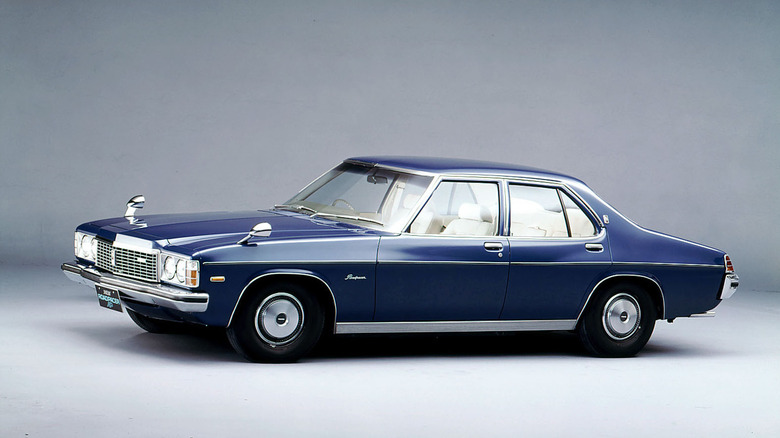
The rotary minibus and pickup truck are baffling, sure, but the Roadpacer AP was Mazda's true engineering disaster. This large, full-size sedan was produced from 1975 to 1977 to meet Japan's more stringent pollution standards, hence the AP (Anti Pollution) in the name. Since Mazda had no such platform, it brought in the Holden HJ Premier body from Australia and equipped it with a twin-rotor 13B. The Japanese automaker could've used the inline-six and V8 engines from the original Australian car, but the rotary was meant to be more efficient. With a combined mileage of just nine mpg, though, it practically pumped out enough hydrocarbons to rival a forest fire.
To make things worse, the Roadpacer AP packed just 130 horsepower and 102 pound-feet of torque. Compare that to the Holden HJ Premier's optional 5.0-liter V8 with 240 horsepower and 315 pound-feet of torque, and the Roadpacer AP looks seriously underpowered. To make things worse, Mazda used a three-speed automatic, which presumably didn't keep the rotary engine in its power band for most of the time. As a result, the Roadpacer AP limped to 60 mph in 15 seconds.
The final nail in the coffin: this car sold for more than double the price of its Australian cousin. Unsurprisingly, Japanese buyers didn't rush to dealerships, and Mazda sold only 800 units — with most of those models going to the government.
Mazda Pathfinder XV-1 (1970 to 1973)
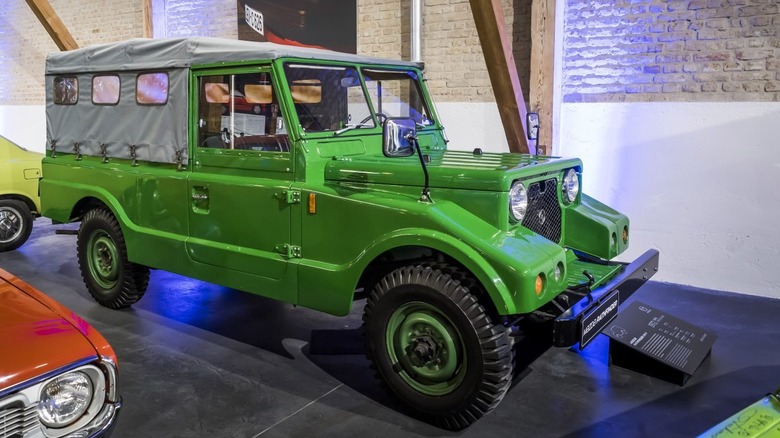
The Pathfinder XV-1 is easily the most obscure vehicle in Mazda's history. Even many Japanese people don't know about Mazda's "Jeep" because it was produced and sold exclusively in Burma, today's Myanmar. The idea for an off-road, military-like vehicle started in Japan, of course. However, according to Curbside Classics, the Japanese government was "very keen on investing in Burma," and it thought that Mazda's off-road vehicle would sell well in that country. As a result, the Pathfinder XV-1's production was moved to Burma.
Unfortunately, the 1970-1973 models also came at a time when Burma was pretty much completely closed off from the outside world by its ruler, Ne Win. He also ordered that all models switch to left-hand drive, further complicating the XV-1's production. Not that it mattered much — regular people couldn't buy Mazda's Jeep, anyway. Instead, it was mainly produced for the police and military.
Our own David Tracy reported that the Pathfinder XV-1 has a solid front axle with leaf springs and drum brakes. A two-speed transfer case was also present to enhance off-roading abilities. The engine was probably a 90 horsepower 2.0-liter unit paired with a three-speed manual.
Mazda Luce Rotary Coupe (1969 to 1972)
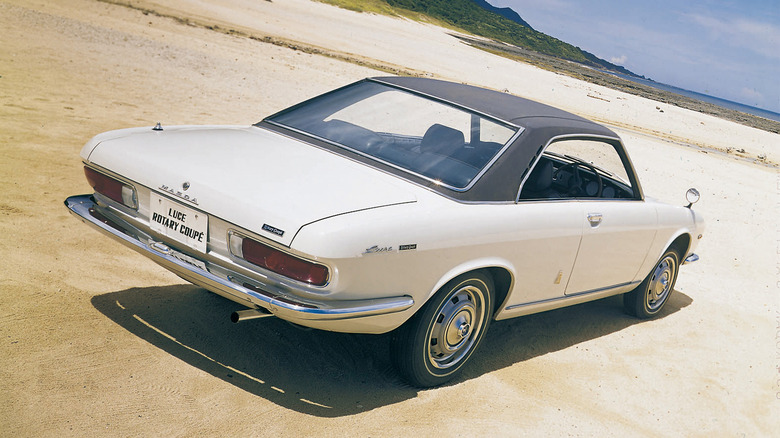
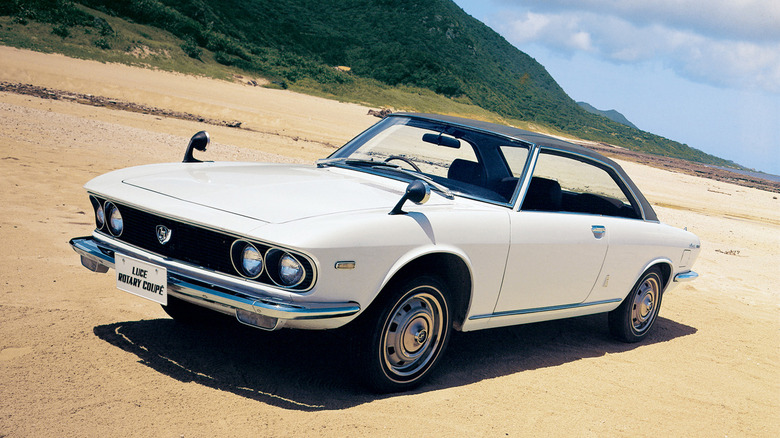
The Cosmo Sport is Mazda's first rotary sports car, and it's easily one of the most beautiful cars ever made. But there is another Mazda that deserves to be put in the same sentence: the Luce Rotary Coupe, which launched in 1969. Mazda's early rotary grand tourer looks so exquisite that it won't be out of place in Italy's Lake Como – and that's an apt analogy, considering its conception. Mazda based the car on an original design by Giorgetto Giugiaro, Bertone's star designer.
As the name implies, the Luce Rotary Coupe was equipped with a twin-rotor Wankel engine, producing 126 horsepower and 127 pound-feet of torque. However, it wasn't borrowed from any other Mazda vehicle. The 1.3-liter 13A unit was used exclusively in the Luce Rotary Coupe, and it allowed the model to hit 118 mph. Not too shabby for an early 1970s Japanese GT.
An even more interesting fact is that power was sent to the front wheels via a four-speed manual transmission. That would make this stunner Mazda's first FWD car, as well as the only FWD Mazda with a rotary until the MX-30. Unfortunately, it wasn't enough to attract buyers, as Mazda has sold only 976 units over a three-year production span.
Mazda MX-5 Le Mans Edition (1991)
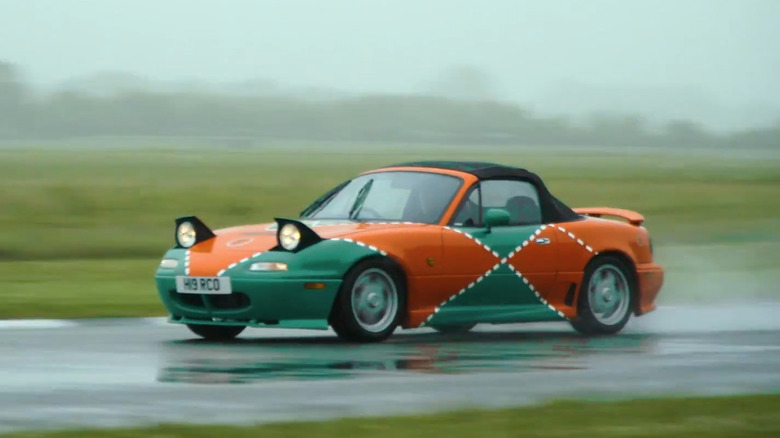
Apart from appearing into almost every vehicle type imaginable, Mazda's rotary also won the 24 Hours of Le Mans. It did that with the 787B, a race car that deservedly sits in the pantheon of greats. To commemorate its biggest racing success, Mazda launched a special MX-5 for the U.K. market in 1991.
The MX-5 Le Mans Edition rocks the same green-and-orange livery as the 787B race car, but it gets way cooler once you open the hood. There, you'll find a turbo kit from BBR, a British tuner that helped Mazda bring this MX-5 to reality. The kit boosted the 1.6-liter engine's power output from 114 to 150 horsepower. It also added 54 pound-feet of torque to the measly 99 pound-feet of the regular engine. As you'd expect, this dropped the car's 0-60 mph sprint from 8.8 to 6.8 seconds, making it a very sprightly roadster for its time.
Mazda also reworked the suspension, getting the MX-5 Le Mans Edition rides on Tokico springs and dampers and five-spoke OZs, which should be enough of an upgrade to enhance the roadster's already stellar handling. Aerodynamic upgrades are part of the deal, too, and including a rear spoiler, side skirts, and a front lip. But don't get too excited by these bonuses, because you can't have one. Mazda has built only 24 samples, all sold in the U.K. According to a report by Piston Heads, only eight examples were licensed by 2022. Rare, indeed.
Mazda Persona (1988 to 1992)
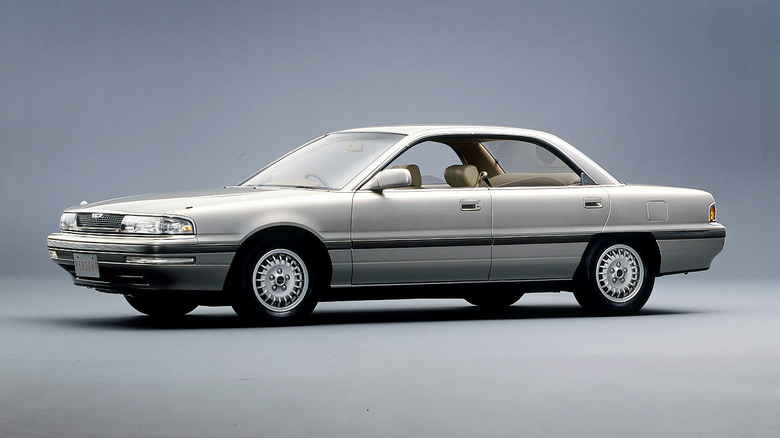
Pillar-less hardtops are some of the classic car design features we want to come back. On top of looking cool on the outside, it also makes the interior nicer for passengers. No B-pillar means an unobstructed view of the outside world. In an effort to offer its customers a unique traveling experience, Mazda wanted joined the pillar-less craze with the rare 1988 Persona sedan, which was also later sold as the Eunos 300.
Mazda didn't just remove the pillars from the 626 (the car the Persona was based on) and call it a day, though. The automaker also completely reworked the interior to give it lounge-like qualities. The car's dashboard is wrapped around the front passengers for a cleaner, cozier atmosphere. That's true even in the back, where the seats resemble a sofa. The clear view from the sides only added to the unique ambiance inside the Persona. Mazda also placed most buttons on a pod around the instrument panel, which, along with the button-rich center console, looked futuristic for its time.
Unfortunately, driving the Persona wasn't like driving a Miata. The base model was equipped with a 1.8-liter four-cylinder with 97 horsepower and a 2.0-liter with 140 horsepower. All things considered, the torsional rigidity was probably hampered by the lack of a B-pillar, too.
Mazda Familia GT-Ae/323 GT-R (1992)
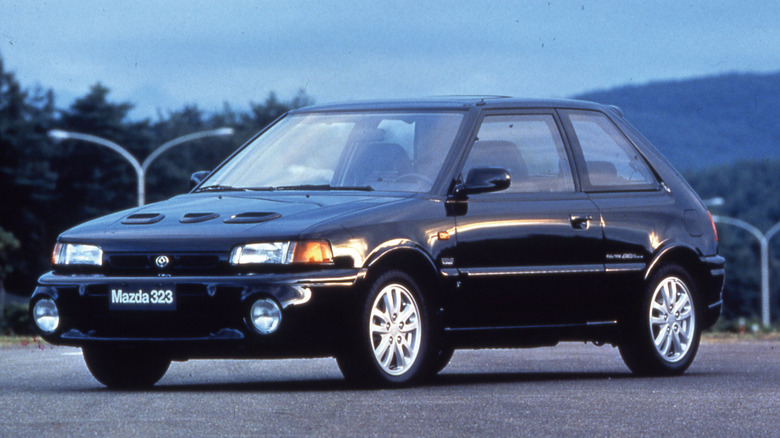
You'd be forgiven to think Mazda never did a rally homologation special. That's the job of Mitsubishi, Subaru, and lately Toyota, right? Well, in 1992, Mazda proved everyone wrong with the Familia GT-Ae, a hyper-focused hot hatch that didn't look out of place next to the Impreza WRX STi and Mitsubishi Lancer Evolution. Of course, it had all-wheel drive, but it also had a viscous limited-slip differential on the back axle for more precise control in the corners. A 1.8-liter turbo-four turned the wheels with 207 hp and 186 pound-feet of torque.
Mazda wanted to make this model as fast as possible, so it lacked the ABS, power windows, and leather upholstery in an effort to save weight. In addition, the closer third and fourth gears of the five-speed manual ensured even quicker acceleration. While it provides some fantastic power, it's also quite the unicorn; Mazda produced only 300 units of the Familia GT-Ae. It was also sold globally as the 323 GT-R, but even that version is a rare sight, with Mazda producing just 2,500 units.
Mazda Lantis Type R (1993 to 1997)
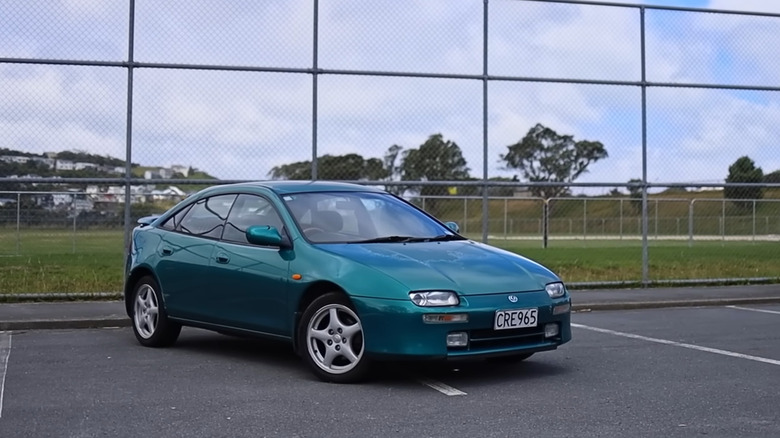
Mercedes-Benz would like you to believe that the CLS is the original four-door coupé. The fact is, Mazda launched a coupé-like economy car in 1989. The 1993-1997 323F (or the Lantis in Japan) might've had a liftback rear, but it still resembles a coupé from almost every other angle. Heck, it even had pop-up headlights. The lower-spec models had underpowered four-cylinder engines, but you could also get this svelte four-door with a 2.0-liter V6. It produced 145 horsepower, which was enough for a 0-62 mph sprint of 9.4 seconds and a top speed of 129 mph.
Naturally, Mazda launched an even hotter version for its domestic market: the Lantis Type R. This high-performance model carried a 2.0-liter KF-ZE engine able to produce 168 horsepower. Thanks to the low curb weight of around 2,650 pounds, the Lantis Type R sprinted to 60 in less than 8 seconds and reached a top speed of 140 mph.
All that power went to the front wheels via a five-speed manual, where a limited-slip differential ensured the effective delivery of torque. To top it all off, the Type R could look even snazzier with additional aerodynamic enhancements chosen by buyers, including a massive rear wing.
Mazda Suitcase Car (1991)
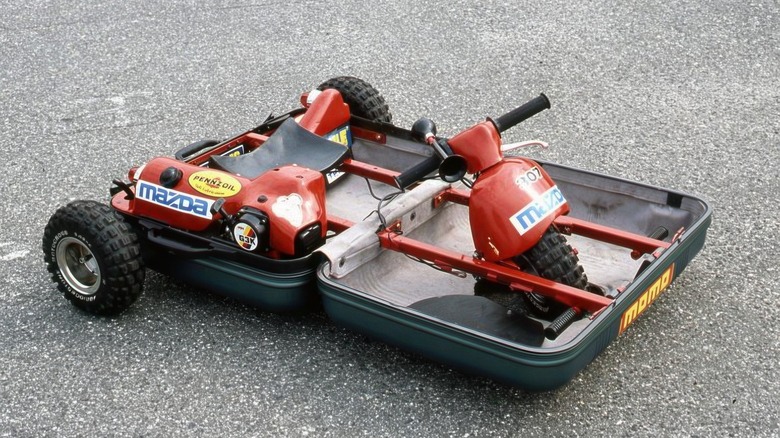
Okay, yes, the 1991 Mazda Suitcase Car isn't a production vehicle. But it's got wheels, has Mazda labels, and can actually move. The idea was conceived in an internal Mazda competition called Fantasyard, where four teams from different departments suggested wild mobility ideas. In particular, the Suitcase Car is a mobility vehicle that would help passengers navigate airport terminals more quickly.
It sounds like an idea you'd get five minutes before the bar closes, but it's a real Samsonite suitcase with wheels, an engine, a seat, and handlebars inside — just the ingredients you need to play real-life Mario Kart on the airport. The Mazda Suitcase Car might only have a 34cc two-stroke engine from a pocket bike, which is good for only 1.7 horsepower, but it can still reach over 18 mph. That's higher than the average running speed for a human being, which ranges between 10-17 mph.
Now, the Mazda Suitcase Car isn't as portable as you'd think. The Samsonite suitcase is quite bulky, measuring a little over 22x29 inches on the outside. Moreover, it weighs above 70 pounds, so carrying it around wouldn't be child's play. Even so, it can apparently transform into an airport go-kart in just around one minute, and — according to Mazda, at least — its low center of gravity makes it fun to drive.