

Yes, There Have Been Production Cars With More Than One Engine
From Hot Wheels toys to crazy SEMA creations and crowd-claiming dragsters, twin-engine cars are nothing new, but they certainly are a novel way to take your custom build to the next level. After all, there are only so many cylinders and liters you can cram into one block. For those following the "no replacement for displacement" theory, adding a second engine seems like the perfect way to maximize a car's performance.
However, twin-engine cars aren't really something you expect to see when strolling into your local car dealership. You might argue that hybrid or elecric cars fit the bill with their inclusion of motors, but we're not accepting that here. Instead, this article zeroes in on production cars with two combustion engines — and not just one-offs, either, but real production models that anyone could stroll into a dealer and buy. It turns out that the list is actually pretty short — just one automaker has really pulled it off — but numerous others have certainly experimented with the idea.
Forget your Ferraris and Lamborghinis; Citroën was the automaker that put twin-engine tech into production models. But other brands, such as Volkswagen, Alfa Romeo, and Mercedes-Benz, have certainly made solid efforts in the past. One largely-forgotten automaker by the name of Tempo managed to produce a valiant effort of its own with the G1200, but with an estimated 20 examples ever made, it's tough to call it a real production effort.
Citroën engineered a twin-engine 2CV for use in Africa
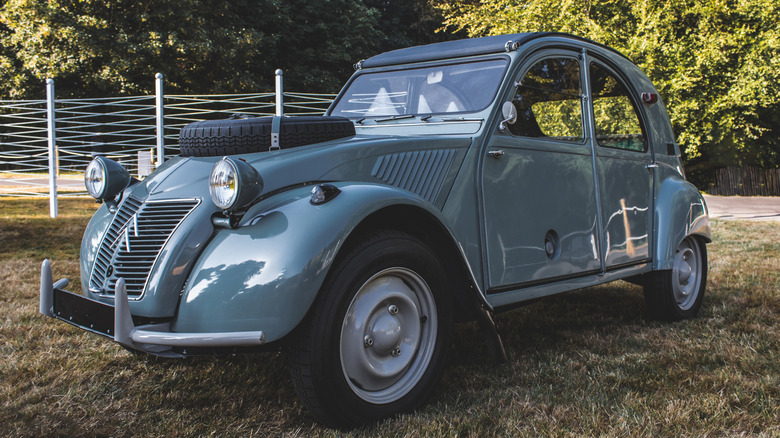
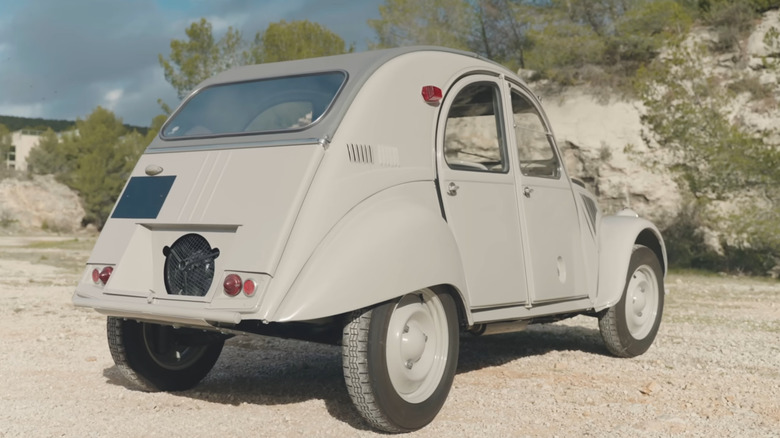
For those unfamiliar, the 2CV — or deux-cheveaux – was a real back-to-basics commuter car for the French, focusing on utility and practicality above all else. And "back-to-basics" goes beyond only boasting standard features; this Citroën had manually-operated windshield wipers when it debuted. In the 1950s, the French empire's presence within Africa allowed Citroën vehicles to be prevalent in the region, but African motorists needed something a little more capable than the simple 2CV. A four-wheel drive car that was lightweight enough to handle Africa's unique terrain was necessary. The answer was simple: drop another engine into the trunk of a 2CV to power the rear wheels in addition to the standard engine powering the front. This is exactly what Citroën did, and its creation was dubbed the 2CV Sahara.
A lightly tweaked variant of the 425cc two-cylinder engine could be found at either end. They both boasted larger carburetors, a raised compression ratio, and an output of 13.5 horsepower. This was no performance car, but it was perfectly able to handle the tasks and terrain it was made for thanks to a 60 mph top speed. Fast-forward to 2026 and these charming little creations are exceptionally popular. RM Sotheby's sold one in 2022 for €132,250 (~$157,000) while another sold from Bonhams in the same year for €77,625 (~$92,000).
Other mainstream automakers utilized twin engines for performance gains
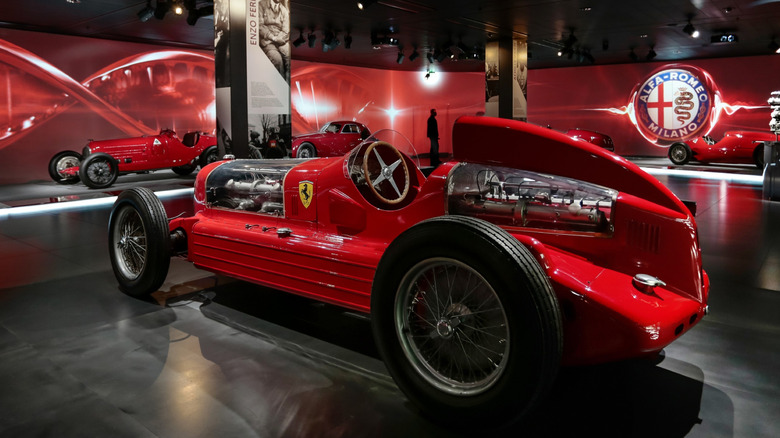
Other automakers didn't manage to put something like the 2CV Sahara into full production, but they toyed with the idea over the years. Whereas the 2CV employed a second engine for practicality, other mainstream twin-engine efforts were more geared towards improving performance. One of these twin-engine efforts hails from Italy in the form of Alfa Romeo's Bimotore. This '30s racer was designed to take on the mighty machines from Auto Union and Mercedes-Benz, utilizing a pair of straight-eight engines providing a combined output of 540 horsepower. It was a brilliant idea, but in practice, the Bimotore had some unfortunate flaws. The twin engines were great at eating through both fuel and tires, which meant any gains the 200+-mph Alfa could gain on the track were soon lost in the pits.
Volkswagen was another automaker to take two engines to the track, although for the German automaker, Pikes Peak was the track in question. The altitude of Pikes Peak eats away at an engine's performance, so one way to counter this was to simply fit another engine to double the output. Volkswagen affixed two 320 horsepower 1.8-liter engines to a MK2 Golf, resulting in a 640 horsepower creation which sent power to all four wheels. Its 62-mph acceleration came about in just 3.4 seconds, and that level of performance saw the Golf on track for a seriously impressive run. However, a ball joint gave way just corners from the finish, resulting in an unfortunate DNF. Volkswagen did return to Pikes Peak and obliterate the record with an electric racer, but this is where the automaker's twin-engine journey ended.