

No, Not All Microfiber Towels Are Created Equal
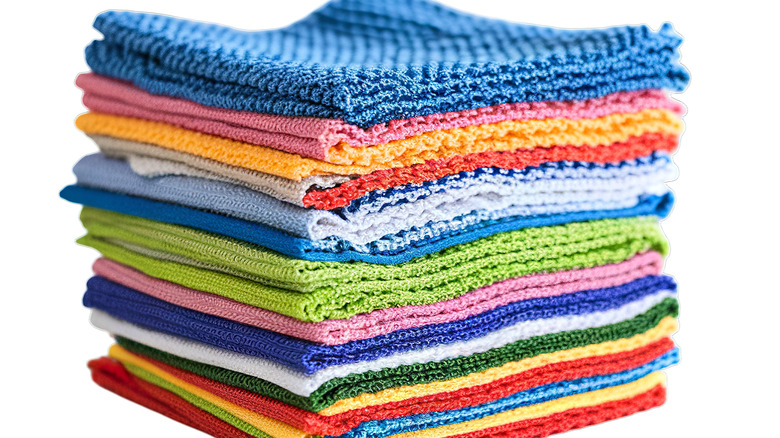
There are a lot of bad habits you can avoid to keep your car's finish shiny and swirl-free. Washing your car too often can cause extra wear and tear, and those dirty and abrasive spinning brushes at an automatic car wash can do more harm than good. What's more, using the wrong materials when washing, drying, and waxing the paint can spell the difference between a job well done and a sea of unsightly scratches.
Professionals demand top dollar for high-end detailing and paint correction for a reason. You're not only paying for their knowledge and skills, but for the tools they use to restore the like-new finish of a car are expensive too. One of those tools, microfiber towels, have been a go-to staple of clean freaks for years.
Microfiber offers game-changing cleaning, absorption, and lint-free drying properties derived from the advanced and unique construction. The delicate fibers in a microfiber towel are typically a blend of polyester (PE) and polyamide (PA), which are ultra-thin synthetic-based fibers. Combining PE with PA also means the fibers are both positively and negatively charged, which makes them superior in grabbing and holding onto dust, dirt, and other contaminants. However, there are many types of microfiber towels for cars, and which ones are best boils down to the towel's density (mainly to Grams per Square Meter or GSM), the blend ratio of PA to PE, and the weave type. Knowing which towels to use for washing, drying, or polishing will help keep your paint scratch-free.
Microfiber GSM and blend ratio
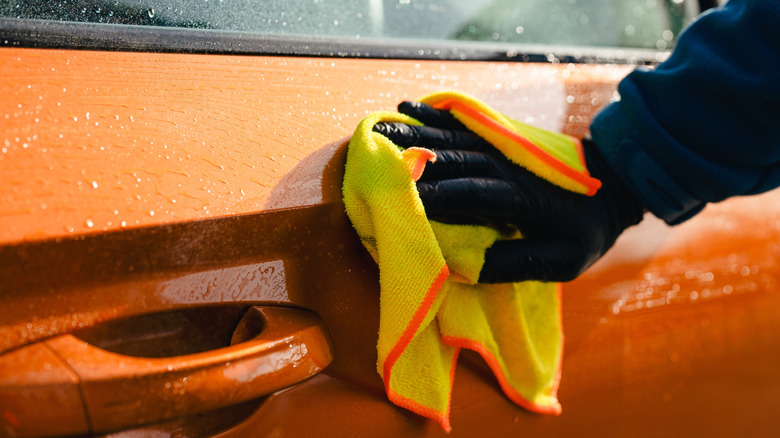
Different microfiber towels have different textures and absorbency properties, and there's a bit of science behind that. The Grams per Square Meter (GSM) refers to the weight or density of the towel when dry. The higher the GSM, the thicker, softer, and more absorbent a towel is. Higher GSM also means it is capable of holding onto more dirt, water, or polish residue. For instance, a 600 GSM towel will be plusher than a 250 GSM microfiber.
Meanwhile, the blend ratio is about the percentage of polyester (PE) and polyamide (PA) in the towel. Manufacturers need to strike the right blend of softness and durability, so balancing the PE and PA content is crucial. Polyester is more economical and contributes greatly to the towel's durability, while polyamide increases the towel's density. The blend ratio is expressed in a pair of numerical values. For instance, a 70/30 towel has 70 percent PE and 30 percent PA. Some detailers recommend sticking exclusively to a blend of 70/30, while others say 80/20 is the right mix for an all-purpose microfiber. Most recommend avoiding towels made entirely of polyester altogether.
What to use where
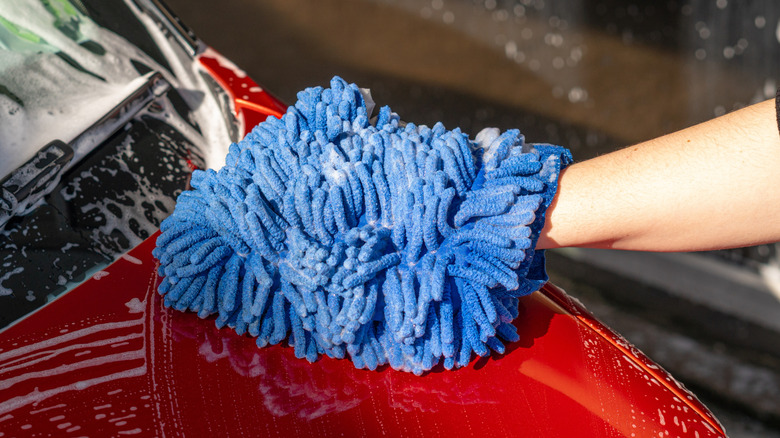
Microfiber towels also come in many weave types. Waffle towels have cross-hatched low and high spots that make them ideal for drying cars. A terry weave microfiber is a bit more common, sometimes double-sided (different weaves on each side of the rag), and its fibers are open-ended. It's considered the most versatile and is for all-purpose cleaning. Chenille is a kind of microfiber with thick, cylindrical bundles sticking out that absorb more liquids, often used in car-wash mitts. Combine the various types with the right GSM, and you've got a recipe for success.
A chenille microfiber wash mitt with a 400 to 600 GSM rating is a good place to start. Drying towels should ideally have a 1000 to 1500 GSM rating, while a 200 to 300 GSM waffle microfiber is perfect for cleaning the windshield and windows. When applying wax or polish to car paint, a coral fleece towel with a 500 to 800 GSM offers the right blend of plushness, softness, and absorbency to remove residue while buffing the paint to a flawless shine.
High-quality microfiber towels can last about 200 to 500 washes when cared for properly. Washing them separately from clothes or other towels, with mild detergent and not using bleach or fabric softeners, goes a long way in extending their lifespan. No matter what kind of microfiber you're using, it's unwise to use a reuse a microfiber towel if you drop it on the ground – especially when removing wax or They lift off dirt instantly and trap the particles within the cloth, which can lead to paint scratches.