

The Münch Mammoth Was A Terrifyingly Huge Motorcycle With The Engine From A Car
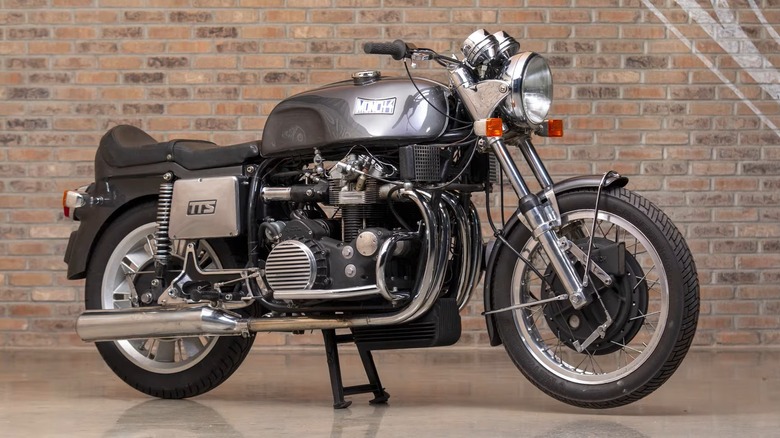
Before Chevy small block V8-powered Boss Hoss Cycles and seven-cylinder aircraft radial-engorged JRL Cycles Lucky 7s, there was the 1966-1980 Münch Mammut. In English, that's "Mammoth," which is the correct name for a motorcycle powered by an honest-to-goodness car engine (cars powered by motorcycle engines are no less awesome, just different). Specifically, that engine was the air-cooled 996-cc four-cylinder from the compact West German NSU Prinz 1000TT, making up to 55 hp, which helped push 480 pounds of bike to 115 mph.
While a 1.0-liter motorcycle doesn't sound like a big deal now, in the '60s it was the equivalent of a Hellcat-swapped golf cart. In September of '66, displacement increased to 1,085 cc and power rose to 70 hp. Then came the NSU TTS's 1.2-liter four in 1968, blessing this monster with 88 horsepower. It also ballooned to 656 pounds, but could easily hit 137 mph. That 1.2-liter had enough torque that a spoked rear wheel simply turned to spaghetti. So the wheel became a solid cast unit made of a magnesium alloy called Elektron. Owners who behaved themselves might have gotten 1,000 miles out of a rear tire.
There were certainly other porcine bikes in the late '60s, such as Harley Davidson's Electra Glide with its 60-hp 74-cube (1.2-liter) V-twin pushing 783 pounds of motorcycle. But that Harley would only hit 100 mph if a cliff were involved. There were other fast bikes, too, such as the 46-hp Triumph Bonneville T120R that could reach 115 mph, but it weighed a comparitively wispy 363 pounds. What made the Münch Mammut special was its combination of brute strength, sheer size, and refined manners. If the Electra Glide was a Cadillac Eldorado and the Bonneville was a 427 Corvette, then the Mammut was a twin-turbo V12 Mercedes-AMG S-Class.
The birth of the Mammoth
German engineer Friedel Münch (whose last name doesn't rhyme with "lunch," as the "u" is akin to the one in "push") worked for the motorcycle company Horex in the late '40s. In 1956, Horex went bankrupt, so Münch purchased one of its defunct factories and continued selling the remaining stock of motorcycles and parts. In 1960, Daimler-Benz took ownership of the Horex name and dissolved the company, and Daimler-Benz would never again have a negative impact on a storied vehicle brand.
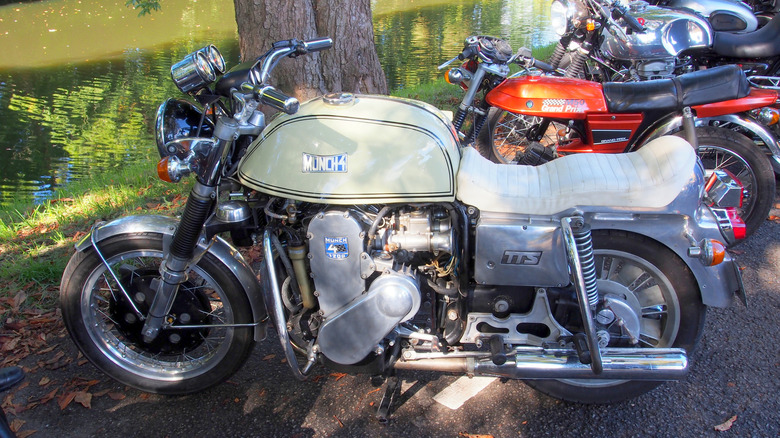
In 1965, French sidecar racer Jean Murit contacted Münch to see if he could help create the most powerful motorcycle in the world. Münch began designing the bike around a Horex 500cc two-cylinder, but upon seeing a 1.0-liter NSU 1000TT air-cooled four, he quickly changed his mind. The Mammut used a 12-volt electrical system with two batteries, and stopping power came from 10-inch drums front and rear. Münch based the frame on the Norton Featherbed's, and to reduce weight, crafted the chain case, brakes, fork sliders, and gearbox shell from Elektron.
In 1966, the production Mammoth was born. At first, it was called the Münch 4TTS, but, when American magazine publisher Floyd Clymer started importing them to United States in 1967, it was renamed the Clymer Münch Mammoth IV. Prices began at a heady $4,000, or nearly $39,000 today. Because excess isn't enough, 1968 saw displacement increase to 1,177cc with NSU's 1200 TT engine. The stock 65 hp wouldn't do, though. Münch increased the compression from 9.5:1 to 10.5:1, ported and polished the intakes, and installed lumpier cams. With 88 hp, 0-60 mph took about four seconds.
A Mammoth legacy to live up to
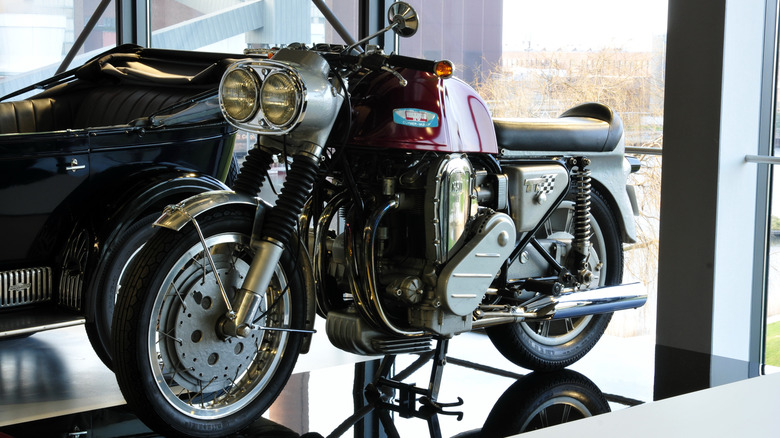
In 1970, Clymer died, forcing Münch to ship motorcycles directly to U.S. buyers. Pushing the engineering further, Münch introduced the 1200 TTS-E for 1973, which could be ordered in 1,278cc displacement for 100 hp. The "E" stands for "Einspritzer," or "fuel injector" in English. It was the first production motorcycle with fuel injection, though calling this hand-built bike "production" is a stretch, and only 130 were built. For context, the Mammut cost $5,135, while a BMW motorcycle was under $2,000.
In 1973, Münch found a new business partner in Heinz Henke, who was initially a customer. This partnership bore little fruit, as Münch made maybe four more Mammuts. In 1975, Münch left Münch. Henke continued through 1980 before calling it quits himself. Around 500 total Mammuts were built.
Münch started a new company in 1976, but couldn't use his own name anymore. So he resurrected Horex for the 1400 TI Turbo, which looked just like a Mammut, but upped the ante with 125 to 140 turbocharged horsepower. From 1981 to 1986, Münch engineered the 160-hp Titan 1800 for American collector Paul Watts. Its supercharger was built by Felix Wankel, also inventor of the displacement-amorphous rotary engine, and the single overhead cam head came from a Volkswagen.
Though Friedel Münch suffered a stroke in 1991, he recovered enough by 1997 to finish his Mammut 2000. It weighed 780 pounds, but with a 260-hp turbocharged Cosworth headed four, the bike could reach 172 mph without its 156-mph electronic limiter. Only 15 were built. Münch died in 2014 at the age of 87, but his brilliant machines still inspire awe. If you want a top-notch example of a Mammut, be prepared to spend six figures.