

How The Chevy Stovebolt Got Its Name And What Made It So Special
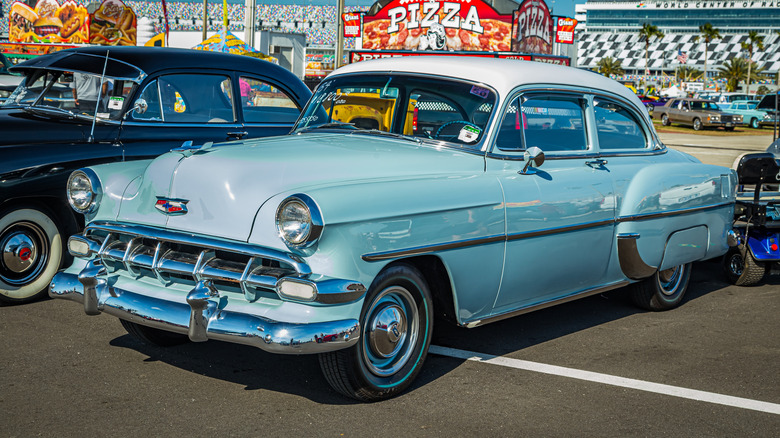
The Chevy "Stovebolt" name is not the result of a marketing effort. When Chevrolet unveiled its inline six-cylinder engine of 1929, enthusiasts were quick to pick up on the slotted fasteners holding the pushrod covers and oil pan together. These bolts were more or less like those on the woodburning stoves of the period, and the nickname "Stovebolt" followed naturally. Chevrolet never officially used the term, but it became so popular that it stuck.
What was special about the Stovebolt was that it was unflashy. Chevrolet did not bring it out to chase speed records or high-end buyers. It took a calculated step to ditch four-cylinder engines altogether and retail a six-cylinder vehicle at the four-cylinder price. Such a choice provided buyers with smoother, quieter, and more convenient driving at no extra expense. While the competition, like Ford, was still considering six-cylinders a luxury upgrade, Chevrolet could afford to make it a standard.
Under the hood, the practical Stovebolt got overhead valves to improve breathing, but cost-saving options like splash lubrication and fewer main bearings (only three, as opposed to four or seven that the modern six-cylinder houses) kept the assembly of the engine cheap. This combination of common-sense engineering and aggressive pricing was what made the Stovebolt the foundation of Chevy's popularity.
Why the Stovebolt got its reputation for reliability
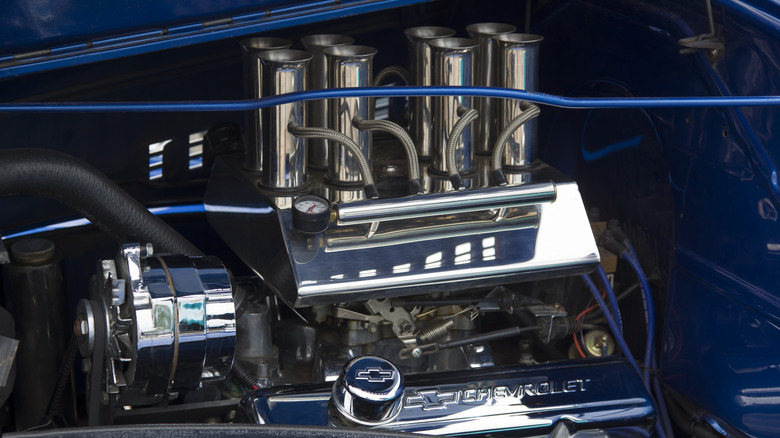
The Stovebolt made its reputation in everyday use. Early versions were not exactly powerful, but ran with noticeably less vibration and tolerated long service intervals, poor-quality fuel, and heavy loads. When Chevrolet perfected the engine during the 1930s and 1940s, displacement and compression increased, thus making the engine bigger and more efficient, but durability remained the main feature. The original model had 194 cubic inches of displacement, which is still greater than some of the largest four-cylinder engines ever made.
That enabled Chevrolet to use the Stovebolt across its line-up. Even when Chevrolet briefly used a tuned version in early sports-car applications, focus was on affordability, not actual performance. But the nickname came to outgrow the engine itself: "Stovebolt" came to describe Chevrolets as a whole, a reflection of how the six-cylinder became intertwined with the brand identity. It wasn't celebrated for speed or technology, but rather for doing its job repeatedly and predictably.
What really set the Stovebolt apart from other engines
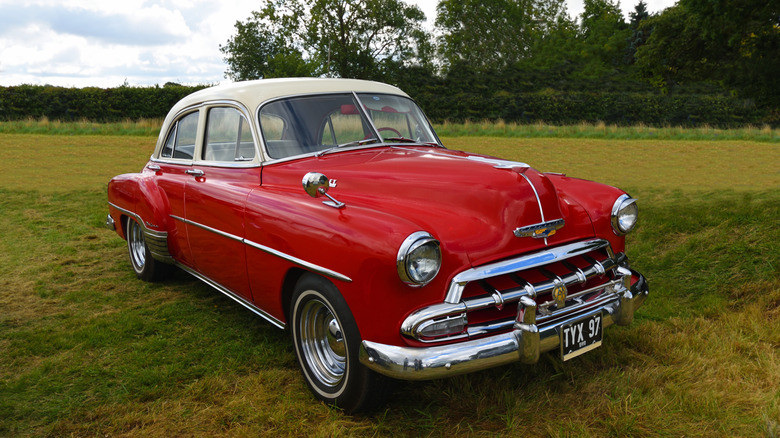
But what really set the Stovebolt apart was longevity: the original design introduced in 1929 was continually refined over decades, remaining in production well into the post-war era. Even when Chevrolet replaced it in 1962, using a modernized inline six that shared architecture with the small-block V8 (also called the mouse motor), the philosophy remained just the same: durable, simple, usable.
Smaller, lighter, more compact, and technically superior, the new six-cylinder engines never reached beyond the status of the Stovebolt. V8s by then had become symbols of progress and performance in the marketplace. Even so, Chevrolet continued to sell worldwide far more six-cylinder cars than V8 versions, especially among trucks and overseas vehicles, and there's a good reason why semi-trucks don't use V8s.
It's defined not through innovation or performance, but through heritage — the heritage of delivered impact by a Stovebolt. It helped Chevrolet beat the competition and power millions of vehicles worldwide, including passenger cars and heavy-duty trucks, all with just slight changes to the structure.